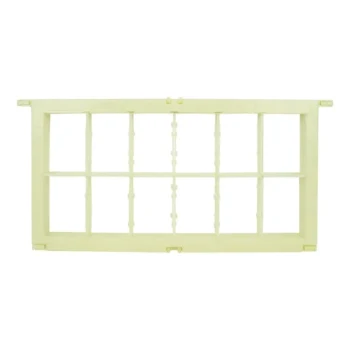
A frame-sized grid acts as a critical standardization tool for assessing honeycomb health. By dividing the natural, irregular surface of a honeycomb into equal geometric units, it allows technical personnel to systematically count cells containing capped larvae or pupae. This facilitates the precise calculation of the total brood area, replacing rough visual estimates with actionable metric data.
The grid system bridges the gap between observation and analysis. By standardizing the measurement of capped brood, it provides the accuracy required to predict colony population replacement and assess the colony's potential for overwintering.
From Observation to Quantification
Creating Standardized Geometric Units
The primary function of the grid is to impose order on the organic structure of the honeycomb. It divides the surface into equal geometric units, creating a reliable framework for measurement. This eliminates the variability inherent in eyeing a frame and attempting to guess the coverage area.
Precise Brood Area Calculation
Once the grid is in place, technical personnel can accurately count specific cells. The focus is specifically on counting capped larvae or pupae. By tallying these units within the grid, observers can mathematically derive the exact brood area, ensuring data consistency across different hives and time periods.
Forecasting Colony Viability
Predicting Population Replacement
Quantifying the larvae is not just about current numbers; it is about future workforce. The data derived from the grid allows for the prediction of colony population replacement. Knowing exactly how many larvae are capped and developing provides a clear timeline for when new bees will emerge to replace aging workers.
Evaluating Overwintering Potential
The most critical application of this data is long-term survival analysis. By calculating the brood area with a frame-sized grid, experts can predict the colony's overwintering potential. A precise count determines if the colony has sufficient developing population to sustain itself through the winter months.
Understanding the Trade-offs
Focus on Capped Stages
It is important to note that this specific method focuses on capped larvae and pupae. While effective for calculating established brood area, it may not account for eggs or very early-stage larvae that have not yet been capped, potentially presenting a partial picture of total reproductive output.
Dependence on Manual Execution
The tool facilitates accuracy, but it does not automate the process entirely. It relies on technical personnel to physically use the grid and perform the counts. The quality of the data is still dependent on the observer's ability to correctly identify the contents of the geometric units.
Applying Data to Colony Management
To effectively use a frame-sized grid, you must align the data with your specific management goals:
- If your primary focus is Immediate Assessment: Use the grid to calculate the exact brood area to determine the current reproductive status of the queen.
- If your primary focus is Long-Term Strategy: Use the capped larvae counts to model population replacement, ensuring the colony is strong enough to survive the coming winter.
Precision in measurement is the only path to accuracy in prediction.
Summary Table:
| Feature | Function & Benefit |
|---|---|
| Geometric Units | Divides irregular honeycomb into equal, measurable sections for systematic counting. |
| Capped Brood Count | Specifically targets capped larvae/pupae to derive exact brood area metrics. |
| Population Prediction | Forecasts the emergence of new workers to estimate colony replacement rates. |
| Overwintering Assessment | Provides precise data to evaluate if a colony has the strength to survive winter. |
Maximize Your Colony Productivity with HONESTBEE
Precision is the foundation of professional beekeeping. At HONESTBEE, we empower commercial apiaries and distributors with the high-quality tools and machinery needed to scale operations and ensure colony health. From precise hive-making and honey-filling machines to a comprehensive range of beekeeping equipment and consumables, our wholesale solutions are designed for your success.
Ready to elevate your apiary's efficiency? Contact us today to discuss your wholesale needs
References
- Matthew Smart, Marla Spivak. Linking Measures of Colony and Individual Honey Bee Health to Survival among Apiaries Exposed to Varying Agricultural Land Use. DOI: 10.1371/journal.pone.0152685
This article is also based on technical information from HonestBee Knowledge Base .
Related Products
- Automatic Heat Preservation 6 Frame Pro Nuc Box for Honey Bee Queen Mating
- Professional Sectional Comb Honey Frame with 250g Cassette System for Beekeeping
- Assembled Wooden Bee Frames with Beeswax Foundation Ready to Use by HONESTBEE
- Plastic Honey Comb Frames Cassette Box for Honey
- 5 Frame Wooden Nuc Box for Beekeeping
People Also Ask
- What are the options for adding frames to a nuc after taking two frames from the parent colony?
- How are nuc boxes used in queen rearing? The Essential Tool for Reliable Queen Mating
- What steps are involved in transferring frames from the nuc box to the hive? A Guide for a Smooth, Low-Stress Colony Move
- What is the process for managing a new bee colony started in a nuc box? Expert Tips for Hive Success
- How long can bees be kept in a nuc box? Expert Timeline for Hive Transfer