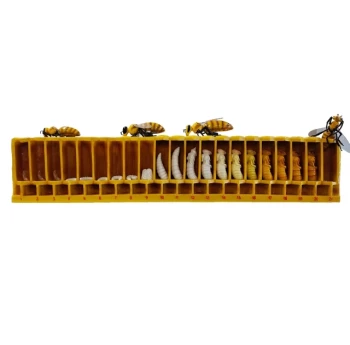
A Queen Bank Colony serves as a specialized biological inventory system within commercial beekeeping, designed to maintain multiple caged queens simultaneously in a temporary state. It functions by utilizing a strong population of worker bees to collectively nurse these isolated queens, ensuring they remain fed and pheromonally viable during the interval between their emergence and their introduction into a new hive.
By decoupling the timing of queen emergence from immediate colony need, a Queen Bank Colony allows apiarists to synchronize biological production with market demand, ensuring a stable supply of healthy queens without requiring immediate hive placement.
The Mechanics of Queen Banking
The Controlled Environment
A Queen Bank is not a standard production hive; it is a controlled temporary environment. Its primary physical characteristic is the use of cages to house individual queens within a single colony structure.
Collective Nursing
The core engine of this system is the worker bee population. These workers collectively nurse the caged queens through the mesh of their enclosures.
This interaction is critical. The workers provide essential nutrition and grooming, preventing the queens from starving or deteriorating while they are in storage.
Pheromone Maintenance
Beyond simple nutrition, the banking system maintains the queens' pheromone profiles. Continued interaction with worker bees ensures the virgin queens retain the chemical signals necessary for successful acceptance when they are eventually introduced to a permanent colony.
Strategic Value in Commercial Operations
Balancing Supply and Demand
Commercial apiaries face a logistical challenge: queen production cycles rarely align perfectly with the immediate availability of destination hives or market orders.
The Queen Bank acts as a buffer zone. It allows producers to harvest queens when they are biologically ready, yet hold them safely until the market or logistics schedule requires them.
Optimization of Resources
By consolidating the care of many queens into a single biological unit, apiarists reduce the equipment and space needed for temporary storage. This aligns with the broader goal of standardized management in professional beekeeping, where efficiency drives profitability.
Understanding the Trade-offs
The "Temporary" Constraint
It is vital to recognize that a Queen Bank is a temporary solution, not a permanent habitat. It is designed to bridge a specific gap in time.
Resource Dependency
While efficient, these colonies require a dense population of young, active nurse bees to be effective. If the ratio of nurse bees to caged queens drops, the nutritional status of the banked queens will suffer, potentially impacting their future performance.
Making the Right Choice for Your Goal
## Integrating Banking into Your Management Strategy
To effectively utilize Queen Bank Colonies, consider your specific operational objectives:
- If your primary focus is Logistics: Use banking to stockpile queens prior to large-scale splits or sales, ensuring you are never waiting on emergence dates to fulfill orders.
- If your primary focus is Quality Control: Monitor the nurse bee population rigorously; the bank must be overflowing with resources to ensure every caged queen receives "royal" attention.
A Queen Bank Colony converts the biological volatility of queen emergence into a predictable, manageable inventory asset.
Summary Table:
| Feature | Description | Commercial Benefit |
|---|---|---|
| Function | Specialized biological inventory for temporary queen storage | Decouples production timing from market demand |
| Mechanism | Worker bees nurse caged queens through mesh | Ensures nutritional health and pheromonal viability |
| Resource | High density of young nurse bees required | Reduces equipment overhead for temporary storage |
| Duration | Short-term bridge (Temporary solution) | Optimizes logistics during large-scale splits |
| Key Outcome | Pheromone maintenance and health preservation | High acceptance rates upon hive introduction |
Maximize Your Apiary Productivity with HONESTBEE
Efficient queen management is the backbone of any successful commercial operation. At HONESTBEE, we empower commercial apiaries and distributors by providing the industrial-grade tools and machinery needed to scale.
Whether you are looking for specialized queen rearing equipment, automated honey-filling machines, or wholesale beekeeping consumables, our comprehensive portfolio is designed to enhance your operational efficiency and profitability. From specialized hardware to hive-making machinery, we supply everything the modern beekeeper needs to succeed.
Ready to upgrade your commercial beekeeping infrastructure?
Contact HONESTBEE Today for Custom Wholesale Solutions
References
- Agnese Smilga-Spalviņa, Ivars Veidenbergs. Field study: Factors influencing virgin queen bee acceptance rate in Apis mellifera colonies. DOI: 10.17221/22/2024-cjas
This article is also based on technical information from HonestBee Knowledge Base .
Related Products
- Premium Nicot Style Cell Bar Holder and Queen Cell Cup Holder System
- JZBZ Type Wide Base Plastic Queen Cell Cups for Base Mounting and Queen Rearing
- No Grafting Queen Rearing Kit: System for Royal Jelly Production and Queen Rearing
- Professional Dual Action Queen Excluder Scraper for Beekeeping
- Portable Queen Bee Incubator with 12V Car Adapter for Safe Transport
People Also Ask
- What roles do specialized queen cell cups play in royal jelly production? Optimize Your Hive's Secretion and Yield
- What role do specialized queen rearing tools play in developing mite-resistant honeybee stock? Master Genetic Selection
- What materials are used to make artificial queen cell cups for grafting? Beeswax vs. Plastic Guide
- Why is a diluted royal jelly solution applied to queen cell cups? Boost Acceptance in Artificial Grafting
- How does the standardized depth of queen cell cups affect larval acceptance? Boost Success with 6mm Precision