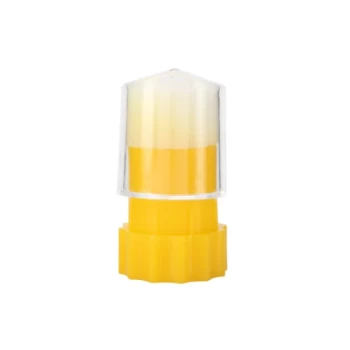
The specialized sampling bottle functions as a selective mechanical filter. It facilitates the sugar shake method by confining honeybees safely within the container while allowing dislodged Varroa mites and excess powdered sugar to pass through the mesh lid for collection and counting.
The core value of this device is its ability to turn a mixture of bees, sugar, and parasites into a verifiable data point without sacrificing the sample. It enables non-destructive monitoring, allowing the beekeeper to return the workforce to the hive after assessment.
The Mechanics of Separation
Dislodging the Parasite
The process begins inside the bottle before the separation occurs. The bottle serves as a containment chamber where powdered sugar and bees are agitated together.
This creates physical friction, causing the fine sugar particles to coat the Varroa mites. This coating interferes with the adhesive pads on the mites' feet, making it impossible for them to hold onto the bees.
The Selective Barrier
Once the mites are dislodged, the mesh lid becomes the critical component. It separates the biological matter based on size.
The mesh aperture (often approximately 0.5 x 0.5 mm) is large enough for mites and sugar granules to exit but small enough to retain adult honeybees.
Dry Separation Process
Unlike liquid-based testing methods, the mesh lid enables a dry separation process.
By inverting and shaking the bottle over a collection tray, gravity and agitation force the mites through the screen, leaving the bees relatively unharmed inside.
Why the Mesh Design Matters
Colony Preservation
The primary advantage facilitated by this specific bottle design is the preservation of the bee sample.
Because the bees are physically separated from the falling mites rather than submerged in a lethal solution, they can be returned to the colony. This is essential for beekeepers who wish to monitor frequently without depleting their hive population.
Live Sample Collection
The mesh lid allows the mites to fall through alive (though coated in sugar).
This is distinct from alcohol washes which kill both bees and mites. It allows researchers or advanced beekeepers to collect live mites for further analysis, such as resistance testing.
Understanding the Trade-offs
Physical Agitation is Required
The mesh lid does not work passively; it requires vigorous shaking to generate the necessary friction.
Insufficient agitation may fail to dislodge all mites or fail to force them through the mesh, leading to an artificially low count.
The Variable of Mesh Size
The efficiency of the system relies entirely on the precision of the mesh.
If the mesh is too fine, mites may be trapped inside with the bees. If the mesh is too coarse, it creates a risk of bees escaping or becoming stuck in the lid.
Making the Right Choice for Your Goal
The sugar shake method, enabled by the mesh-lidded bottle, is a tool designed for specific management objectives.
- If your primary focus is Colony Preservation: This is your ideal method, as the mesh barrier ensures the bees are retained and can be returned to the hive alive.
- If your primary focus is Resistance Testing: The dry separation allows you to harvest live mites to test for resistance to various treatments.
The mesh-lidded bottle effectively bridges the gap between the need for accurate data and the desire to maintain a healthy, living colony.
Summary Table:
| Feature | Function & Impact |
|---|---|
| Selective Mesh Barrier | Allows mites and sugar to pass while safely retaining honeybees. |
| Mechanical Friction | Powdered sugar coating prevents mites from adhering to the bees. |
| Non-Destructive Method | Enables bees to be returned to the colony alive after testing. |
| Dry Separation | Facilitates live mite collection for research and resistance testing. |
| Precision Aperture | Optimized 0.5mm sizing ensures accurate counting and bee safety. |
Scale Your Varroa Monitoring with HONESTBEE
Reliable Varroa mite detection is the cornerstone of professional apiary health. At HONESTBEE, we specialize in supporting commercial apiaries and distributors with high-precision beekeeping tools and machinery. Whether you need specialized sampling equipment for non-destructive testing or advanced honey-processing hardware, our comprehensive wholesale offering has you covered.
Why partner with HONESTBEE?
- Full Spectrum Supply: From hive-making and honey-filling machines to essential industry consumables.
- Quality for Professionals: Durable equipment designed to withstand the demands of large-scale operations.
- Tailored Solutions: We cater specifically to the needs of distributors and large commercial beekeepers.
Ready to enhance your product portfolio or upgrade your apiary's efficiency? Contact us today to explore our wholesale catalog and see how our expertise can drive your business forward.
References
- Gloria DeGrandi‐Hoffman, Lloyd Schantz. Population growth of Varroa destructor (Acari: Varroidae) in commercial honey bee colonies treated with beta plant acids. DOI: 10.1007/s10493-014-9821-z
This article is also based on technical information from HonestBee Knowledge Base .
Related Products
- Varroa Easy Check Mite Tester Kit Counter Alcohol Wash Jar
- Compact Circular Bee Mite Treatment Dispenser
- Langstroth Screen Bottom Board for Beekeeping Wholesale
- Adjustable Formic and Acetic Acid Dispenser for Bee Mite Treatment
- Queen Bee Catcher Plastic Bee Marker Bottle with Piston Marking Tube
People Also Ask
- What tools are utilized within an Integrated Pest Management (IPM) strategy for honeybees? Optimize Colony Health
- What is the significance of standardized detection tools in Varroa control? Data-Driven Beekeeping Strategies
- Why is surfactant added to 70% alcohol for Varroa detection? Ensure Accurate Mite Counts for Professional Beekeeping
- What is the purpose of using white filter cloth for Varroa mite screening? Enhance Detection and Accuracy
- How does a specialized Varroa mite tester with sugar powder facilitate mite diagnosis? Precise B2B Hive Health Solutions