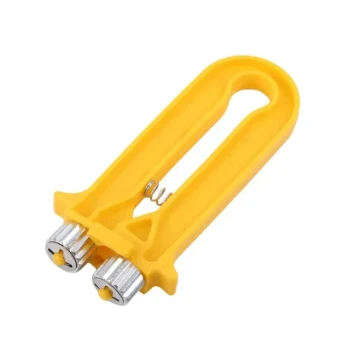
The automatic grafting tool improves success rates by mechanically stabilizing the release of the larva, which is the most error-prone stage of the grafting process. By utilizing a flexible tongue to lift the larva and a spring-loaded plunger to gently deposit it, the tool ensures the larva is transferred alongside its original bed of royal jelly, effectively minimizing physical damage and transplant shock.
Successful grafting relies on minimizing physical handling and maintaining nutritional continuity. The spring-loaded plunger mechanism achieves this by pushing the larva and its surrounding royal jelly off the tool simultaneously, preventing the dehydration and physical trauma that commonly lead to rejection by the colony.
The Mechanics of Safe Transfer
The Flexible Tongue
The core component of this tool (often called a Chinese-type grafting needle) is a flexible tongue made of horn or plastic.
This tongue relies on appropriate elasticity to slide underneath the larva rather than scooping or pinching it.
This design allows the tip to conform to the cell bottom, gliding beneath delicate one-day-old larvae without piercing their soft cuticle.
The Spring-Loaded Plunger
Once the larva is on the tongue, the challenge is getting it off without damage.
The spring-loaded plunger solves this by mechanically pushing the payload off the tongue.
Instead of requiring the beekeeper to scrape the larva off against the side of the cup—which risks injury—the plunger gently deposits the larva directly into the center of the artificial queen cell cup.
Why This Increases Acceptance Rates
Preservation of the Nutritional Environment
The most critical advantage of this tool is its ability to transfer the existing royal jelly along with the larva.
The wide, flat tongue lifts the liquid bed the larva is floating in.
When the plunger activates, it pushes this jelly pool into the new cup, ensuring the larva never touches dry plastic and retains its immediate food source.
Minimizing Physical Trauma
Larval cuticles are microscopic and incredibly fragile; even slight pressure can cause damage that results in rejection by nurse bees.
High-precision tips minimize the surface area touching the actual larva.
By moving the "bed" (the jelly) rather than pinching the "passenger" (the larva), the tool significantly reduces the physical trauma that correlates with poor survival rates.
Understanding the Trade-offs
Loss of Tactile Feedback
While the spring mechanism improves consistency, it can dampen the tactile feedback a beekeeper feels.
With a rigid metal tool, you feel the bottom of the cell instantly; with a flexible, spring-loaded tool, you must rely more on visual cues to ensure you haven't pressed too hard.
Maintenance of Moving Parts
Unlike simple steel needles, this tool contains a moving plunger mechanism.
Sticky royal jelly can build up inside the sleeve, potentially causing the spring to jam or the release to become jerky, which defeats the purpose of the smooth transfer.
Making the Right Choice for Your Goal
To maximize your grafting results, align your tool choice with your specific operational needs:
- If your primary focus is maximizing larval survival: Use the spring-loaded tool to ensure every larva is transferred with a sufficient bed of royal jelly to prevent desiccation.
- If your primary focus is speed and efficiency: Utilize the plunger mechanism to eliminate the time-consuming step of manually scraping larvae off the needle, allowing for faster sequential transfers.
By mechanically preserving the larva's environment, you transform a surgical procedure into a repeatable, high-yield process.
Summary Table:
| Feature | Mechanical Benefit | Impact on Larval Survival |
|---|---|---|
| Flexible Tongue | Glides under larva without piercing cuticle | Minimizes physical trauma and injury |
| Spring-Loaded Plunger | Pushes payload off mechanically and centrally | Prevents dehydration and accidental scraping |
| Nutritional Retention | Transfers original bed of royal jelly | Maintains food supply and prevents shock |
| Precision Tip | Conforms to cell bottom geometry | Increases consistency in high-volume grafting |
Boost Your Apiary's Productivity with HONESTBEE
Are you looking to scale your queen rearing or streamline your commercial beekeeping operations? HONESTBEE specializes in supporting commercial apiaries and distributors with premium wholesale solutions. From high-precision grafting tools and honey-filling machines to durable hive-making equipment and essential consumables, we provide the full spectrum of hardware needed for modern beekeeping.
Our expertise goes beyond tools; we offer the technical reliability required to ensure every larva counts. Contact us today to discuss how our professional equipment can enhance your efficiency and yield. Let’s build a more productive apiary together.
References
- Ralph Büchler, J. Wilde. Standard methods for rearing and selection of <i>Apis mellifera</i> queens 2.0. DOI: 10.1080/00218839.2023.2295180
This article is also based on technical information from HonestBee Knowledge Base .
Related Products
- Retractable Chinese Queen Rearing Grafting Tools Equipment
- Stainless Steel Queen Grafting Tool for Beekeeping and Bee Queen Grafting
- Double Head Beekeeping Grafting Tools for Beekeepers
- HONESTBEE Ergonomic Spring Loaded Frame Wire Crimper
- Plastic Chinese Queen Grafting Tool for Bee Queen Rearing
People Also Ask
- Which specialized tools are necessary for implementing standardized queen rearing? Scale Your High-Yield Apiary
- Why are specialized queen rearing tools necessary to mitigate winter hive losses? Boost Apiary Survival and Recovery
- How do queen-rearing tools facilitate the sustainability and expansion of a commercial apiary? Drive Scalable Growth
- In what ways do modern queen rearing equipment and grafting tools improve competitiveness? Boost Breeding Success Rate
- What role do specialized queen rearing tools and consumables play in modern large-scale apiculture? Drive Production & Scale