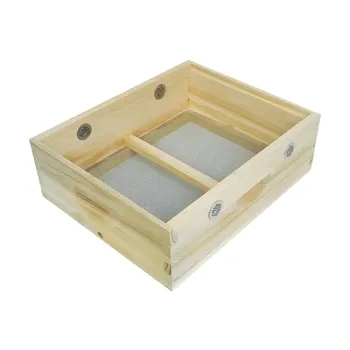
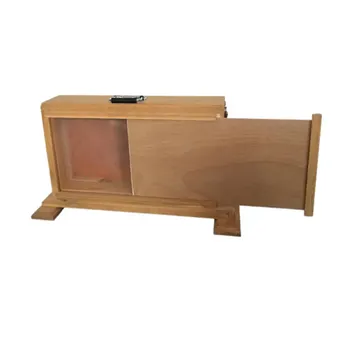
Rough, unpolished hive interiors generally attract substantially more propolis than smoothly sanded surfaces. Bees use propolis to seal gaps, smooth unwanted openings, manage moisture, and create an antimicrobial barrier around the nest. Apiary managers can encourage this behavior with suitable box textures, shallow grooves, or removable propolis traps that collect resin while supporting colony hygiene.
Hive texture influences where bees invest propolis. Rough interior wood and narrow gaps provide natural deposition sites, while propolis traps concentrate the same behavior on removable surfaces for cleaner harvesting and easier equipment management.
Why Interior Texture Influences Propolis Deposition
Smooth wood provides fewer deposition targets
Planed and heavily sanded hive walls offer relatively few cracks, edges, or irregularities for bees to seal. As a result, colonies may deposit less propolis across the interior than they would in a rough tree cavity.
By contrast, rough-sawn or lightly textured wood gives resin-foraging bees more points to fill and coat. The objective is not to create uncontrolled splinters, but to provide stable, bee-safe irregularities that stimulate natural sealing behavior.
Propolis forms part of the colony’s social immunity
Honeybees collect plant resins containing compounds such as terpenes and flavonoids, then mix and apply them inside the nest. The resulting material helps seal cracks, inhibit microbial growth, reinforce hive structures, and entrap small intruders.
This protective envelope can reduce the colony’s exposure to environmental pathogens and may lower the need for continuous physiological immune activation. Better internal hygiene supports the colony’s ability to allocate resources toward brood rearing and worker maintenance.
Texture affects distribution, not only total yield
A rough interior can encourage a broader propolis coating across the hive walls. A dedicated trap, however, concentrates deposition in a removable grid or sheet.
The best choice depends on the operational goal: natural internal protection, clean propolis recovery, or a combination of both.
Hive Design Features That Encourage Propolis Use
Use unfinished or lightly textured interior wood
Hive bodies with unplaned or rough-sawn inner surfaces can encourage bees to build a more continuous propolis layer. This approach requires no additional collector and can be integrated directly into commercial hive-body production.
Manufacturers should balance texture with practical handling requirements. Interior surfaces must remain structurally sound, free of hazardous splinters, and compatible with frame movement and routine inspections.
Add shallow grooves to interior walls
Narrow grooves, including approximately 3 mm grooves, create consistent lines for bees to seal with resin. Grooves can be placed on the inside walls of hive boxes during manufacturing.
This design gives distributors and apiary operators a repeatable specification rather than relying on random wood roughness. Consistent geometry also simplifies product standardization across large equipment orders.
Roughen existing boxes carefully
For existing smooth boxes, managers may lightly texture interior walls with a wire brush or another controlled method. The modification should create useful irregularity without producing loose fibers, sharp projections, or contamination risks.
Any modified equipment should be inspected before returning it to service. The goal is to encourage propolis deposition while preserving safe bee space and easy frame access.
Fit internal trap sheets when collection is important
Propolis trap sheets can be cut to fit the inner walls of a hive body and attached with the rough side facing the colony. Narrow openings encourage bees to fill the gaps with resin as they attempt to eliminate drafts and unwanted openings.
Some installations may require reducing the frame count from ten to nine to maintain clearance. This must be checked against the specific hive dimensions and frame spacing rather than assumed for every equipment system.
How Propolis Traps Improve Management
Concentrate propolis on removable surfaces
A trap gives bees a defined place to deposit resin instead of distributing it across frames, walls, and covers. Once filled, the trap can be removed and replaced without scraping large amounts of propolis from permanent hive components.
This is particularly useful for commercial apiaries that need consistent collection, repeatable handling, and clean separation between hive maintenance and product recovery.
Use slotted grids or narrow-gap designs
Commercial traps commonly use slotted plastic grids or mats. Narrow openings, such as approximately 24 × 3 mm gaps, provide the type of small spaces bees tend to seal with propolis.
The exact opening size should follow the trap manufacturer’s design and the target hive system. Fit, rigidity, and bee-safe spacing are more important than applying one dimension universally.
Position traps where bees naturally seal drafts
A common arrangement places a trap above the uppermost hive body and beneath the inner cover. Bees often propolize these openings because they perceive light, airflow, or small gaps as conditions requiring closure.
Traps can also be fitted against interior walls, provided they do not obstruct frames, entrances, ventilation, or inspections. Proper placement is a design decision that should account for the colony’s normal traffic patterns.
Create collection cycles suited to the apiary
When the objective is harvesting, managers can remove filled traps, cool or freeze them, and flex them gently so the brittle propolis separates from the grid. This supports cleaner flake recovery than scraping resin directly from permanent hive surfaces.
Collection timing should avoid disrupting essential colony sealing. Managers should leave sufficient propolis in the hive to maintain the colony’s protective envelope and should coordinate harvesting with seasonal conditions and colony strength.
Maintaining Colony Health Through Better Propolis Management
Preserve the colony’s protective coating
Propolis should not be treated solely as a commodity. Bees use it to seal cracks, coat internal surfaces, manage moisture, and create a defensive barrier against bacteria and fungi.
If every accessible deposit is removed for sale, the colony may lose part of the protection the management system was designed to encourage. Selective harvesting is therefore preferable to complete removal.
Keep equipment properly fitted
Poorly fitted covers, excessive gaps, damaged boxes, and inconsistent frame spacing can cause bees to deposit large amounts of propolis in inconvenient locations. Traps work best when they complement sound hive construction rather than compensate for structural defects.
A well-designed system gives bees targeted sealing sites while preserving normal bee space and efficient inspections.
Monitor colony response
Managers should evaluate:
- Amount and distribution of propolis on walls, frames, and traps.
- Ease of frame removal during inspections.
- Brood pattern and colony population over time.
- Signs of excessive moisture, drafts, or pest intrusion.
- Trap occupancy and contamination before collection.
Propolis deposition is influenced by colony genetics, resin availability, season, local vegetation, hive airflow, and weather. Interior texture is important, but it is not the only control variable.
Understanding the Trade-offs
Rough interiors can complicate inspections
A heavily textured surface may increase propolis deposition but can also make boxes, frames, and covers harder to separate. Excessive buildup may damage equipment during opening or increase labor requirements.
The practical target is controlled roughness, not maximum roughness.
Traps can interfere with normal hive operation
A poorly installed trap may reduce clearance, obstruct frames, alter ventilation, or create inconvenient inspection points. Managers should confirm that the selected grid fits the hive body and does not compromise bee space.
Pilot testing on a limited number of colonies is advisable before deploying a new trap specification across a commercial operation.
Harvesting can conflict with hygiene goals
Cleaner, higher-grade propolis is easier to obtain from removable collectors, but collecting too frequently or too aggressively can remove material the colony still needs. Harvesting plans should distinguish between surplus propolis and the colony’s active protective layer.
Traps should also be kept clean and replaced when damaged or contaminated. Product quality depends on both bee behavior and equipment hygiene.
Health benefits should not replace disease management
Propolis supports natural colony defenses, but it is not a substitute for inspection, biosecurity, hygienic equipment handling, or appropriate disease-management protocols. Claims about improved brood production or reduced disease should be evaluated through colony records rather than assumed from trap use alone.
Selecting a Commercial Hive Design and Trap System
For equipment manufacturers and distributors
A product portfolio can include rough-interior hive bodies, grooved wall designs, removable trap mats, slotted plastic grids, and compatible replacement components. Standardized dimensions and clear installation instructions help resellers serve both small beekeepers and commercial apiaries.
Reliable supply, rapid response, and accurate compatibility information are especially important because a trap that does not match the hive format can create operational problems.
For commercial apiary operators
Choose the design according to the primary objective. Rough interior walls favor a persistent natural propolis envelope, while removable traps favor controlled collection and simplified processing.
Many operations can combine both approaches, using modest interior texture for colony protection and strategically placed traps for surplus recovery.
For propolis processors and buyers
Prioritize traps that allow clean removal, minimal contact with soil or hive debris, and repeatable batch handling. Product specifications should address material safety, fit, opening dimensions, cleaning, storage, and compatibility with the target hive system.
A dependable supplier should also provide consistent replacement availability so collection programs are not interrupted by missing or incompatible components.
How to Apply This to Your Apiary
The most effective approach is to match the hive surface and trap design to the colony’s health priorities and the apiary’s handling capacity.
- If your primary focus is colony hygiene: Use safe, lightly roughened or grooved interior surfaces and preserve an adequate natural propolis envelope.
- If your primary focus is clean propolis harvesting: Install removable slotted traps in locations bees naturally seal, then cool and flex filled traps for controlled recovery.
- If your primary focus is commercial standardization: Specify compatible hive-body dimensions, trap openings, frame clearance, and replacement parts before scaling across the apiary.
- If your primary focus is operational efficiency: Test the system on representative colonies and monitor propolis yield, inspection time, frame access, and colony condition before full deployment.
With controlled hive texture, correctly fitted traps, and selective harvesting, apiary managers can support colony defenses while turning propolis collection into a more consistent commercial process.
Summary Table:
| Factor | Smooth Interior | Rough Interior | Propolis Trap |
|---|---|---|---|
| Deposition | Less propolis | More propolis | Concentrated in trap |
| Management | Easier cleaning | Harder to separate | Easy harvest |
| Colony Health | Less protection | More protection | Controlled extraction |
Optimize your hive designs with our specialized wooden boxes and propolis traps. Our wholesale solutions for beekeeping equipment help you improve colony health and streamline propolis harvesting. Contact us today to learn more about our products and support for distributors!
Related Products
- 5 Frame Wooden Nuc Box for Beekeeping
- Wholesales Dadant Size Wooden Bee Hives for Beekeeping
- Wooden Bee Hive Frames for Beekeeping and Wholesale
- Langstroth Honey Bee Box Hive Boxes for Different Depths
- Assembled Wooden Bee Frames with Plastic Foundation for Durability and Convenience by HONESTBEE
People Also Ask
- What are the options for adding frames to a nuc after taking two frames from the parent colony?
- What frames should be moved into the queenless hive when requeening with a nuc? Ensure a Successful Queen Introduction
- What roles do five-frame nucleus boxes and ten-frame Langstroth hive boxes play in colony standardization?
- What is the primary function of five-frame nuclei boxes? Master Early Colony Establishment for Stronger Hives
- What is the typical composition of frames in a nuc? A 5-Frame Blueprint for a Thriving Hive