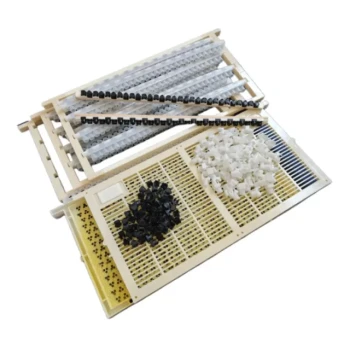
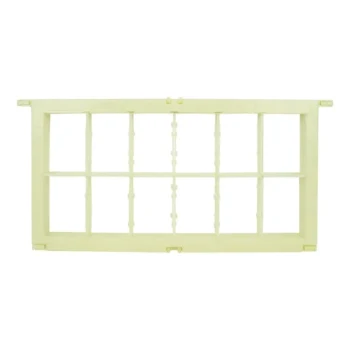
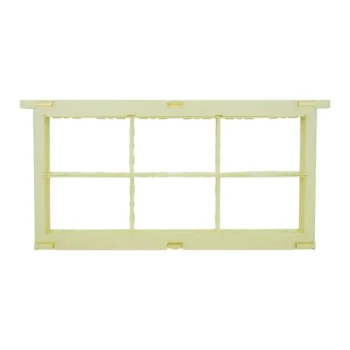
The layout of the hive is a critical lever for production efficiency. Specifically, sandwiching the grafting frame between Honey and Pollen Combs acts as a powerful behavioral trigger for the colony. This arrangement creates a localized nutrient-dense zone, which drastically reduces the travel distance for nurse bees and concentrates their population directly around the developing queen cells.
The proximity of food sources to the grafting frame determines the density of the nurse bee population. By flanking the target area with protein and energy reservoirs, you effectively "lock" nurse bees into the production zone, ensuring constant attention to the cell cups.
The Mechanics of Strategic Placement
Creating a Resource Reservoir
In a royal jelly production setup, Honey and Pollen Combs serve a function beyond simple storage. They act as immediate reservoirs of protein and energy.
By placing these combs on both sides of the grafting frame, you ensure that the raw materials required for royal jelly production are accessible within millimeters of the target area.
Leveraging Bee Instincts
This layout is designed to exploit the natural foraging and nursing instincts of the colony.
Bees are driven to congregate where resources are plentiful. By artificially concentrating food stores around the grafting frame, you manipulate the colony's internal traffic, directing the workforce exactly where you need it.
The Biological Impact on Yield
Concentrating Nurse Bees
The primary goal of this layout is to attract a specific demographic: the young nurse bees.
These are the bees biologically capable of secreting royal jelly. The presence of pollen (protein) immediately next to the larvae attracts these nurses in high numbers, creating a zone of intense biological activity.
Increasing Jelly Depth
The efficiency of this layout is measured by the physical volume of the product.
Because nurse bees are concentrated in this specific area and have immediate access to nutrients, they feed the larvae more aggressively. This results in a measurable increase in the depth of royal jelly deposited in the cell cups.
Understanding the Constraints
The Necessity of Filled Combs
This layout strategy relies entirely on the quality of the "reservoir" combs.
Placing empty or low-resource combs next to the grafting frame will not achieve the desired effect. The layout is only as effective as the density of the stores within those honey and pollen frames; without sufficient protein and energy on those specific frames, the "magnet" effect for nurse bees is lost.
Making the Right Choice for Your Goal
To maximize your royal jelly production, you must treat the frame layout as a funnel that directs biological resources to a single point.
- If your primary focus is Volume: Ensure the pollen combs flanking the grafting frame are heavily stocked to support maximum glandular secretion by nurse bees.
- If your primary focus is Consistency: Maintain this specific "sandwich" layout for every grafting frame to ensure uniform feeding across all cell cups.
The physical architecture of your hive frames dictates the biological behavior of your bees.
Summary Table:
| Factor | Strategic Layout Impact | Production Benefit |
|---|---|---|
| Nurse Bee Density | Concentrates young bees around grafting frames | Increases feeding frequency and attention |
| Resource Proximity | Pollen and honey placed within millimeters | Reduces travel time for high-energy jelly secretion |
| Jelly Volume | Aggressive feeding due to nutrient-dense zone | Measurable increase in jelly depth per cell cup |
| Consistency | Uniform 'sandwich' arrangement across hive | Ensures stable production quality and yield |
Scale Your Royal Jelly Production with HONESTBEE
Maximize your apiary's output by pairing strategic hive management with professional-grade equipment. HONESTBEE supports commercial apiaries and distributors with a complete wholesale range of beekeeping tools, from advanced grafting supplies to heavy-duty honey-filling machines and hive-making hardware.
Whether you are looking to optimize specialized machinery or stock up on essential industry consumables, our expert team is ready to provide the high-performance solutions your business demands.
Ready to elevate your beekeeping operations? Contact us today to explore our full catalog and wholesale pricing!
References
- Mohamed Ali. Relationship Between Number of Grafted Queen Cell Cups and Amount of Produced Royal Jelly in Honey Bee Colonies Apis mellifera L.. DOI: 10.21608/eajbsa.2017.12651
This article is also based on technical information from HonestBee Knowledge Base .
Related Products
- No Grafting Queen Rearing Kit: System for Royal Jelly Production and Queen Rearing
- JZBZ Langstroth Queen Rearing Frame for Beekeeping
- 8 Frame and 10 Frame Propolis Trap Collector Screen for Propolis Collection
- Heart-Shaped Comb Honey Frame and Honeycomb Cassette
- Professional Sectional Comb Honey Frame with 250g Cassette System for Beekeeping
People Also Ask
- What is the primary function of a queen rearing kit? Eliminate Manual Grafting for Superior Bee Breeding
- How do specialized queen rearing kits and queen management tools improve the success rate of bee colony expansion?
- What are some alternative methods to grafting for queen cell production? Discover Graft-Free Queen Rearing Systems
- Are queen rearing systems generally suitable for all honeybee species? Master Efficient Breeding Methods
- Are queen rearing systems suitable for all beekeepers? Modern Tools for Every Experience Level