The specification and design of industrial-grade queen rearing frames are the primary drivers of yield density and workflow standardization. By utilizing a multi-layered crossbar specification—typically a three-tier design supporting up to 45 queen cells per frame—these units allow a single nurse colony to rear a significantly higher volume of queens simultaneously. This high-integration design directly impacts efficiency by maximizing vertical apiary space and enabling precise, batch-level management of queen emergence.
Core Takeaway The shift to high-integration frame designs transforms queen rearing from a variable craft into a scalable industrial process. By aligning high-capacity hardware with biologically optimized spacing, producers can maximize nurse colony resources and ensure uniform output across large production cycles.
Maximizing Yield Through Vertical Integration
The Three-Tier Design Advantage
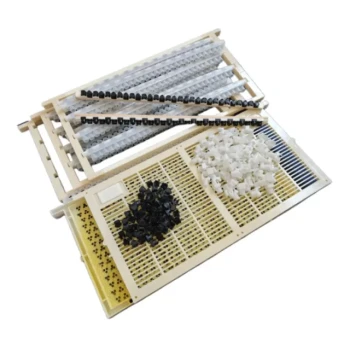
Standard industrial-grade frames utilize a multi-layered structure, most commonly featuring three tiers of crossbars. Each tier is designed to accommodate approximately 15 units, creating a total capacity of 45 queen cells on a single frame.
Optimizing Nurse Colony Resources
This density allows a single nurse colony to manage a massive batch simultaneously without increasing the apiary's physical footprint. By leveraging the vertical space within the hive, breeders can drastically increase the yield per colony compared to single-tier traditional methods.
Batch Management Consistency
The integration of 45 cells into one frame streamlines the production timeline. It ensures that all queens within that frame emerge within the same production cycle, simplifying the scheduling of mating nucs and reducing labor complexity.
Biological Optimization and Quality
Leveraging Hive Microclimates
Placing bars at varying heights does more than save space; it positions larvae in the "sweet spot" of the brood nest. This configuration exploits the optimal thermal environments and humidity gradients found in the center of the beehive.
Increasing Acceptance Rates
By keeping larvae in these biologically ideal zones, acceptance rates for grafted larvae improve significantly. Consequently, this leads to the production of heavier, higher-quality queen bees that are consistently uniform, rather than variable in size or vitality.
The Role of Standardization in Efficiency
Precision and Interchangeability
Industrial-grade efficiency relies on high-precision manufacturing to ensure absolute uniformity in frame dimensions. This standardization is critical for ensuring that internal spacing aligns perfectly with bee biology, preventing the bees from building unwanted comb that hinders management.
Mechanized Scalability
Standardized components facilitate seamless equipment interchangeability across the apiary. This supports mechanized management, allowing apiarists to rapidly expand infrastructure and apply automated processes to what was previously a manual-only operation.
Understanding the Trade-offs
The Weight of Efficiency
High-density rearing concentrates resources, adding physical load to the system. Professional-grade hive chests must be robust enough to support approximately 40 kilograms and withstand the vibrations of mobile operations to prevent structural failure.
Thermal Stress Management
Denser colonies require superior environmental management. If the hive chest materials do not possess high weather resistance and insulation, thermal stress can spike, interfering with foraging activities and potentially compromising the development of the sensitive queen cells.
Making the Right Choice for Your Goal
To maximize the efficiency of your queen rearing operation, align your equipment choices with your specific production targets:
- If your primary focus is Volume maximization: Prioritize frames with a three-tier, 45-cell capacity to extract the highest possible yield from your existing nurse colonies.
- If your primary focus is Operational scalability: Invest in high-precision, standardized components that ensure interchangeability and support mechanized handling as your apiary expands.
- If your primary focus is Queen quality: Ensure your multi-layered frames are paired with well-insulated hive bodies that maintain the specific humidity and thermal gradients required for optimal larval development.
Efficiency in queen rearing is not just about numbers; it is about the precision engineering that allows biology to thrive at scale.
Summary Table:
| Feature | Specification | Impact on Efficiency |
|---|---|---|
| Capacity | 3 tiers / 45 cells per frame | Maximizes yield density per nurse colony |
| Design | Multi-layered vertical integration | Optimizes hive space and thermal gradients |
| Standardization | High-precision dimensions | Facilitates mechanization and interchangeability |
| Output | Batch-level management | Ensures uniform emergence and simplified scheduling |
| Durability | Heavy-duty construction | Supports high-load (40kg+) industrial operations |
Scale Your Queen Rearing Operations with HONESTBEE
At HONESTBEE, we specialize in empowering commercial apiaries and distributors with the precision-engineered tools required for industrial-scale success. From high-capacity queen rearing frames to specialized honey-filling machines and robust hive-making hardware, our comprehensive wholesale portfolio is designed to maximize your production density and workflow standardization.
Why partner with us?
- Full Spectrum Supply: Access a complete range of beekeeping machinery, tools, and essential consumables.
- Industrial Reliability: Our products are built to withstand the rigors of mobile operations and high-volume cycles.
- Expertise for Professionals: We cater specifically to the needs of large-scale honey producers and global distributors.
Ready to enhance your apiary's efficiency and yield? Contact us today to explore our wholesale solutions and see how HONESTBEE can transform your production capabilities.
References
- Haitham Ramadan. Queen Rearing Activity and Virgin Queen’s Weight for Enhancing the Beekeeping Performance among the Carniolan, Buckfast, Italian and Cordovan Bees. DOI: 10.21608/asejaiqjsae.2023.314232
This article is also based on technical information from HonestBee Knowledge Base .
Related Products
- JZBZ Langstroth Queen Rearing Frame for Beekeeping
- Professional Wooden Requeening Frame for Beekeeping
- Portable Bee Mating Hive Boxes Mini Mating Nucs 8 Frames for Queen Rearing
- Premium Nicot Style Queen Rearing Kit with Hair Roller Bee Cages
- No Grafting Queen Rearing Kit: System for Royal Jelly Production and Queen Rearing
People Also Ask
- Why use finishing colonies for queen cell capping? Secrets to Superior Queen Quality and Performance
- How do queen rearing frames and grafting needles function together? Master the Doolittle Method for High-Quality Queens
- What is the purpose of queen rearing frames? Master Controlled Queen Production for Your Apiary
- What are the functions of queen rearing frames and artificial queen cells? Master Bee Genetic Improvement
- What roles do professional queen rearing frames and artificial queen cells play? Scaling Your Queen Bee Production