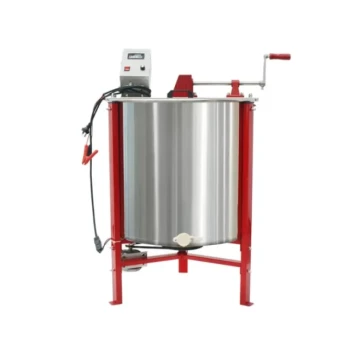
A laser optical tachometer serves as a precision calibration tool used to measure the actual rotational speed of a honey extractor’s main shaft without physical contact. By comparing these real-world measurements against the machine’s power settings, operators can fine-tune the centrifugal force to ensure the transmission system performs exactly as intended.
Core Takeaway: The tachometer acts as a verification bridge between power input and mechanical output. Its primary value lies in identifying the precise RPM "sweet spot" that maximizes honey yield without generating enough centrifugal force to shatter the fragile honeycomb structure.
The Science of Extraction Optimization
Verifying Transmission Accuracy
Honey extractors often rely on analog dials or power percentages that do not always correlate perfectly with rotational speed.
A laser optical tachometer measures the main shaft directly.
This non-contact measurement reveals the actual RPM of the system, allowing technicians to see if the transmission is slipping or if the motor output matches the preset parameters.
Tuning Centrifugal Force
The efficiency of a honey extractor is dictated by centrifugal force, which is a function of the rotation speed.
If the speed is too low, honey remains trapped in the cells.
This results in waste and lower production efficiency. The tachometer provides the data needed to incrementally increase power until the optimal extraction force is reached.
Preventing Structural Damage
The limiting factor in honey extraction is the structural integrity of the wax comb.
Excessive RPM creates forces that snap the honeycomb.
By using the tachometer to map the relationship between power settings and actual speed, operators can define a safe "red line" for the machine—the maximum speed that extracts honey without causing breakage.
Common Pitfalls in Speed Calibration
Reliance on Presets
A common mistake is assuming that a "Medium" or "50%" setting delivers consistent speed across different machines or load weights.
Variable loads affect actual RPM.
Without verification via a tachometer, relying solely on the machine's dial indicators can lead to inconsistent results, either leaving honey behind or damaging frames.
The "Faster is Better" Fallacy
Operators often push for higher speeds to reduce cycle times.
Optimization is about balance, not just velocity.
The tachometer objectively proves when increased speed ceases to improve yield and begins to threaten the comb, preventing operators from guessing the safety limits.
Making the Right Choice for Your Goal
To effectively apply this measurement data to your operation:
- If your primary focus is Maximum Yield: Use the tachometer to verify that the main shaft reaches the highest RPM safely possible for your specific frame type without exceeding the breakage threshold.
- If your primary focus is Comb Preservation: Use the tachometer to establish a "Low-RPM" baseline, verifying that the machine maintains a consistent, gentle speed that drains honey without stressing the wax.
Ultimately, the laser optical tachometer transforms honey extraction from a guessing game into a precise, data-driven process.
Summary Table:
| Optimization Goal | Tachometer Function | Benefit for Operation |
|---|---|---|
| Transmission Accuracy | Measures actual shaft RPM vs. dial settings | Identifies motor slippage and power loss |
| Yield Maximization | Identifies the extraction "Sweet Spot" | Ensures maximum honey recovery per cycle |
| Comb Preservation | Defines the RPM "Red Line" safety limit | Prevents centrifugal force from breaking wax |
| Consistency | Verifies speed across variable loads | Ensures uniform quality regardless of frame weight |
Elevate Your Beekeeping Efficiency with HONESTBEE
At HONESTBEE, we understand that precision is the difference between a wasted harvest and a record-breaking yield. Whether you are a commercial apiary looking to optimize your extraction line or a distributor seeking high-performance beekeeping machinery, we provide the industrial-grade tools you need.
Our comprehensive portfolio includes:
- Advanced Honey Extractors & Filling Machines for large-scale production.
- Precision Hardware & Hive-Making Machinery for operational self-sufficiency.
- Essential Consumables & Specialized Tools for daily apiary management.
Ready to transform your honey production from a guessing game into a data-driven success? Contact us today to discuss your wholesale needs and see how our expertise can power your growth.
References
- M. A. Al-Rajhi, A. El-Sheikha. DEVELOPMENT AND EVALUATION OF A TANGENTIAL HONEY - EXTRACTOR. DOI: 10.21608/mjae.2014.98404
This article is also based on technical information from HonestBee Knowledge Base .
Related Products
- HONESTBEE 72 Frame Industrial Electric Honey Extractor for Beekeeping
- Commercial Electric 12 Frame Honey Extractor Spinner Motorized Honey Extractor
- HONESTBEE 3-Frame Manual Acrylic Honey Extractor
- electric honey extractor honey centrifuge 3 frame honey extractor stainless steel honey frame extractor
- HONESTBEE 6 Frame Self Reversing Electric Honey Extractor for Beekeeping
People Also Ask
- What is the importance of balancing honeycomb frames within a honey extractor? Ensure Stability and Protect Machinery
- How is honey separated from the frames after they are uncapped? Efficient Extraction Methods for High Yields
- What are the main benefits of using a honey extractor? Maximize Yields and Protect Your Honeycomb
- What are the recommended methods for removing honey from the honeycomb? Top Extraction Techniques for Maximum Efficiency
- How do manual honey extractors compare to electric honey extractors? Choosing the Right Tool for Your Apiary Growth