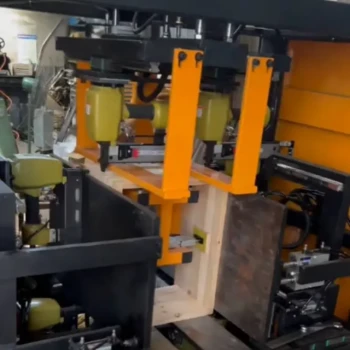
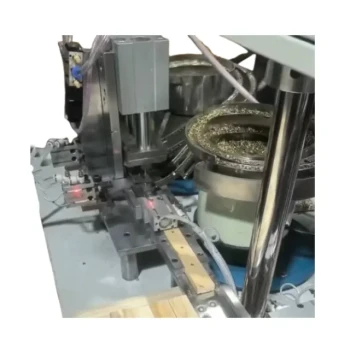
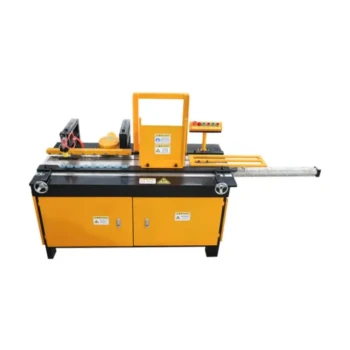
The Bee Box machine operates as an automated, continuous-feed system designed to streamline high-volume manufacturing. The primary operational task is manual material handling, where an operator fills the infeed hopper with panels while the machine executes the cutting sequences automatically. Regarding staffing, the machine can be run by one person at a reduced pace, but achieving maximum production speeds requires a two-person crew.
The machine’s logic computer handles the complex sequencing of operations, limiting human error and physical strain. Consequently, your staffing strategy should be determined purely by your desired cycle time: add a second person only when you need to exceed the throughput limits of a single loader.
Operational Workflow
Automated Logic Control
Once the machine is running, a logic computer takes over the sequencing of operations. It automatically coordinates the movement of components to maintain correct cycling, meaning the operator does not need to manually trigger individual cuts for dados, rabbets, or handholds.
Continuous Material Feeding
The machine is designed for continuous operation. The operator’s primary responsibility is to keep the infeed hopper filled with panels. As long as the hopper is stocked, the machine continues to process the wood without interruption.
Integrated Waste Management
Due to the significant volume of chips produced during the cutting of joints and handholds, the machine utilizes a well-designed dust collection system. Effective operation requires monitoring this system to ensure the large volume of waste does not impede the mechanical components.
Staffing and Production Scaling
Single-Operator Configuration
For lower production requirements, the machine is fully capable of being operated by a single person. In this configuration, the operator manages both the loading of raw panels and the unloading of finished parts, which necessitates running the machine at a reduced rate.
Two-Person Crew for High Output
To utilize the machine's higher speed capabilities, such as a 7-second cycle time, a two-person crew is required. One person focuses on loading the infeed hopper while the other manages the off-loading.
Workload Balance
Even at high speeds, a two-person crew experience a manageable workload. The division of labor ensures that managing the loading and unloading remains an "easy day" rather than a strenuous physical challenge, despite the rapid output.
Understanding the Trade-offs
Throughput vs. Labor Costs
There is a direct correlation between cycle time and labor requirements. A slower 12-second cycle allows for a single operator but caps production at approximately 560 boxes per shift. Increasing the speed to a 6.5-second cycle nearly doubles production to 960 boxes but necessitates the second salary of a two-person crew.
Setup and Tooling Maintenance
While daily operation is automated, the machine relies on specific tooling configurations, including dado blades and custom handhold cutters. Although tool life is excellent—reported at 30,000 boxes without sharpening—operators must be aware that specific setups are required to maintain the machine's precision.
Making the Right Choice for Your Goal
To determine the optimal staffing for your production floor, consider your volume targets against your labor budget.
- If your primary focus is cost efficiency: Run the machine with a single operator at a 12-second cycle time to produce ~560 boxes per shift with minimal labor overhead.
- If your primary focus is maximum throughput: Deploy a two-person crew to unlock the 6.5-second cycle time, pushing daily production toward 1,000 boxes.
By matching your crew size to your cycle time, you optimize the machine for your specific production metrics.
Summary Table:
| Operational Mode | Crew Size | Cycle Time | Daily Production (8hr Shift) | Key Benefit |
|---|---|---|---|---|
| Cost Efficiency | 1 Person | 12 Seconds | ~560 Boxes | Minimum labor overhead |
| High Throughput | 2 Persons | 6.5 - 7 Seconds | ~960+ Boxes | Maximum manufacturing speed |
| Continuous Feed | 1-2 Persons | Automated | Ongoing | Reduced human error & strain |
Scale Your Apiary Production with HONESTBEE
Maximize your workshop efficiency with HONESTBEE’s high-performance beekeeping machinery. As a leading supplier for commercial apiaries and global distributors, we provide everything from automated hive-making and honey-filling machines to essential industry consumables and specialized hardware.
Whether you are looking to optimize your labor costs with a single-operator setup or double your output with our high-speed continuous-feed systems, HONESTBEE delivers the reliability and precision your business demands.
Ready to upgrade your production line? Contact our expert team today to discover how our comprehensive wholesale offerings and honey-themed cultural merchandise can grow your brand.
Related Products
- Automatic High-Speed Bee Hive Box Stapling Machine
- High-Efficiency Pneumatic Bee Hive Making Machine for Rapid Box Assembly
- HONESTBEE Top Bar & Bottom Bar Forming Machine | Bee Frame Machine
- Automatic Pneumatic Bee Frame Machine for Eyelet Insertion
- Professional Bee Frame Machine for Side Bar Shaping
People Also Ask
- How is the Bee Box machine adjusted for different box sizes? Maximize Your Woodworking Versatility and Precision
- How was the Bee Box machine designed? Industrial Engineering for High-Volume Beekeeping Production
- What is the production capacity of the Bee Box machine? Boost Output up to 1,000 Boxes Daily
- What are the power requirements and control system for the Bee Box machine? Optimize Your Apiary Equipment Production
- What are the details regarding the tooling and its maintenance on the Bee Box machine? High-Volume Durability Guide