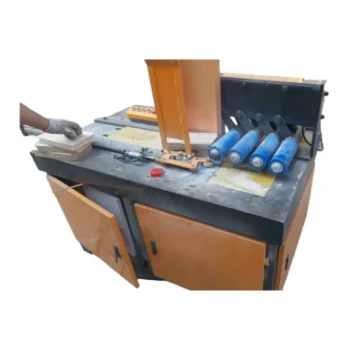
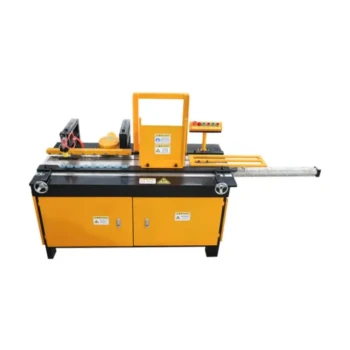
The rabbet on the super ends was machined across the top edge using a 6-inch dado blade mounted on a shaper. This precise cut served two critical functions: standardizing the top edge thickness to exactly 3/8 inch and creating a built-in ledge to support frames without requiring additional hardware.
By utilizing a shaper with a dado blade, manufacturers achieved a consistent 3/8-inch edge regardless of lumber variations. This integrated design streamlined hive assembly by removing the necessity for separate metal frame rests in the standard configuration.
The Manufacturing Mechanics
The Tooling Setup
The manufacturing process utilized a 6-inch dado blade mounted on a shaper. This specific setup provided the power and stability required to make accurate cuts across the top of the super ends.
Achieving Dimensional Consistency
One of the primary challenges in woodworking is handling variations in board thickness. The rabbet cut was designed to ensure the top edge of the super end was always 3/8 inch thick. This standardized the component irrespective of the original thickness of the raw lumber.
Functional Design and Purpose
The Standard Configuration
For standard orders, the rabbet was cut to a depth of 3/4 inch. This depth was calculated to act as a direct support for the hive frames. By using the wood itself as the ledge, the design eliminated the need for separate frame rests.
Customization for Hardware
The manufacturing process was flexible enough to accommodate specific customer preferences. Upon special request, the rabbet could be cut deeper to 7/8 inch. This additional depth was necessary for beekeepers who intended to install their own metal frame rests.
Understanding the Configuration Trade-offs
Integrated Support vs. Add-on Hardware
The standard 3/4 inch cut prioritizes efficiency and simplicity. It creates a ready-to-use component that requires no further modification or parts. However, this depth does not provide the necessary clearance for adding metal rests later.
The Necessity of Planning
If a user attempts to install frame rests on a standard 3/4 inch cut, the spacing will likely be incorrect. The 7/8 inch cut is a strict requirement for adding hardware, meaning the decision to use metal rests must be made before the machining process begins.
Making the Right Choice for Your Equipment
Before selecting your super ends, determine your preferred method of frame support.
- If your primary focus is simplicity and assembly speed: Utilize the standard 3/4 inch rabbet, as it provides a functional ledge without requiring extra parts.
- If your primary focus is installing metal frame rests: Request the 7/8 inch deep rabbet to ensure adequate space for the hardware installation.
Precision in the initial cut ensures the longevity and functionality of the hive components.
Summary Table:
| Feature | Standard Configuration | Custom Hardware Configuration |
|---|---|---|
| Rabbet Depth | 3/4 inch | 7/8 inch |
| Edge Thickness | 3/8 inch (Standardized) | 3/8 inch (Standardized) |
| Frame Support | Built-in wooden ledge | Metal frame rest (Required) |
| Key Benefit | No additional hardware needed | Allows for metal rest installation |
| Tooling Used | 6-inch dado blade on shaper | 6-inch dado blade on shaper |
Scale Your Beekeeping Operation with HONESTBEE Precision
At HONESTBEE, we understand that precision in manufacturing—like the perfect rabbet cut—is the foundation of a productive commercial apiary. As a dedicated partner to commercial apiaries and global distributors, we offer a comprehensive wholesale range designed to streamline your business:
- Premium Beekeeping Tools & Equipment: From precision-machined hive components to complete hardware sets.
- Industrial Machinery: High-performance hive-making and honey-filling machines to scale your production.
- Essential Consumables: A reliable supply of all the industry staples your operation needs to thrive.
- Cultural Merchandise: Unique honey-themed products to expand your retail portfolio.
Whether you are looking to source high-quality hive parts or equip a large-scale honey processing facility, our team is ready to provide the expertise and wholesale value you deserve.
Contact HONESTBEE Today to Discuss Your Wholesale Needs
Related Products
- Beehive Machine Double End Saw for Precision Hive Component Manufacturing
- HONESTBEE AC Powered Wire Embedder with Alligator Clips
- Heavy-Duty Ergonomic Grip Galvanized Pollen Shovel
- Professional Rolling Wax Cutter with Ergonomic Handle
- Solar Beeswax Melter Easy Solar Wax Melter for Beeswax
People Also Ask
- Why is precision woodworking machinery critical for the standardization of beehive components? Ensure Hive Compatibility
- How does beehive manufacturing machinery benefit large-scale commercial beekeeping? Scale Your Apiary Efficiency
- Why is professional beehive manufacturing machinery essential for raw honey quality? Precision for Commercial Success.
- What are the operational advantages of specialized beehive manufacturing machinery for expanding commercial apiaries?
- What is the significance of specialized beehive manufacturing machinery? Drive Scalability for Commercial Apiaries