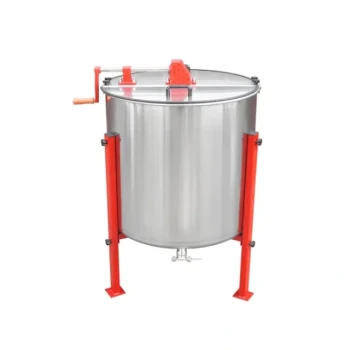
Letting bees clean a honey extractor is a strategy used to minimize waste, but it carries significant operational risks that often outweigh the benefits. While the primary advantage is returning excess honey to the colony, the practice introduces serious downsides, including inciting aggressive robbing behavior, creating safety hazards near human traffic, and risking physical damage to the equipment during transport.
While biological cleaning efficiently recycles excess honey, it creates a high-risk environment for robbing and equipment damage, often making manual gravity draining the superior choice for professional management.
The Singular Benefit: Resource Conservation
Returning Honey to the Hive
The only significant advantage to this method is resource efficiency. By moving the wet machine outside, you allow the bees to reclaim honey that would otherwise be washed down the drain, returning those calories to the hive.
The Risks to the Apiary and Operator
Inciting Robbing Behavior
The most dangerous biological consequence is the potential for robbing. Presenting an open, easily accessible source of large-volume honey can trigger a feeding frenzy, causing stronger hives to attack and plunder weaker colonies.
Creating Safety Hazards
The cleaning process generates intense bee activity. If the extractor is placed anywhere near walkways, doorways, or areas with human traffic, this heightened activity becomes a safety liability for people and pets.
Bee Mortality Risks
Ironically, this method can kill the very bees it aims to feed. Honey tends to accumulate in the seam at the bottom of the extractor, acting as a trap where bees frequently get stuck and drown.
Understanding the Trade-offs
Physical Equipment Damage
Honey extractors are heavy, cumbersome, and slippery when wet. Moving the unit outside significantly increases the risk of damaging the equipment, particularly fragile components like plastic lids or motors.
Disease Transmission Potential
While not explicitly detailed in the primary text, open feeding on shared equipment is a known vector for spreading disease. If bees from multiple colonies congregate on one machine, pathogens present in one hive can easily be transferred to others.
Making the Right Choice for Your Goal
Before moving your equipment outside, consider whether the small amount of reclaimed honey is worth the potential chaos in the apiary.
- If your primary focus is resource conservation: Utilize the "tilt and drain" method indoors with increased room temperature to recover honey without triggering a frenzy.
- If your primary focus is colony safety: Avoid open cleaning entirely to prevent robbing behavior and minimize the risk of bees drowning in equipment seams.
- If your primary focus is equipment longevity: Keep the extractor stationary to prevent accidental drops or damage to plastic components during transport.
Ultimately, standardizing an indoor cleaning process using gravity and heat is safer for your bees and your equipment than relying on biological cleaning.
Summary Table:
| Factor | Biological Cleaning (Bees) | Manual/Gravity Draining |
|---|---|---|
| Resource Recovery | High - Bees reclaim almost all residue | Moderate - Requires heat and time |
| Apiary Safety | Low - Risk of robbing and feeding frenzies | High - No risk of colony aggression |
| Equipment Safety | Low - Risk of damage during transport | High - Extractor remains stationary |
| Bee Mortality | Risk of drowning in bottom seams | None |
| Disease Risk | Higher due to cross-colony contact | Minimal |
| Labor Intensity | Low physical effort, high monitoring | Moderate physical effort |
Maximize Your Harvest Efficiency with HONESTBEE
At HONESTBEE, we understand that professional beekeeping requires precision, safety, and durability. Whether you are a commercial apiary or a distributor, we provide the industrial-grade machinery you need to minimize waste without risking your colony's health. From high-capacity honey-filling machines to robust honey extractors and specialized beekeeping tools, our wholesale solutions are designed for longevity and performance.
Ready to upgrade your honey processing operation? Contact our experts today to discover how our comprehensive equipment range can streamline your production and protect your investment.
Related Products
- HONESTBEE 72 Frame Industrial Electric Honey Extractor for Beekeeping
- Commercial Electric 12 Frame Honey Extractor Spinner Motorized Honey Extractor
- HONESTBEE 6 Frame Self Reversing Electric Honey Extractor for Beekeeping
- HONESTBEE 3-Frame Manual Acrylic Honey Extractor
- Stainless Steel Manual 8 Frame Radial Honey Extractor Machine for Beehives
People Also Ask
- What is the importance of balancing honeycomb frames within a honey extractor? Ensure Stability and Protect Machinery
- How is honey separated from the frames after they are uncapped? Efficient Extraction Methods for High Yields
- What are the main benefits of using a honey extractor? Maximize Yields and Protect Your Honeycomb
- What are the recommended methods for removing honey from the honeycomb? Top Extraction Techniques for Maximum Efficiency
- How do manual honey extractors compare to electric honey extractors? Choosing the Right Tool for Your Apiary Growth