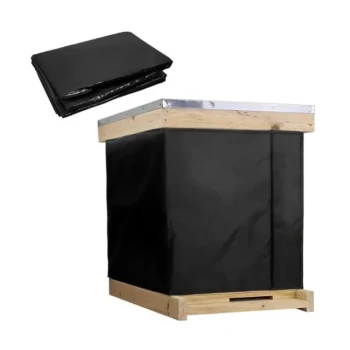
The primary advantage is a drastic increase in operational efficiency. Using an insulated polystyrene box allows for a "dipping" method where multiple comb discs are submerged simultaneously, rather than the slower, traditional method of pouring liquid nitrogen over individual samples. This approach significantly lowers material costs while stabilizing the temperature required for accurate testing.
By switching from pouring to dipping within an insulated vessel, you can nearly triple your testing capacity per liter of liquid nitrogen. This shift turns a resource-intensive task into a scalable solution suitable for commercial phenotype recording.
Maximizing Resource Efficiency
Drastic Reduction in Material Costs
The most immediate impact of using an insulated polystyrene box is the conservation of liquid nitrogen.
Under the traditional pouring method, one liter of liquid nitrogen is typically sufficient for testing only 3 colonies.
By utilizing the box to facilitate the dipping method, that same liter can test approximately 8 colonies. This represents a substantial reduction in consumables for large-scale operations.
Minimizing Natural Evaporation
Liquid nitrogen is highly volatile and evaporates rapidly at ambient temperatures.
The industrial-grade polystyrene material provides essential thermal insulation.
This insulation minimizes natural evaporation, ensuring that the freezing agent is consumed by the testing process itself, rather than being lost to the surrounding environment.
Streamlining the Workflow
Simultaneous Processing
The traditional pouring method is inherently linear, often requiring the operator to treat one sample at a time.
The polystyrene box acts as a stable, low-temperature vessel.
This allows operators to submerge multiple comb discs simultaneously. This batch-processing capability removes bottlenecks and speeds up phenotype recording in the field.
Consistency of Application
Maintaining a stable temperature is critical for hygienic behavior testing.
The insulated environment ensures that all submerged discs are exposed to consistent temperatures.
This reduces variability between tests, leading to more reliable data when assessing colony health.
Understanding the Trade-offs
Safety and Handling
While dipping is more efficient, it introduces specific safety considerations.
Maintaining a "bath" of liquid nitrogen in a box creates a larger volume of hazardous material than a small pouring vessel.
Operators must be vigilant to avoid splashing when submerging discs, requiring strict adherence to safety protocols.
Equipment Portability
The pouring method requires very little equipment.
An industrial-grade insulated box adds bulk to your field kit.
For operators working in rough terrain or with limited transport space, the added volume of the box may require logistical adjustments.
Making the Right Choice for Your Apiary
When deciding between the traditional pouring method and the insulated box method, consider the scale of your operation.
- If your primary focus is large-scale commercial testing: Adopt the insulated polystyrene box to maximize throughput and drastically reduce liquid nitrogen costs.
- If your primary focus is testing a very small number of colonies: The traditional pouring method may be sufficient, avoiding the need for bulky equipment and larger volumes of nitrogen.
Utilizing the thermal efficiency of polystyrene transforms hygienic behavior testing from a costly experiment into a viable, high-volume management tool.
Summary Table:
| Feature | Traditional Pouring Method | Insulated Box Dipping Method |
|---|---|---|
| Colonies per Liter (N2) | ~3 Colonies | ~8 Colonies |
| Processing Speed | Linear (One at a time) | Batch (Multiple simultaneously) |
| Temperature Stability | Variable | High (Insulated environment) |
| Resource Waste | High (Rapid evaporation) | Low (Minimized evaporation) |
| Best For | Small-scale / Hobbyist | Large-scale Commercial Testing |
Scaling Your Commercial Apiary?
Maximize your operational efficiency with high-quality equipment designed for precision. HONESTBEE provides commercial apiaries and distributors with a full spectrum of professional tools—from honey-filling and hive-making machinery to essential consumables and honey-themed cultural merchandise.
Whether you are looking to streamline your phenotype recording or stock your distribution network with reliable hardware, we offer comprehensive wholesale solutions tailored to your growth.
Contact HONESTBEE Today to discover how our specialized beekeeping tools can transform your productivity!
References
- Elena Facchini, E.W. Brascamp. Hygienic behaviour in honeybees: a comparison of two recording methods and estimation of genetic parameters. DOI: 10.1007/s13592-018-0627-6
This article is also based on technical information from HonestBee Knowledge Base .
Related Products
- Professional Insulated Winter Hive Wrap for Beekeeping
- Professional Insulated Plastic Bee Hives
- Styrofoam Mini Mating Nuc Box with Frames Feeder Styrofoam Bee Hives 3 Frame Nuc Box
- 5 Frame Langstroth Poly Nuc Corrugated Plastic Nuc Boxes
People Also Ask
- What are the steps to properly wrap a beehive for winter? Ensure Your Colony Survives the Cold
- When is the best time to wrap a beehive for winter? A Guide to Perfect Winterization Timing
- How do professional insulation wraps provide protection for bee colonies? Optimize Winter Survival & Energy Efficiency
- What are the technical benefits of using winter wraps for beehive insulation? Boost Colony Survival & Hive Health
- What are the benefits of using insulated covers for hives? Ensure Colony Survival and Health