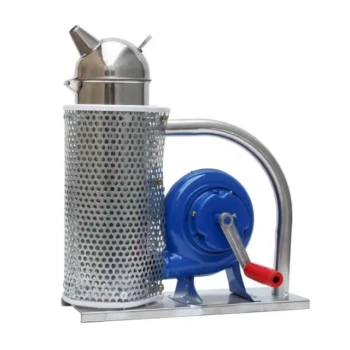
Professional bee smokers offer a definitive advantage by producing controlled, cool smoke that neutralizes bee aggression without the destructive heat associated with open flames. By interfering with the honeybees' chemical communication systems, these devices ensure a safer harvesting operation while drastically reducing the risk of environmental damage and hive degradation.
Core Insight: The transition from open flames to professional smokers is not just about operator safety; it is a fundamental requirement for sustainable beekeeping. Professional smokers protect the hive's reproductive future (larvae and queen) and preserve the commercial purity of the honey, whereas open flames compromise both colony viability and product quality.
The Mechanism of Control and Safety
Disrupting Chemical Communication
The primary function of a professional smoker is the generation of cool smoke. This smoke temporarily masks the alarm pheromones honeybees release when threatened.
By blocking these chemical signals, the colony's defensive response is interrupted. Instead of attacking, the bees enter a calmer state, often focusing on feeding—a reaction similar to their natural response to distant forest fires.
Eliminating High-Temperature Risks
Traditional open-flame methods lack temperature regulation. This uncontrolled heat poses a severe threat to the internal structure of the hive.
Professional smokers contain the combustion, ensuring the smoke exiting the nozzle is cool. This prevents thermal damage to the honeycombs, ensuring the structural integrity of the hive is maintained during inspections or extraction.
Protecting the Apiary's Future
Safeguarding the Queen and Larvae
The most critical biological advantage of using a professional smoker is the protection of the colony's reproductive cycle.
High-temperature smoke from open flames can easily kill or damage sensitive larvae and the queen bee. Professional smokers eliminate this risk, preserving the colony's ability to regenerate and maintaining the sustainability of beekeeping resources.
Reducing Environmental Hazards
Technically, replacing open flames with enclosed smokers acts as a significant fire prevention measure.
Open flames are unstable and prone to sparking, which significantly increases the risk of accidental forest fires, especially in dry apiary locations. Professional smokers contain the fuel source, providing a controlled combustion chamber that mitigates wildfire risks.
Trade-offs: The Cost of Traditional Methods
While open flames may seem like a low-cost, traditional alternative, the hidden costs to production stability are high. This is where the distinction between "harvesting honey" and "managing an apiary" becomes clear.
Colony Abandonment vs. Retention
Using open flames creates a hostile environment that often forces bees to abscond (flee) the hive permanently after harvesting.
In contrast, standardized bee smokers create a temporary disruption rather than a permanent trauma. Data indicates that using proper smoking techniques ensures approximately 96.9% of the colony remains in the hive, guaranteeing the continuity of production for the next season.
Product Contamination
Open-fire smoking generates excessive ash, soot, and uncontrolled odors. These contaminants inevitably settle into the open honeycombs.
This introduction of foreign matter degrades the commercial purity of the honey and introduces off-flavors. Professional smokers prevent this, ensuring the final product maintains its market value and original flavor profile.
Making the Right Choice for Your Goal
To maximize the potential of your apiary, align your equipment choice with your long-term objectives.
- If your primary focus is Product Quality: Use a professional smoker to prevent ash contamination and soot from altering the flavor and purity of your honey.
- If your primary focus is Colony Sustainability: Rely on cool smoke to protect the queen and larvae from heat damage, ensuring the colony survives the harvest.
- If your primary focus is Operational Safety: Utilize the controlled combustion of a smoker to minimize the risk of accidental forest fires and reduce bee aggression.
Investing in precise smoke control is an investment in the longevity of your colony and the purity of your harvest.
Summary Table:
| Feature | Professional Bee Smokers | Traditional Open Flames |
|---|---|---|
| Temperature Control | Produces cool, regulated smoke | Uncontrolled, destructive heat |
| Colony Protection | Safely protects queen and larvae | Risk of thermal death for brood |
| Honey Quality | Prevents ash and soot contamination | High risk of off-flavors and debris |
| Bee Behavior | Calms bees via pheromone masking | Induces trauma; high absconding rates |
| Fire Safety | Contained combustion chamber | High risk of sparks and forest fires |
Maximize Your Apiary Productivity with HONESTBEE
At HONESTBEE, we understand that commercial beekeeping success depends on precision and sustainability. As a leading partner for commercial apiaries and distributors, we provide a comprehensive range of professional tools—from high-efficiency bee smokers to advanced honey-filling machines and specialized hive-making equipment.
Our solutions are designed to protect your colonies and ensure your honey meets the highest market standards. Ready to scale your operation with professional-grade hardware?
Contact our wholesale team today for a custom quote
References
- Nguyễn Quang Tân, Dang Thanh Ha. Socio-economic factors in traditional rafter beekeeping with<i>Apis dorsata</i>in Vietnam. DOI: 10.1080/0005772x.2002.11099559
This article is also based on technical information from HonestBee Knowledge Base .
Related Products
- Professional Bee Smoker with Elongated Spout and Durable Bellows for Beekeeping
- Professional Replacement Bee Smoker Bellows for Beekeeping Equipment
- Heavy-Duty Bee Smoker with Durable Plastic Bellows for Beekeeping
- Premium Traditional Copper Bee Smoker with Bellows
- Stainless Steel Honey Bee Smoker Hive and Honeycomb Smoker for Beekeeping
People Also Ask
- What roles do bee smokers and precision tools play in honey harvesting? Master Safety and Quality Control
- Why is a professional bee smoker considered an essential tool for hive management and safety? Master Colony Control.
- Why is the use of professional bee smokers and specialized fuel essential? Protect Honey Purity & Colony Safety
- What is the mechanism by which a professional bee smoker assists in colony management? Boost Hive Safety and Efficiency
- Why is a professional bee smoker essential for hive maintenance? Master Colony Control & Safety