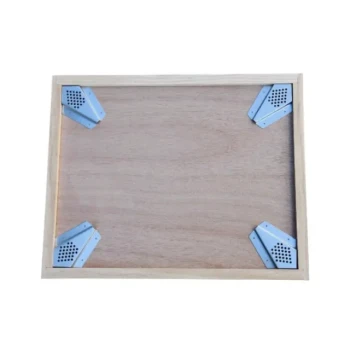
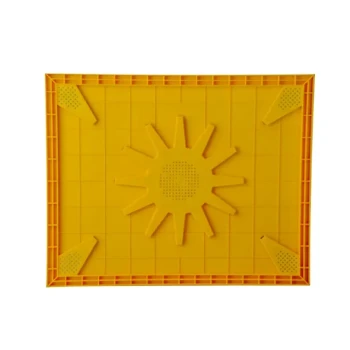
The three common crown board materials are cedar-framed plywood, strand board, and polycarbonate. Cedar-framed plywood provides a dependable balance of quality, durability, and cost. Strand board is the budget option but generally deteriorates faster in field conditions, while polycarbonate offers the strongest resistance to rot and the longest service life.
For most beekeeping operations, cedar-framed plywood is the balanced choice; strand board suits price-sensitive supply, and polycarbonate is best where long-term durability and moisture resistance matter most.
How the Main Crown Board Materials Compare
Cedar-Framed Plywood
Cedar-framed plywood crown boards combine a plywood panel with a cedar-wood perimeter frame. This construction provides standard quality and reliable durability for general beekeeping use.
Cedar is particularly suitable for hive components because it offers useful resistance to moisture and rot. The plywood center keeps the product practical and cost-effective, making this configuration a common middle-ground option.
Strand Board
Strand board crown boards are made from an engineered wood product and are typically positioned as the lower-cost alternative. Their main advantage is a more accessible purchase price for distributors, wholesalers, and beekeepers managing larger equipment volumes.
The trade-off is reduced durability under field conditions. Repeated exposure to moisture can cause strand board to deteriorate faster than cedar-framed plywood or polycarbonate.
Polycarbonate
Polycarbonate crown boards provide the highest level of rot resistance and long-term durability among the three primary options. They are well suited to operations that prioritize service life, reduced replacement frequency, and consistent performance in damp environments.
Their durability makes them a practical premium option for commercial apiaries and resellers serving customers who value lifecycle performance over the lowest initial price.
What Performance Characteristics Matter Most?
Moisture and Rot Resistance
Hive components are exposed to outdoor moisture, condensation, and changing weather conditions. Material resistance to these conditions is therefore one of the most important factors in crown board selection.
Polycarbonate performs best for rot resistance. Cedar-framed plywood offers a practical level of durability, while strand board generally requires more careful management and may degrade sooner.
Expected Service Life
Material selection directly affects how often crown boards may need to be replaced. Strand board can reduce upfront expenditure, but faster deterioration may increase replacement requirements over time.
Polycarbonate generally provides the longest service life, while cedar-framed plywood offers a reasonable balance between durability and purchase cost.
Purchase Economics
For high-volume orders, the lowest unit price can be attractive, particularly for entry-level product lines or price-sensitive markets. Strand board is suited to this role, provided customers understand its shorter expected field life.
Cedar-framed plywood supports a broader value proposition because it combines acceptable durability with moderate cost. Polycarbonate carries a stronger premium-value position because its higher durability can justify a greater initial investment.
Suitability for Commercial Supply
Distributors and wholesalers commonly need a product range rather than a single material choice. Offering all three options allows customers to select according to budget, operating conditions, and expected replacement cycle.
A full-spectrum portfolio can therefore include strand board for economy buyers, cedar-framed plywood as the standard offering, and polycarbonate for premium or heavy-duty applications.
Understanding the Trade-offs
Lower Price Does Not Always Mean Lower Total Cost
Strand board may be the most economical option at purchase, but faster deterioration can lead to more frequent replacements. The relevant comparison is not only unit price but also expected service life in the customer’s operating environment.
For buyers managing many hives, a more durable material may provide better long-term value even when its initial cost is higher.
Premium Durability Requires the Right Customer Positioning
Polycarbonate is not automatically the best choice for every buyer. Its main benefits are strongest where moisture exposure, long service life, and reduced maintenance are important enough to justify a premium product position.
Resellers should present it as a lifecycle-value solution rather than simply as a higher-priced crown board.
Construction Quality Still Matters
Material category is important, but finished-product quality also depends on manufacturing consistency, dimensions, fit, and overall construction. A well-made crown board should be supplied with reliable specifications and consistent quality across repeat orders.
This is especially important for distributors that need dependable replenishment and efficient order fulfillment.
How to Choose the Right Crown Board
The best material depends on the customer’s budget, operating conditions, and expectations for product longevity.
- If your primary focus is lowest purchase cost: Choose strand board, while clearly communicating that it may deteriorate faster under field conditions.
- If your primary focus is balanced value: Choose cedar-framed plywood for a dependable combination of durability, standard quality, and cost control.
- If your primary focus is maximum service life: Choose polycarbonate for superior rot resistance and long-term durability.
- If your primary focus is broad product coverage: Stock all three materials to serve economy, standard, and premium customer segments.
- If your primary focus is commercial apiary reliability: Prioritize polycarbonate or cedar-framed plywood, depending on the required balance between lifecycle performance and upfront cost.
A well-segmented crown board portfolio helps buyers match material performance to operating needs while giving suppliers greater flexibility across different markets.
Summary Table:
| Material | Key Characteristics | Best For |
|---|---|---|
| Cedar-Framed Plywood | Balanced quality, durability, and cost; moisture and rot resistant | General beekeeping use, reliable standard option |
| Strand Board | Low initial cost, less durable under moisture | Price-sensitive buyers, entry-level products |
| Polycarbonate | Superior rot resistance, longest service life | Premium and heavy-duty applications, damp environments |
Choose the right crown board for your apiary with HONESTBEE. We supply the full spectrum of beekeeping equipment, including high-quality crown boards in cedar-framed plywood, strand board, and polycarbonate. As your one-stop wholesale partner, we offer rapid response, dedicated service, and ultra-fast delivery to support your business. Whether you're a distributor, wholesaler, or commercial beekeeper, contact us today to discuss your needs and benefit from our professional expertise and reliable supply chain.
Related Products
- Langstroth Solid Bottom Board for Beekeeping
- Solid Bottom Board Australian Pine Wood Langstroth Bottom Board for Wholesale
- HONESTBEE Durable Frame Wiring Board with Integrated Tensioner
- HONESTBEE Professional Frame Wiring Board and Jig
- HONESTBEE Wooden Bee Escape Board with Triangle Mesh Design for Beekeeping
People Also Ask
- What are the functions of solid bottom boards for a beehive? Essential Thermal Protection and Winter Survival Tips
- What is the purpose of a solid bottom board for bee hives? Enhance Hive Health and Winter Survival
- How does climate influence the choice between a solid and screened bottom board? Optimize Your Hive for Local Weather
- What is the primary function of a bottom board in a modern modified beehive system? Essential Foundation Guide
- What are the characteristics of a solid bottom board for a beehive? Boost Colony Health and Thermal Insulation