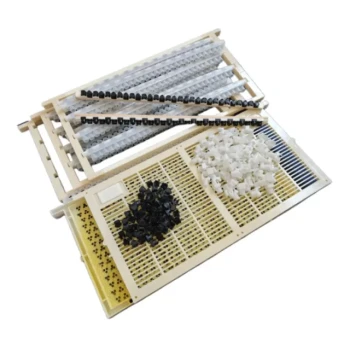
The primary design requirements for a specialized grafting spatula center on tip flexibility and structural precision to safely handle larvae less than 24 hours old. This tool must be engineered to slide beneath the larva to lift it along with a small amount of original royal jelly, ensuring the transfer occurs without physical damage. By preserving the larva's physiological activity, the design directly secures high acceptance rates, which is the deciding factor in royal jelly yield.
The grafting spatula is not merely a transfer instrument; it is the primary safeguard of larval health. Its design must prioritize extreme tip flexibility to mimic natural conditions, as even microscopic mechanical damage leads to rejection by the colony and a loss of production.
Critical Design Features
Optimized Tip Flexibility
The defining characteristic of a functional grafting spatula (often referred to as a grafting needle) is the elasticity of the tip. The material must be soft and pliable enough to deform slightly when pressing against the cell bottom.
This flexibility allows the operator to slide the tool under the delicate body of a larva that is less than 24 hours old. A rigid tip would risk crushing the larva or piercing its outer membrane during this high-precision maneuver.
Precision Structural Geometry
The physical structure of the spatula tip must be fine enough to navigate the tight constraints of a natural honeycomb cell. It requires a specific geometry that allows for the retrieval of the larva without disrupting its posture.
This structural precision ensures the tool can scoop the larva up rather than rolling or dragging it. Maintaining the larva's orientation is vital for its continued development once placed in the artificial cell cup.
Capacity for "Wet" Transfer
The design must facilitate the lifting of the larva accompanied by a small droplet of its original royal jelly. The spatula must hold this viscous fluid effectively during the transfer.
Moving the larva within its original jelly bed prevents dehydration and maintains a consistent chemical environment. This reduces transfer shock and preserves the larva's physiological activity.
The Impact on Production Metrics
Ensuring Physiological Integrity
The ultimate design goal is to prevent any compromise to the physiological activity of the larva. If the spatula design causes mechanical stress, the larva may survive the move but fail to thrive.
The tool must function as a non-invasive extension of the hand. If the design fails to protect the larva's biological state, the colony's nurse bees will likely detect the damage and remove the larva.
Maximizing Acceptance Rates
The success of royal jelly production is measured by the acceptance rate—the percentage of grafted larvae the colony accepts and feeds. The grafting spatula is the single most significant hardware variable in this equation.
A design that ensures smooth, damage-free transfer directly correlates to higher acceptance. Higher acceptance means more active queen cells, leading to a maximized harvest of royal jelly.
Understanding the Trade-offs
Rigidity vs. Sensitivity
A common pitfall in spatula design is balancing structural integrity with sensitivity. A tool that is too stiff may allow for faster, more aggressive grafting, but it drastically increases the rate of larval injury and rejection.
Conversely, a tip that is too flimsy may fail to lift the necessary "bed" of royal jelly along with the larva. This trade-off requires a material that is firm enough to carry the payload but flexible enough to yield against the delicate wax of the comb.
Making the Right Choice for Your Goal
Selecting the correct grafting tool is about balancing operator efficiency with biological sensitivity.
- If your primary focus is Maximum Yield: Prioritize spatulas with ultra-high tip flexibility to ensure zero physical damage to <24-hour larvae, guaranteeing the highest possible acceptance rates.
- If your primary focus is Operational Speed: Look for a tool with a structured, pre-curved tip that naturally fits the geometry of your specific artificial cups, allowing for quicker deposition without manual adjustment.
The effectiveness of your grafting spatula defines the biological success of the entire production cycle.
Summary Table:
| Requirement | Key Feature | Production Benefit |
|---|---|---|
| Tip Flexibility | Soft, pliable material | Prevents larval damage & rejection |
| Precision Geometry | Fine, curved structure | Maintains larva posture & orientation |
| Wet Transfer | Retains original jelly | Prevents dehydration & transfer shock |
Elevate Your Production with HONESTBEE
As a dedicated partner to commercial apiaries and distributors, HONESTBEE provides a comprehensive wholesale portfolio designed for professional success. From high-precision grafting tools that ensure maximum larval acceptance to industrial honey-filling machines and hive-making equipment, we supply the full spectrum of beekeeping hardware and essential consumables.
Ready to optimize your harvest and streamline your operations?
Contact our experts today for wholesale inquiries and customized solutions!
References
- O. Mischenko, D. Kryvoruchko. The influence of honey harvest conditions on the production of the royal jelly by queen bees. DOI: 10.31073/agrovisnyk202104-06
This article is also based on technical information from HonestBee Knowledge Base .
Related Products
- Plastic Chinese Queen Grafting Tool for Bee Queen Rearing
- No Grafting Queen Rearing Kit: System for Royal Jelly Production and Queen Rearing
- Stainless Steel Beekeeping Queen Grafting Tool for Honey Bee Rearing
- Stainless Steel Queen Grafting Tool for Beekeeping and Bee Queen Grafting
- Plastic Beekeeping Honey Bee Larvae Grafting Tools for Queen Rearing and Chinese Grafting
People Also Ask
- Why is it necessary for migratory beekeeping enterprises to utilize professional queen bee rearing tools? Boost Resilience
- What specialized tools and frame configurations are needed for larval grafting during queen rearing, and how are queen cells properly spaced? Master the essentials for efficient queen production
- What are the benefits of using a queen grafting tool for queen rearing? Master Precision for Superior Bee Genetics
- What is grafting in queen rearing? Take Control of Your Apiary's Genetics
- What are the steps involved in using a queen grafting tool? A Guide to Successful Queen Rearing