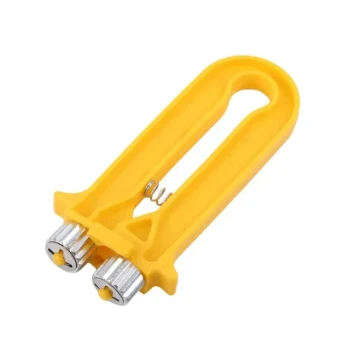
The primary purpose of a grafting tool in artificial queen rearing is to execute the precise physical transfer of young honeybee larvae from worker cells to artificial queen cell cups. This instrument is essential for migrating specific-aged larvae from a maternal colony to a rearing colony without inflicting injury, serving as the foundational step for selective breeding and large-scale production.
Core Takeaway The grafting tool is the bridge between a standard worker larva and a potential queen. Its value lies not just in moving the larva, but in doing so with such delicacy that the larva suffers no mechanical damage, ensuring the nurse bees accept it and raise it as a queen.
The Mechanics of Precision Transfer
Targeted Selection
Grafting tools allow the apiarist to select larvae of a specific age.
This precision is vital because the age of the larva determines its potential to develop into a high-quality queen rather than a worker bee.
Relocation to Artificial Environments
The tool is used to lift the larva from the natural worker cell and deposit it at the bottom of an artificial queen cell cup.
This transfer moves the biological material from the maternal source to a "rearing colony," where the environment is manipulated to encourage queen development.
Ensuring Biological Integrity
Prevention of Mechanical Damage
Honeybee larvae are incredibly fragile; even slight pressure can be fatal or cause developmental deformities.
Grafting tools are designed to scoop or lift the larva—often floating on a bed of royal jelly—to ensure zero physical harm during the move.
Maximizing Acceptance Rates
If a larva is damaged during transfer, the nurse bees in the rearing colony will detect the injury and remove (clean out) the larva rather than feeding it.
By using a specialized tool to maintain the larva's integrity, breeders ensure high acceptance rates of the artificial queen cells.
Facilitating Large-Scale Production
The Foundation of Mass Rearing
While natural swarming produces a few queens, grafting allows for the simultaneous production of dozens or hundreds of queens.
The grafting tool is the "core technical step" that makes this industrial-scale scalability possible, allowing for mass production of queens or royal jelly.
Standardization of Breeding
Using these tools allows for the systematic creation of experimental groups.
This is critical for establishing drone production colonies or testing specific genetic traits under controlled conditions.
Understanding the Trade-offs
The Skill Barrier
While grafting tools are the standard for professional breeding, they require significant manual dexterity and good eyesight.
Improper use leads to high failure rates due to unseen mechanical damage inflicted on the larvae during the lift.
Alternative Methods (The Jenter System)
It is important to note that grafting is not the only method. Systems like the Karl Jenter set rely on egg transfer rather than larval grafting.
In these systems, the queen lays eggs directly into removable plugs, eliminating the need to manually touch the larvae. This often results in larger queens because the larvae are never disturbed, but the equipment is more expensive and complex than a simple grafting tool.
Making the Right Choice for Your Goal
To determine how heavily you should rely on manual grafting tools versus other methods, consider your specific breeding objectives:
- If your primary focus is large-scale commercial production: Master the manual grafting tool, as it remains the most efficient, cost-effective method for mass-producing queens and royal jelly.
- If your primary focus is maximum individual queen quality (Morphology): Consider egg-transfer systems (like Jenter) to avoid all risk of mechanical damage and potentially increase birth weight and spermatheca size.
- If your primary focus is selective breeding: Use grafting tools to precisely select larvae from your best genetic lines, ensuring only the strongest genetics are propagated.
Mastery of the grafting tool is the single most important technical skill for converting a standard beekeeper into a queen breeder.
Summary Table:
| Feature | Purpose & Benefit in Queen Rearing |
|---|---|
| Larval Selection | Enables precise selection of 12-24 hour old larvae for optimal queen quality. |
| Mechanical Safety | Specialized tips prevent physical injury to fragile larvae during relocation. |
| Success Rate | Ensures high acceptance by nurse bees by maintaining biological integrity. |
| Scalability | Essential for commercial-scale production of queen cells and royal jelly. |
| Genetic Control | Facilitates selective breeding by migrating larvae from superior maternal lines. |
Elevate Your Queen Rearing Operations with HONESTBEE
To achieve professional-grade acceptance rates and produce superior queens, you need precision instruments designed for the task. HONESTBEE serves commercial apiaries and distributors worldwide with a comprehensive suite of professional beekeeping solutions.
From ergonomic grafting tools and artificial cell cups to advanced honey-filling machinery and hive-making equipment, we provide the industrial-scale tools necessary to grow your business. Whether you are looking for bulk industry consumables or specialized hardware to streamline your production, our expert team is ready to assist you.
Ready to scale your apiary's potential? Contact us today to explore our wholesale catalog and expert solutions!
References
- Soha Gomaa, Mohamed Salama. Morphometric analysis of some external and internal body characteristics of honey bee Apis mellifera queens treated with Paenibacillus larvae larvae. DOI: 10.21608/ajbs.2018.65271
This article is also based on technical information from HonestBee Knowledge Base .
Related Products
- Stainless Steel Queen Grafting Tool for Beekeeping and Bee Queen Grafting
- Plastic Chinese Queen Grafting Tool for Bee Queen Rearing
- Stainless Steel Beekeeping Queen Grafting Tool for Honey Bee Rearing
- Plastic Beekeeping Honey Bee Larvae Grafting Tools for Queen Rearing and Chinese Grafting
- Retractable Chinese Queen Rearing Grafting Tools Equipment
People Also Ask
- What is grafting in queen rearing? Take Control of Your Apiary's Genetics
- What are the steps involved in using a queen grafting tool? A Guide to Successful Queen Rearing
- What are the benefits of using a queen grafting tool for queen rearing? Master Precision for Superior Bee Genetics
- What is the step-by-step process for using a queen grafting tool? Master Larva Transfer for Better Queen Rearing
- What is the primary function of a queen grafting tool? Master Precise Larval Transfer for High Queen Acceptance