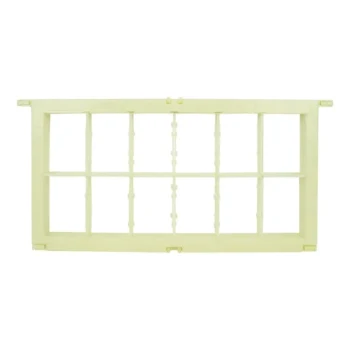
Frames and combs function as the structural skeleton and the biological heart of a managed beehive. Frames are the rigid, movable rectangles—typically wood or plastic—that hang vertically inside the hive box to support the beeswax. The combs held within these frames serve as the colony's nursery and pantry, providing the cells necessary for raising young and storing honey.
The critical distinction is that combs are essential for the bees' survival, while frames are essential for the beekeeper's management. The frame system imposes order on the colony's natural building instincts, allowing you to inspect the hive, assess health, and harvest honey without destroying the colony's home.
The Structural Role of the Frame
Providing Essential Stability
Frames act like the studs in a house. They provide a rigid boundary that supports the delicate wax comb, which can become heavy when filled with honey and brood.
Without this perimeter, fresh wax is fragile and prone to collapsing under its own weight or during hot weather. The frame ensures the comb remains vertical and secure.
Enabling Non-Destructive Inspection
The defining feature of a modern hive is the ability to move components. Frames are designed to be lifted out individually.
This allows you to inspect the brood pattern, check for the queen, or manage resources without cutting or crushing the comb. Before the invention of movable frames, harvesting honey often meant destroying the colony.
Guiding Linear Growth
Bees naturally build comb in erratic, curving shapes. To prevent this, frames often contain a sheet of foundation—a guide made of wax or plastic embossed with a hexagonal pattern.
This foundation encourages the bees to build straight, uniform combs. This uniformity is vital for removing frames without them touching or damaging adjacent combs.
Maintaining "Bee Space"
Frames are engineered with precise dimensions and spacers to maintain a specific gap between parts known as bee space (usually 3/8 inch).
This gap allows bees to move freely between combs. If the space is too large, bees build extra "burr comb"; if too small, they seal it with propolis. Correct frame spacing prevents these issues.
The Biological Function of the Comb
The Colony's Nursery (The Brood)
The central role of the comb is reproduction. The queen lays eggs in the center of the comb, where the temperature is easiest to regulate.
Worker bees use these hexagonal cells to raise larvae and pupae. This area is referred to as the brood chamber.
The Resource Pantry
Surrounding the brood nest, the comb serves as a storage vessel. Bees store pollen (protein) near the brood for easy feeding.
The upper and outer edges of the comb are typically used to cure and cap honey (carbohydrates) for long-term winter storage.
Understanding the Trade-offs
Foundation vs. Natural Comb
While frames provide order, using them with foundation sheets forces bees to build cells of a specific size. This maximizes honey production and keeps combs straight, but some argue it limits natural bee behavior.
The Risk of Cross-Comb
If you use frames without foundation (to allow natural cell sizing), bees may ignore the frame's guidance. They might build cross-comb, connecting several frames together.
This negates the primary benefit of the frame system. Once cross-comb occurs, you can no longer pull frames for inspection without breaking the comb and killing bees.
Making the Right Choice for Your Goal
To maximize the effectiveness of your hive, align your equipment usage with your management style:
- If your primary focus is ease of inspection and honey production: Use frames with full foundation to ensure perfectly straight combs that are durable during extraction.
- If your primary focus is natural wax production: Use frames with a small starter strip instead of full foundation, but inspect frequently to correct cross-combing early.
The frame is the tool that bridges the gap between the wild chaos of a natural nest and the managed order of a productive apiary.
Summary Table:
| Component | Material/Nature | Primary Function | Key Benefit to Beekeeper |
|---|---|---|---|
| Frame | Wood or Plastic | Structural support & stability | Enables non-destructive inspection |
| Comb | Beeswax | Nursery (brood) & Pantry (honey/pollen) | Essential for colony reproduction & survival |
| Foundation | Wax or Plastic Sheet | Guide for linear comb building | Ensures straight combs for easy extraction |
| Bee Space | 3/8 inch Gap | Facilitates bee movement | Prevents burr comb and propolis buildup |
Elevate Your Apiary with HONESTBEE Professional Equipment
Maximize your honey production and hive health with premium infrastructure. HONESTBEE provides commercial apiaries and distributors with high-quality frames, foundation, and specialized machinery designed for durability and precision.
Our value to your business:
- Comprehensive Wholesale Range: From standard frames to honey-filling machines and hive-making hardware.
- Precision Engineering: Maintain perfect 'bee space' and structural integrity across your entire operation.
- Industry Expertise: We supply the essential consumables and merchandise that keep large-scale beekeeping profitable.
Ready to scale your production with the industry's most reliable tools? Contact us today to discuss our wholesale offerings!
Related Products
- Wooden Bee Hive Frames for Beekeeping and Wholesale
- Professional Frame Comb Fork and Lifter for Efficient Handling
- Professional Sectional Comb Honey Frame with 250g Cassette System for Beekeeping
- Assembled Wooden Bee Frames with Plastic Foundation for Durability and Convenience by HONESTBEE
- Assembled Wooden Bee Frames with Beeswax Foundation Ready to Use by HONESTBEE
People Also Ask
- How do wooden and plastic hive frames compare in terms of durability? Wood vs. Plastic Longevity & Repairability
- How does balancing the number of frames impact hive productivity? Optimize Your Apiary's Biological Output
- What are the main considerations when choosing between wooden and plastic bee hive frames? Optimize Your Apiary's Efficiency
- How should beehive frames be maintained to prolong their lifespan? 5 Pro Tips for Durable Beekeeping Equipment
- Can I reuse old beehive frames? Save Money and Boost Hive Productivity