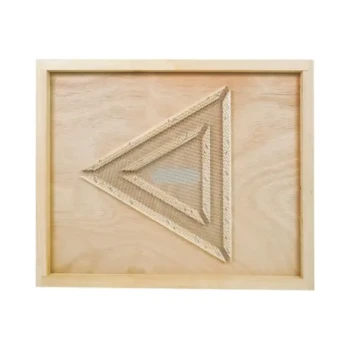
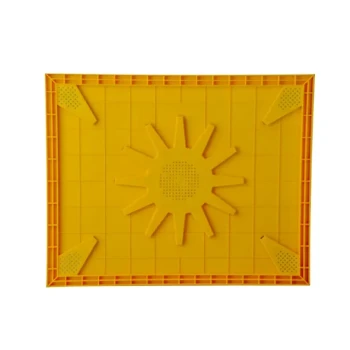
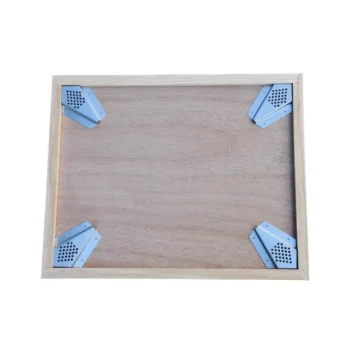
The bottom board constitutes the structural foundation and floor of a beehive. It serves as the single entry and exit point for the colony, acts as a landing pad for foragers, and supports the immense weight of the hive boxes stacked above it.
While its primary function is structural support, the choice between solid and screened variations plays a critical role in colony health by regulating ventilation, moisture, and pest management.
The Functional Role of the Base
Foundation and Support
The bottom board is the base upon which the entire hive stack rests. It must be constructed from durable materials, typically wood or a wood-screen combination, to withstand the considerable load of brood, honey, and equipment.
The Colony Entrance
Placing the brood box on top of the bottom board creates the hive's "front door." This gap allows bees to defend a single point of entry against predators and robber bees.
Forager Landing Zone
Most bottom boards extend beyond the front of the hive body. This extension provides a necessary takeoff and landing platform for foraging bees returning with heavy loads of nectar and pollen.
Variations in Design
Specialized IPM (Screened) Boards
According to the primary technical standard, a specialized bottom board is often designed for Integrated Pest Management (IPM). These boards feature a mesh floor rather than solid wood.
Ventilation Control
The IPM board functions as a screened bottom board that significantly increases airflow. By removing the accompanying drawer or insert, beekeepers can provide extra ventilation, which is critical in warmer climates.
The Solid Bottom Board
This is the standard, traditional variation. It creates a fully enclosed floor, offering maximum protection against drafts during colder months but providing less passive ventilation than screened models.
Reversible Dimensions
Many commercial boards are reversible, offering two different entrance heights. One side typically provides a 7/8-inch opening for heavy summer traffic, while the other offers a 3/8-inch opening to restrict access during winter or times of robbing.
Understanding the Trade-offs
Moisture vs. Insulation
Screened boards excel at drainage in rainy areas and prevent water pooling, but they can make the hive too cool in winter if not properly managed. Solid boards insulate better but require careful tilting to ensure rainwater drains out the front.
Ground Clearance
Regardless of the type chosen, the bottom board must never sit directly on the ground. It requires elevation to prevent moisture absorption, rot, and easy access for ground-based pests.
Making the Right Choice for Your Goal
- If your primary focus is pest management and ventilation: Choose a screened (IPM) bottom board, as it allows varroa mites to fall out of the hive and offers superior airflow control via the removable drawer.
- If your primary focus is maximum insulation in cold climates: Choose a solid bottom board or ensure your screened board has a high-quality insert to seal the hive against freezing drafts.
- If your primary focus is seasonal versatility: Choose a reversible bottom board, allowing you to toggle between a large summer entrance and a defensible winter entrance simply by flipping the floor.
Select the foundation that best supports your local climate conditions and your specific strategy for mite control.
Summary Table:
| Feature | Solid Bottom Board | Screened (IPM) Bottom Board |
|---|---|---|
| Primary Use | Traditional, cold climates | Pest management, warm climates |
| Ventilation | Minimal (via entrance) | High (mesh floor) |
| Pest Control | Standard protection | Varroa mite monitoring/reduction |
| Insulation | Superior thermal retention | Lower (requires inserts in winter) |
| Versatility | Often reversible entrances | Adjustable airflow with drawers |
| Maintenance | Low; requires tilting for drainage | Moderate; debris cleanup needed |
Elevate Your Apiary Operations with HONESTBEE
As a leading global provider for commercial apiaries and distributors, HONESTBEE understands that the right foundation is critical for colony success. We offer a comprehensive wholesale range of high-quality beekeeping equipment, from durable bottom boards and hives to advanced honey-filling machines and specialized hardware.
Whether you are looking to source high-performance Integrated Pest Management (IPM) solutions or need to stock up on essential industry consumables, our expert team is here to support your growth and efficiency.
Ready to scale your business with professional-grade tools?
Contact HONESTBEE Today to discuss our wholesale offerings and customized machinery solutions.
Related Products
- Langstroth Solid Bottom Board for Beekeeping
- Solid Bottom Board Australian Pine Wood Langstroth Bottom Board for Wholesale
- Langstroth Screen Bottom Board for Beekeeping Wholesale
- HONESTBEE Top Bar & Bottom Bar Forming Machine | Bee Frame Machine
- Australian Pine Wood Langstroth Screen Bottom Board for Wholesale
People Also Ask
- What are the functions of solid bottom boards for a beehive? Essential Thermal Protection and Winter Survival Tips
- What is the purpose of a solid bottom board for bee hives? Enhance Hive Health and Winter Survival
- How does climate influence the choice between a solid and screened bottom board? Optimize Your Hive for Local Weather
- What is the primary function of a bottom board in a modern modified beehive system? Essential Foundation Guide
- What are the characteristics of a solid bottom board for a beehive? Boost Colony Health and Thermal Insulation