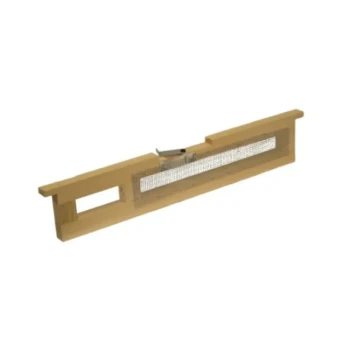
Beehive frames serve as the movable internal skeleton of a modern hive. They are rectangular structures, typically crafted from wood or plastic, that hang vertically within hive boxes. Their fundamental purpose is to hold the honeycomb securely, enabling beekeepers to remove, inspect, and reorganize the comb without destroying the bees' work or killing the colony.
The Core Insight Frames transform a static natural nest into a manageable agricultural system. By containing the honeycomb within a removable border, they allow for non-destructive inspections, easy honey harvesting, and the precise reorganization of resources essential for colony health.
The Role of Structural Support
Providing a Foundation
Frames function much like the studs in a house. They provide a standardized, rigid structure where honeybees can secrete wax and build their cells.
Housing Critical Resources
The wax cells built within the frame serve as the colony's primary infrastructure. They act as storage units for essential survival resources like pollen and honey, as well as the nursery for egg-laying and larval development (brood).
Ensuring Stability
The structural stability of the frame directly impacts the colony's productivity. A stable frame allows for higher reproductive efficiency and secure honey storage, preventing the heavy comb from collapsing under its own weight.
Enabling Colony Management
Non-Destructive Inspection
Without frames, bees would attach comb directly to the hive walls (as they do in nature). Frames allow a beekeeper to lift out a single section of comb to check for the queen, disease, or food levels without tearing the hive apart.
Modularity and Mobility
Because frames are independent units, they are moveable. Beekeepers can shift them within a box to encourage better comb building or move them between boxes to manage population distribution.
Regulating "Bee Space"
Frames are constructed to hang vertically while maintaining a specific gap known as "bee space." This precise spacing allows bees to move freely around the comb without being crushed or feeling the need to glue the frames together with propolis.
Anatomy and Assembly
The Four Key Components
A standard frame is assembled from four parts: a top bar, a bottom bar, and two side bars.
The Suspension Mechanism
The top bar features protruding ends (often called ears or lugs) that rest on a rabbet (a step-shaped recess) inside the hive body. This allows the frame to hang freely without touching the bottom of the box.
Internal Reinforcement
To keep the wax foundation sheet straight, frames often feature a groove under the top bar. Additionally, holes in the side bars allow beekeepers to thread 28-gauge wire through the frame, adding tensile strength to support heavy honey loads.
Understanding the Trade-offs
Material Differences
Frames are generally available in wood or plastic.
- Wood frames are traditional and allow for component replacement, but they require assembly (gluing, nailing, and wiring).
- Plastic frames often come as a one-piece design including the foundation. They are durable and require no assembly, but they can be more difficult to clean or repair if damaged.
Sizing Incompatibility
Frames are not "one size fits all." They come in deep, medium, and shallow sizes to correspond strictly with the box depth.
- The Pitfall: Placing a shallow frame in a deep box leaves a large gap at the bottom. Bees will fill this void with "wild" comb (burr comb), which defeats the purpose of the movable frame and makes inspection difficult.
Making the Right Choice for Your Goal
Selecting and utilizing frames correctly is vital for hive management.
- If your primary focus is brood rearing: Prioritize deep frames in the lower hive bodies, as the larger surface area supports uninterrupted egg-laying patterns for the queen.
- If your primary focus is honey harvest: Utilize medium or shallow frames (supers) for honey storage; these are lighter when full and easier to lift and extract than deep frames.
- If your primary focus is stability: Ensure your frames are reinforced with wire or use one-piece plastic models to prevent the comb from blowing out during the extraction process.
The proper use of frames is the single most important factor in transitioning from simply keeping bees to effectively managing a colony.
Summary Table:
| Key Function | Benefit to Beekeeping | Essential Components |
|---|---|---|
| Structural Support | Acts as a skeleton for wax foundation and honey storage. | Top bar, bottom bar, side bars |
| Colony Management | Enables non-destructive inspections and modular movement. | Movable, hanging design |
| Space Regulation | Maintains "bee space" to prevent wild burr comb building. | Standardized frame width |
| Resource Housing | Provides a secure nursery for brood and storage for pollen. | Internal wire or plastic sheet |
| Extraction Efficiency | Supports heavy honey loads during centrifugal extraction. | Reinforced joints and wire |
Scale Your Apiary Operations with HONESTBEE
As a dedicated partner for commercial apiaries and distributors, HONESTBEE provides a comprehensive wholesale catalog designed to optimize your beekeeping productivity. We supply the full spectrum of professional equipment, from high-durability frames and industry consumables to advanced machinery like hive-making and honey-filling units.
Why choose HONESTBEE for your business?
- Comprehensive Wholesale Offering: Access everything from specialized hardware to honey-themed cultural merchandise.
- Industrial-Grade Machinery: Enhance your production with our honey-filling and hive-manufacturing solutions.
- Targeted Support: We cater specifically to the needs of large-scale operations and global distributors.
Ready to elevate your hive management and production capacity? Contact our expert team today to discuss your wholesale requirements and see how our tools can drive your success!
Related Products
- Wooden Bee Hive Frames for Beekeeping and Wholesale
- Assembled Wooden Bee Frames with Plastic Foundation for Durability and Convenience by HONESTBEE
- HONESTBEE Wired and Assembled Wooden Bee Frames Foundation for a Thriving Hive
- Heavy-Duty Stainless Steel Clip-On Frame Perch
- Professional Galvanized Steel Frame Rest for Beehives
People Also Ask
- How do wooden and plastic hive frames compare in terms of durability? Wood vs. Plastic Longevity & Repairability
- How does balancing the number of frames impact hive productivity? Optimize Your Apiary's Biological Output
- What are the main considerations when choosing between wooden and plastic bee hive frames? Optimize Your Apiary's Efficiency
- How should beehive frames be maintained to prolong their lifespan? 5 Pro Tips for Durable Beekeeping Equipment
- What are frames and combs used for in beekeeping? The Foundation of Modern Hive Management