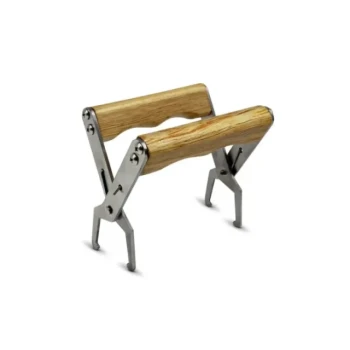
Industrial-grade standard hive frames serve as the essential quantitative benchmark for monitoring queen bee reproductive health and colony stability. These frames transform the complex, three-dimensional activity of a hive into a structured, two-dimensional planar surface, allowing technicians to observe egg-laying patterns with precision. By providing a uniform physical grid, they enable the tracking of drone cell utilization and brood distribution, which are critical indicators of physiological shifts and potential colony migration.
Standardized hive frames are not merely structural components; they are precision diagnostic tools that allow for the measurable evaluation of queen productivity and colony health, enabling proactive management through early warning signals.
Transforming Biological Activity into Actionable Data
The Planar Surface Advantage
Industrial-grade frames constrain the movement of the queen and the colony into a two-dimensional visual plane. This physical limitation is critical for high-resolution camera systems to record continuous movement trajectories between brood and storage areas.
By eliminating the visual interference of complex 3D spaces, these frames serve as the foundation for digital behavioral data collection. This allows for the systematic tracking of how a queen utilizes available space over time.
Spatial Benchmarking for Population Estimates
Standardized frames provide a reliable physical metric for estimating adult bee counts. Technicians typically use a ratio of 3,000 adult bees per standard frame to assess colony strength.
This quantitative approach allows distributors and professional beekeepers to evaluate how different feeding or management strategies influence colony development before winter. It turns biological growth into a measurable business metric.
Early Warning Systems for Colony Management
Monitoring Physiological Shifts via Drone Cells
Technicians monitor the edges, tops, and bottoms of standard frames to observe the utilization of drone cells. A shift from worker eggs to drone eggs often signals a physiological change within the colony.
Because these frames provide a structured environment, any deviation in egg-laying location becomes immediately apparent. This serves as a vital visual monitoring platform for professional apiary managers.
Predicting Migration and Swarming
The pattern of egg deposition on standard frames acts as an early warning system for colony migration. If a queen ceases her typical concentric laying pattern, it may indicate she is preparing to swarm.
Identifying these shifts early allows for rapid intervention. For B2B resellers, providing frames that facilitate this level of inspection is key to offering high-value professional equipment.
Quantitative Metrics for Commercial Productivity
Evaluating Egg-Laying Continuity
Professional inspection tools used alongside standard frames allow for the evaluation of brood circles. A healthy queen maintains a concentric distribution with consistent developmental stages among her offspring.
By providing an orderly inspection path, standard frames ensure that egg-laying continuity and space utilization are treated as indicators of hive productivity. This level of detail is essential for large-scale commercial operations.
Measuring Reproductive Volume with Precision
Specialized measuring grid frames, often featuring 5x5 centimeter cells, are applied to standard frames to count sealed brood accurately. This allows for the calculation of the queen's total egg-laying volume over a specific cycle.
This standardized method enables the comparison of queen reproductive capacity across different environmental conditions. It provides the empirical data necessary for selecting superior breeding stock.
Understanding the Trade-offs
Physical Limitations and Maintenance
While standard frames provide a necessary grid, they are subject to wear and tear that can distort measurements. Propolis buildup or warping can alter the "bee space," leading to irregular comb building that obscures observation.
Wood vs. Synthetic Materials
Industrial-grade frames must be manufactured to exact tolerances to remain effective as diagnostic tools. While wooden frames are traditional, synthetic or plastic-molded frames often offer higher dimensional stability, which is crucial for long-term data consistency in automated monitoring systems.
Sourcing Strategies for Professional Distribution
How to Apply This to Your Portfolio
When selecting hive components for your inventory, it is essential to view frames as precision instruments rather than simple commodities. Your sourcing strategy should emphasize compatibility and technical reliability.
- If your primary focus is operational efficiency: Prioritize sourcing frames with ultra-precise dimensions that minimize "burr comb" to ensure rapid, unobstructed inspections for your clients.
- If your primary focus is data-driven beekeeping: Select industrial-grade frames that are compatible with electronic scales and camera-ready observation hives to support the growing demand for digital apiary management.
As a leading partner in the supply chain, our expertise ensures that your inventory meets the rigorous technical standards required for modern, data-driven colony management.
Summary Table:
| Key Function | Monitoring Detail | Commercial Management Benefit |
|---|---|---|
| Planar Surface | 2D visual mapping | Enables precise digital behavioral data collection |
| Spatial Benchmark | 3,000 bees per frame | Accurate population estimation and colony strength metrics |
| Early Warning | Drone cell utilization | Detects physiological shifts and swarming risks early |
| Quantitative Grid | 5x5 cm cell counting | Empirical data for selecting superior breeding stock |
Scale Your Distribution with HONESTBEE’s Professional Equipment
Partner with HONESTBEE to elevate your B2B offerings with precision-engineered beekeeping solutions. As a premier one-stop sourcing partner, we provide distributors and wholesalers with a comprehensive full-spectrum portfolio—ranging from industrial-grade hive frames and hive-making machinery to honey-filling systems and essential industry consumables.
The HONESTBEE Advantage for Distributors:
- Deep Industry Expertise: Diagnostic-grade tools designed for data-driven, modern apiary management.
- Operational Efficiency: Ultra-fast delivery and efficient order fulfillment to keep your supply chain moving.
- Premium Trading Services: Dedicated customer service with OEM/ODM support to maximize your competitive edge and profit margins.
Ensure your inventory meets the rigorous technical standards required by professional apiaries. Contact our expert team today to explore our wholesale offerings!
References
- Juraeva Dildora Rustamovna. THE INFLUENCE OF MIGRATION OF THE MALE LINE OF BEES IN THE BEE FAMILY. DOI: 10.5281/zenodo.7824191
This article is also based on technical information from HonestBee Knowledge Base .
Related Products
- Wooden Bee Hive Frames for Beekeeping and Wholesale
- Professional Galvanized Steel Frame Rest for Beehives
- Plastic Bee Frame Beekeeping Hive Frames for Wholesale
- Heavy-Duty Stainless Steel Clip-On Frame Perch
- HONESTBEE Wired and Assembled Wooden Bee Frames Foundation for a Thriving Hive
People Also Ask
- How do wooden and plastic hive frames compare in terms of durability? Wood vs. Plastic Longevity & Repairability
- How does balancing the number of frames impact hive productivity? Optimize Your Apiary's Biological Output
- What are the main considerations when choosing between wooden and plastic bee hive frames? Optimize Your Apiary's Efficiency
- How should beehive frames be maintained to prolong their lifespan? 5 Pro Tips for Durable Beekeeping Equipment
- What are frames and combs used for in beekeeping? The Foundation of Modern Hive Management