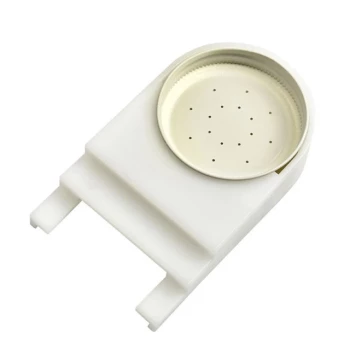
The ideal vertical spacing between the hive-top feeder floor and the hive's top bars is approximately 5/16 inch (8 mm). This specific dimension is not arbitrary; it corresponds to the natural "bee space" required for a colony to function efficiently. Maintaining this precise gap ensures that bees have unhindered access to their food source without triggering their instinct to modify the hive structure.
Precision is vital in hive management: a 5/16 inch gap strikes the perfect balance for bee traffic. Adhering to this standard prevents the maintenance headache of unwanted wax build-up while ensuring your colony can actually reach the syrup.
The Principles of Bee Space
Why 8 Millimeters is Critical
The distance of 5/16 inch (8 mm) acts as a biological "highway" for the hive. It is large enough to allow a single bee to travel comfortably between the frames and the feeder floor above. This specific clearance facilitates the smooth flow of traffic needed for the colony to collect and store syrup rapidly.
The Problem with Excessive Gaps
If the space between the feeder and the top bars exceeds this 5/16 inch recommendation, the bees will perceive the void as a structural flaw.
To correct this, they will construct unwanted "burr comb" or "brace comb" in the gap. This not only wastes the bees' energy but also fuses the feeder to the frames, making removal difficult and messy.
The Problem with Insufficient Gaps
Conversely, if the gap is significantly smaller than 5/16 inch, the bees physically cannot pass through.
When a space is too small for a bee to traverse, they view it as a crack to be sealed. They will likely close the gap with propolis (bee glue), effectively blocking off access to the feeder entirely.
Common Pitfalls to Avoid
Ignoring Tolerance Levels
The margin for error in hive construction is surprisingly small. A variation of just a few millimeters can shift the functionality of the feeder from "accessible" to "blocked" or "cluttered."
Misunderstanding the Goal
New beekeepers often assume a larger space allows more bees to feed simultaneously. However, this ignores the bees' instinct to fill voids. The goal is not to create a large open chamber, but a precise transit corridor.
Applying This to Your Apiary
Whether you are constructing your own equipment or troubleshooting a commercial feeder, verify the measurements carefully.
- If your primary focus is construction: Ensure your rim depth creates exactly a 5/16 inch (8 mm) gap to align with natural bee behavior.
- If your primary focus is troubleshooting: Inspect the area under the feeder for burr comb, which indicates your spacing is too wide.
Respecting the "bee space" is the most effective way to ensure smooth feeder operation and minimize hive disturbance.
Summary Table:
| Spacing Measurement | Effect on Bee Behavior | Resulting Hive Condition |
|---|---|---|
| Under 5/16" (8mm) | Bees cannot pass through; gap is seen as a crack | Sealed with propolis; feeder access blocked |
| Exactly 5/16" (8mm) | Natural 'bee space' for comfortable travel | Smooth traffic flow; no structural modifications |
| Over 5/16" (8mm) | Bees perceive the void as a structural flaw | Construction of burr/brace comb; feeder becomes stuck |
Elevate Your Apiary's Productivity with HONESTBEE
Precision is the difference between a thriving colony and a maintenance nightmare. At HONESTBEE, we specialize in providing commercial apiaries and distributors with high-precision beekeeping tools and machinery designed to respect natural bee biology.
Whether you need specialized hive-making machinery to ensure perfect tolerances or industrial honey-filling equipment for your harvest, our comprehensive wholesale portfolio has you covered. From essential consumables to honey-themed cultural merchandise, we deliver the quality your business deserves.
Ready to scale your operations with professional-grade equipment? Contact us today to discuss our wholesale offerings and how we can support your growth.
Related Products
- HONESTBEE Square Top Hive Bee Feeder Top Bee Feeder
- HONESTBEE Professional Hive Top Bee Feeder Feeding Solution
- Rapid Bee Feeder White Plastic 2L Round Top Feeder for 8 or 10-Frame Bee Hives
- Professional Hive Top Bee Feeder for Beekeeping
- HONESTBEE Round Hive Top Bee Feeder for Syrup
People Also Ask
- How does a bee hive top feeder work? A Guide to Efficient, Protected Feeding
- How to use a top feeder in a beehive? A Guide to Effective Beehive Feeding
- What is the structural design and placement of a beehive top feeder? Optimize Your Apiary's Feeding Efficiency
- What is a top feeder and how is it designed? Maximize Hive Feeding Efficiency
- How do you use a top feeder for bees? Expert Guide to Installation and High-Volume Hive Feeding