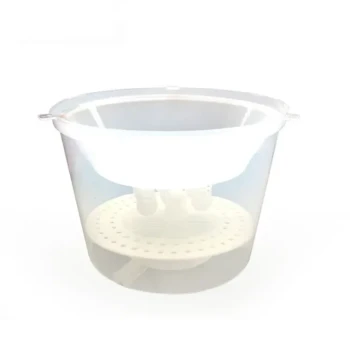
The mechanical purpose of the upward-facing wire mesh cone is to act as a directional isolation valve. By exploiting the Oriental Hornet's natural instinct to fly or climb upward, the cone guides the insect into a secure upper chamber while mechanically obscuring the return path to prevent escape.
The cone design leverages "insect ethology"—specifically the biological drive to move upward after feeding—to ensure high retention rates by turning a small entry point into an impossible-to-find exit.
The Mechanics of Directional Flow
Exploiting Natural Movement
The effectiveness of the cone is rooted in insect ethology (behavior). After entering the trap to locate food, the Oriental Hornet instinctively attempts to leave by flying or climbing upwards.
The conical shape aligns with this natural trajectory. It acts as a funnel, seamlessly guiding the hornet from the lower bait area toward the trap's upper section.
The Physical Isolation Mechanism
Once the hornet passes through the cone, it enters a larger upper cage. This creates a physical separation between the trapping zone and the environment.
The geometry of the cone is critical here. While the wide end invites the hornet in, the narrow end leads them into containment.
Preventing Escape
The trap relies on a small bottom opening (relative to the upper cage) to secure the catch.
Because the hornet seeks to move upward and outward, it struggles to locate the small aperture below it. This mechanical design prevents the hornet from finding an exit, ensuring it remains isolated in the upper cage.
Understanding the Trade-offs
The Reliance on Ethology
This mechanism is entirely dependent on the specific behavior of the Oriental Hornet.
If the insect did not have a biological imperative to climb upwards, the cone would be ineffective. The trap is not an active mechanical device (like a spring trap) but a passive one that requires the insect to "cooperate" based on its instincts.
Necessity of Precision
The design ensures high retention rates, which is vital for performance.
However, this implies that the size of the bottom opening is a critical constraint. If it were too large, the "physical isolation" would fail; if too small, the hornet might not enter the upper cage at all.
Making the Right Choice for Your Goal
The cone mechanism serves two distinct purposes depending on your objective:
- If your primary focus is Pest Control: The cone ensures high retention, preventing captured hornets from returning to the colony to signal danger or continue foraging.
- If your primary focus is Research: The high retention rate guarantees the accuracy of population statistical data, ensuring your sample size reflects the actual number of entrants.
Effective trapping requires aligning mechanical design with biological reality.
Summary Table:
| Feature | Mechanical Function | Benefit |
|---|---|---|
| Conical Geometry | Directional funneling based on upward flight instincts | Guides hornets into the secure upper chamber |
| Narrow Aperture | Minimizes the visual and physical return path | Prevents trapped hornets from finding an exit |
| Physical Isolation | Separates the bait area from the containment cage | Ensures high retention for pest control or research |
| Passive Design | Relies on biological behavior rather than moving parts | Low maintenance with consistent capture results |
Optimize Your Apiary with Professional Pest Control Solutions
Protecting your colony from Oriental Hornets requires precision engineering and reliable equipment. HONESTBEE specializes in supporting commercial apiaries and distributors with a comprehensive wholesale range of beekeeping tools and machinery. From high-retention traps to specialized honey-filling machines and hive-making hardware, we provide the essential supplies needed to scale your operations and safeguard your honey production.
Partner with HONESTBEE today to secure your apiary's future.
Contact our expert team for wholesale pricing and equipment solutions
References
- H. Mahfouz, M. A. Abd Al-Fattah. CLIMATIC CHANGES EXPOSE HONEYBEE COLONIES TO ERADICATION DUE TO INCREASING FEROCITY OF ATTACKING PREDATOR, ORIENTAL HORNET VESPA ORIENTALIS L, IN NORTH SINAI REGION. DOI: 10.21608/mjapam.2022.228663
This article is also based on technical information from HonestBee Knowledge Base .
Related Products
- Compact Multi-Funnel Hanging Wasp Trap
- Reusable Aluminium Beetle Trap for Small Hive Beetles Silver Bullet
- Professional Bucket Style Wasp and Moth Pheromone Trap
- Reusable Clear Small Hive Beetle Traps for Beehives Beetle Trapping Tools
- Gourd Shaped Hanging Wasp Trap Professional Wasp Catcher
People Also Ask
- What are the practical advantages of using professional wasp traps and protective equipment in apiary management? Scale Up
- Why replace sugar syrup bait in wasp traps every three days? Ensure Maximum Attraction and Catch Rates
- What is the importance of deploying hornet traps around an apiary for maintaining colony stability? Protect Your Yields.
- What are the advantages of placing hornet traps on the tops of beehives? Maximize Hive Defense Against Predators
- What trapping methods and equipment setups protect commercial apiaries against seasonal hornet predation?