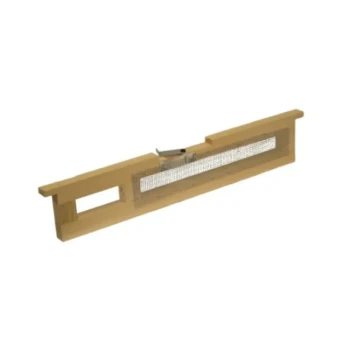
Modern Wooden Beehives function as the primary fixed asset in commercial beekeeping, acting as the foundational hardware that determines production capacity. Beyond simply housing colonies, these hives create a controlled environment that enables the standardization required for industrial-scale operations, directly linking capital investment to output volume.
Core Takeaway The economic power of Modern Wooden Beehives lies in their ability to generate economies of scale. By standardizing the production unit, these hives allow producers to increase total honey output while significantly reducing the average production cost per ton, transforming beekeeping from a variable craft into a predictable industrial process.
The Operational Function: Standardization and Control
The Movable Frame Architecture
The defining technical feature of the modern hive is the movable frame design. Unlike traditional methods, this allows for the extraction of honey without destroying the honeycomb structure.
Because the comb is preserved, bees do not need to expend energy and resources rebuilding wax structures after every harvest. This non-destructive cycle significantly shortens the turnaround time between harvests, directly boosting yield.
Standardization of Infrastructure
Modern Wooden Beehives are engineered for interchangeability. Frames and boxes are standardized, meaning components can be swapped between hives without modification.
This uniformity simplifies daily inspections, pest monitoring, and colony expansion. It also ensures hardware compatibility with industrial extraction and filtration equipment, which is essential for automating the honey processing workflow.
Optimized Colony Management
The structure of these hives provides a controlled growth environment that protects the colony from harsh weather while facilitating scientific management.
Data indicates that this optimized environment has a massive impact on yield. A Modern Beehive can produce up to 22 kilograms of honey annually, compared to just 9 kilograms from a traditional hive.
The Economic Impact: Scaling Production
Hives as Fixed Asset Investments
In large-scale production, the beehive is treated as a fixed asset. There is a direct, linear correlation between the number of wooden hives invested in and the potential production scale.
Expanding the inventory of hives is the primary lever for increasing total honey output. This turns the hive into a scalable unit of production rather than just a habitat.
Reducing Unit Production Costs
The most critical economic impact is the reduction of operational costs through economies of scale. As the investment in wooden hives increases, the average production cost per ton of honey decreases.
Standardization reduces labor intensity by streamlining inspections and enabling mobile beekeeping operations. This efficiency allows fewer personnel to manage a larger number of hives, lowering the overhead cost per unit of honey produced.
Understanding the Trade-offs
Capital Intensity vs. Operational Ease
While modern hives lower long-term operational costs, they require a significant upfront capital expenditure. Unlike traditional setups using locally scavenged materials, these are manufactured assets that require financial planning and depreciation management.
Maintenance and Durability
Wood is organic and susceptible to environmental degradation. To protect this fixed asset, operators must account for ongoing maintenance costs, such as painting and repairing rot, to ensure the longevity of the investment.
Biosecurity Risks
The interchangeability of frames, while efficient for logistics, introduces a risk of cross-contamination. If not managed with strict hygiene protocols, diseases and pests can spread rapidly across an apiary through the very equipment designed to improve efficiency.
Making the Right Choice for Your Goal
When integrating Modern Wooden Beehives into your operation, align your strategy with your specific production targets:
- If your primary focus is Rapid Scaling: Prioritize high volumes of strictly standardized hives to maximize hardware compatibility and reduce the labor hours required per hive.
- If your primary focus is Cost Efficiency: Focus on the "cost per ton" metric; increase your hive count to the point where your fixed overhead is spread most efficiently across your output.
- If your primary focus is High Yield: Leverage the movable frame design to implement high-frequency, non-destructive harvesting cycles, aiming for the 22kg/hive benchmark.
Ultimately, the Modern Wooden Beehive is not just a shelter for bees; it is the essential industrial tool that converts biological activity into a scalable, profitable commercial enterprise.
Summary Table:
| Feature | Modern Wooden Beehive | Traditional Beehive | Economic Impact |
|---|---|---|---|
| Design Type | Movable frame architecture | Fixed structure | Enables non-destructive harvesting |
| Standardization | High (Interchangeable parts) | Low (Unique/Natural) | Simplifies scaling and automation |
| Annual Yield | ~22 kg per hive | ~9 kg per hive | +144% increase in production |
| Labor Efficiency | High (Streamlined inspections) | Low (Manual/Irregular) | Reduces unit production cost |
| Primary Role | Industrial production tool | Habitat/Craft tool | Transforms beekeeping into a scalable asset |
Scale Your Apiary with HONESTBEE Industrial Solutions
At HONESTBEE, we specialize in empowering commercial apiaries and distributors with the high-performance hardware needed to dominate the honey market. Our comprehensive wholesale portfolio includes everything from precision-engineered modern wooden beehives and specialized hive-making machinery to advanced honey-filling systems and cultural merchandise.
Whether you are looking to reduce your cost per ton or rapidly expand your production capacity, our equipment is designed for the standardization and durability that industrial-scale beekeeping demands. Contact us today to discuss how our bulk supply solutions and technical machinery can optimize your operations and maximize your ROI.
References
- Eman T. Alropy, Mohamad Alnafissa. Economics of technical efficiency in white honey production: Using stochastic frontier production function. DOI: 10.1016/j.sjbs.2019.09.029
This article is also based on technical information from HonestBee Knowledge Base .
Related Products
- Wooden Bee Hive Frames for Beekeeping and Wholesale
- Wholesales Dadant Size Wooden Bee Hives for Beekeeping
- Assembled Wooden Bee Frames with Plastic Foundation for Durability and Convenience by HONESTBEE
- HONESTBEE Wired and Assembled Wooden Bee Frames Foundation for a Thriving Hive
- Professional Wooden Requeening Frame for Beekeeping
People Also Ask
- How does balancing the number of frames impact hive productivity? Optimize Your Apiary's Biological Output
- How do wooden and plastic hive frames compare in terms of durability? Wood vs. Plastic Longevity & Repairability
- What are the main considerations when choosing between wooden and plastic bee hive frames? Optimize Your Apiary's Efficiency
- How should beehive frames be maintained to prolong their lifespan? 5 Pro Tips for Durable Beekeeping Equipment
- What are frames and combs used for in beekeeping? The Foundation of Modern Hive Management