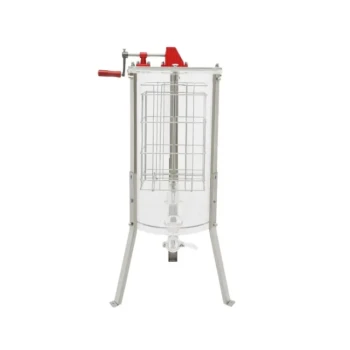
The primary function of a mechanical honey press is to maximize extraction yield by applying significant physical force to honeycombs that would otherwise retain valuable product. By utilizing a screw-driven pressure plate within a loading chamber, the device compresses the honeycomb matrix, forcing the viscous honey through a filter or overflow outlet while retaining the solid wax and impurities.
Core Insight Unlike centrifugal extractors that spin honey out to save the comb, a mechanical press prioritizes total harvest volume. It relies on direct, uniform compression to separate honey from wax, making it the superior choice for processing wax cappings or extracting thixotropic (gel-like) honeys where gravity drainage is inefficient.
The Mechanics of Extraction
The Screw-Driven Pressure System
The core operating principle rests on a mechanical screw or jack system. This mechanism drives a pressure plate downward into a confined loading chamber.
By converting rotational motion into linear force, the press generates high, uniform pressure that manual squeezing cannot replicate.
Separation via Compression
As the pressure plate descends, it physically crushes the honeycomb structure. This action breaks the wax caps and compresses the internal cells.
The pressure forces the liquid honey out of the wax matrix. The honey then flows through a designated overflow outlet or strainer, leaving behind a compressed "cake" of beeswax and solid impurities.
Advantages Over Manual and Gravity Methods
Increased Recovery Rate
Traditional gravity drainage leaves a significant amount of honey clinging to the wax.
The mechanical press solves this by applying force sufficient to overcome the honey's viscosity and surface tension. This results in a significantly higher yield per frame of honeycomb.
Enhanced Hygiene Standards
Manual squeezing introduces the risk of human contact and biological contamination.
Mechanical presses utilize a closed or semi-closed system that minimizes direct handling. This reduction in secondary contamination helps ensure the final product meets higher hygiene and quality standards.
Understanding the Trade-offs
Comb Destruction
The most critical distinction to make is that a honey press destroys the honeycomb.
Unlike centrifugal extractors, which use high-speed rotation to empty cells while leaving the wax structure intact for reuse by the bees, a press crushes the comb into a block of wax.
Application Specificity
Because of the destructive nature of the process, presses are rarely used for standard liquid honey extraction if the beekeeper intends to return drawn combs to the hive.
They are, however, the industry standard for processing "cappings" (the wax lids sliced off before centrifuging) or for specific honey varieties that are too thick to spin out.
Making the Right Choice for Your Operation
To determine if a mechanical press fits your workflow, consider your specific production goals:
- If your primary focus is maximizing total honey yield: The press is essential for recovering honey from wax cappings or damaged combs that cannot be spun.
- If your primary focus is comb preservation: Avoid using a press for your main extraction; utilize a centrifugal extractor to allow bees to reuse the comb structure.
- If your primary focus is hygiene and scalability: Transitioning from manual squeezing to a mechanical press will standardize your output and significantly reduce labor costs.
Ultimately, the mechanical press is a tool of efficiency, trading the structural integrity of the comb for the maximum possible extraction of honey.
Summary Table:
| Feature | Mechanical Honey Press | Centrifugal Extractor |
|---|---|---|
| Core Function | Physical compression & crushing | Centrifugal force (spinning) |
| Extraction Yield | Maximum (extracts almost all honey) | Moderate (leaves some residue) |
| Comb Condition | Destroyed (crushed into wax cake) | Preserved (reusable by bees) |
| Best Used For | Wax cappings, thixotropic honey | Standard liquid honey frames |
| Hygiene Level | High (minimal manual contact) | High (automated process) |
Maximize Your Harvest with HONESTBEE Professional Solutions
At HONESTBEE, we understand that for commercial apiaries and honey distributors, every drop of honey counts. Whether you are processing difficult thixotropic varieties or looking to reclaim high-value honey from wax cappings, our industrial-grade mechanical honey presses and extraction machinery are engineered for maximum recovery and hygiene.
Why partner with HONESTBEE?
- Comprehensive Wholesale Catalog: From hive-making and honey-filling machines to a full spectrum of beekeeping tools.
- Industry-Leading Equipment: Durable, high-pressure systems designed to reduce labor costs and standardize output.
- Global Distribution Support: We supply the essential consumables and hardware needed to scale your beekeeping operation.
Ready to upgrade your extraction facility or stock your distribution center with premium beekeeping technology? Contact us today to receive a customized quote and see how our expertise can drive your business growth.
References
- A. Adekunle, Oluwatosin Emmanuel Obembe. PARTICIPATORY ASSESSMENT OF HONEY EXTRACTION METHODS IN THE SAVANNA BELT OF NIGERIA. DOI: 10.1081/fri-120014689
This article is also based on technical information from HonestBee Knowledge Base .
Related Products
- Stainless Steel Manual Honey Press with Guard for Pressing Honey and Wax
- Easy Use Manual Stainless Steel Honey Press for Honey Comb
- Electric Honey Press Machine for Squeezing Honey Comb Press Equipment
- 10L Stainless Steel Electric Honey Press Machine
- Honey Wax Separating Wax Press with Metal Screw Wax Separator Machine
People Also Ask
- What other functions can a honey press serve besides honey extraction? Discover Versatile Multi-Purpose Uses
- How does the honey press preserve the quality of honey during extraction? Maintain Pure Enzymes and Flavor
- What materials are used to construct the honey press? Choose Durable, Food-Grade Solutions for Your Apiary
- What are the fundamental differences between manual honey presses and centrifugal honey extractors? A Guide for Pros
- What are some general features of a honey press? Maximize Your Yield with Durable Extraction Tools