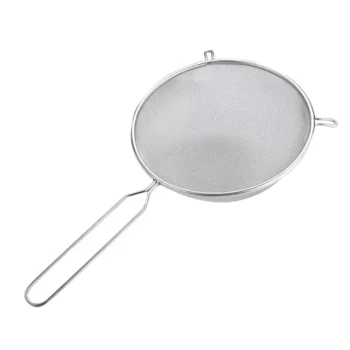
The primary function of metal sieves in late-stage honey production is to serve as a precise mechanical filtration medium. Positioned after the initial extraction phase, these sieves are responsible for the physical separation of pure liquid honey from residual solids, such as beeswax fragments, bee parts, and other organic impurities.
By effectively removing organic debris, metal sieves do more than clean the honey; they transform a raw extraction into a stable, commercial-grade product that meets food safety standards and consumer expectations for clarity.
The Mechanics of Purification
Post-Extraction Refining
Once honey is extracted from the comb, it contains a significant amount of "non-honey" material.
The refining stage utilizes metal sieves to process this raw mixture. This is not a chemical alteration but a purely physical separation designed to isolate the liquid product.
Removal of Organic Impurities
The core task of the sieve is debris retention.
During extraction, pieces of wax cappings and minor insect parts inevitably mix with the honey. The metal sieve acts as a rigid barrier, allowing the viscous liquid to pass through while trapping these solid contaminants.
Impact on Product Quality and Safety
Enhancing Visual Clarity
Consumer perception of honey quality is heavily influenced by appearance.
Filtration through metal sieves eliminates the particulate matter that causes cloudiness or sedimentation. This results in the clean, translucent aesthetic associated with high-quality honey.
Extending Shelf Life
Impurities are not just an aesthetic issue; they are a stability issue.
Organic debris left in the honey can act as nucleation points, accelerating crystallization, or introduce moisture and yeast that may lead to fermentation. Removing these elements is essential for maintaining the product's longevity.
Ensuring Food Safety Compliance
Beyond quality, filtration is a regulatory necessity.
Metal sieves ensure the final product is free of foreign objects. This rigorous separation allows producers to meet strict food safety compliance standards required for retail distribution.
Operational Considerations and Trade-offs
Balancing Flow Rate and Purity
While metal sieves are effective, they present a bottleneck in the production line.
A finer mesh provides superior clarity but significantly slows down the flow of viscous honey. Producers must select a mesh size that balances the need for purity with the practical requirements of production speed.
Maintenance and Clogging
Because sieves work by trapping solids, they are prone to obstruction.
Accumulated beeswax can quickly block the mesh, halting production. Regular cleaning intervals are mandatory to maintain efficiency, requiring a process that accommodates downtime or redundant systems.
Making the Right Choice for Your Goal
To optimize your filtration process, consider which aspect of the final product is most critical to your operation:
- If your primary focus is Visual Appeal: Prioritize a finer mesh sieve to ensure maximum removal of micro-particulates, guaranteeing the high clarity required for premium retail jars.
- If your primary focus is Production Volume: Utilize a multi-stage system or slightly coarser mesh to maintain high flow rates while still achieving baseline separation of wax and debris.
Effective filtration is the bridge between raw harvest and a safe, marketable product.
Summary Table:
| Feature | Function in Filtration | Key Benefit |
|---|---|---|
| Debris Retention | Removes wax fragments, bee parts, and organic solids | Ensures a clean, pure liquid product |
| Visual Clarity | Eliminates particulate matter causing cloudiness | Enhances consumer appeal for retail |
| Stability Control | Removes nucleation points for crystals | Delays crystallization and prevents fermentation |
| Safety Compliance | Acts as a physical barrier against foreign objects | Meets rigorous food safety and retail standards |
Elevate Your Honey Quality with HONESTBEE Solutions
At HONESTBEE, we understand that professional filtration is the bridge between a raw harvest and a premium, marketable product. As a dedicated partner to commercial apiaries and distributors, we provide more than just sieves—we offer a full spectrum of beekeeping tools, honey-filling machines, and industrial consumables designed to scale your operation.
Whether you need precision filtration hardware or comprehensive hive-making machinery, our wholesale offerings are tailored to enhance your efficiency and product shelf life. Contact us today to discover how our specialized equipment can refine your production process and help you deliver honey that meets the highest global standards.
References
- Telly Yarita Macías Zambrano, Yesenia Dioselina Macías Zambrano. Honey, pollen and propolis in therapeutic treatments for COVID-19. DOI: 10.53730/ijhs.v6n1.3766
This article is also based on technical information from HonestBee Knowledge Base .
Related Products
- Stainless Steel Double Layer Honey Strainer Sieve Filters
- Stainless Steel Triangle Support Honey Strainer and Filters
- Professional Stainless Steel Honey Filter with Support Handle
- Metal Hive Feet Bee Hive Stand for Ant Protection
- Professional Cone-Shaped Honey Filter with Reinforced Steel Ring
People Also Ask
- What are some typical mesh size combinations found in double sieve honey strainers? Expert Guide to Honey Filtration
- How is a double-layer honey filter used for monitoring Varroa mite infestation? Achieve Precise Pest Control Data
- How do double-layer honey filters and white blotting paper function together in Varroa mite detection? Expert Guide
- What is the function of honey sieves, strainers, and filters in processing? Master the 3 Stages of Honey Purity
- What mesh sizes are commonly used in double sieve honey strainers? Achieve Clean, Raw Honey Efficiently