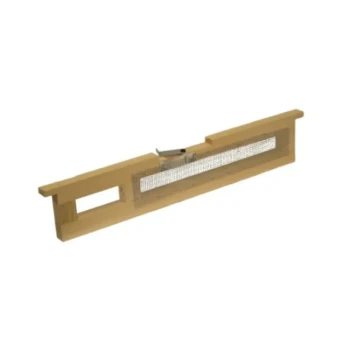
Modern wooden beehives function as the standardized infrastructure for commercial apiculture, acting as both a protective habitat and a modular production unit. They provide a stable, controlled environment for maintaining colony health while utilizing a structured design that allows for precise scalability and high-efficiency management.
The primary role of the modern wooden hive is to convert beekeeping from a variable craft into a scalable industry. By providing a uniform, modular environment, these hives stabilize annual honey production and serve as the essential hardware for automated logistics and extraction.
The Foundation of Commercial Efficiency
Creating a Controlled Habitat
The most fundamental role of the wooden hive is to act as a central habitat that buffers the colony against external variables. The structure maintains stable internal temperature and humidity levels, which are critical for brood rearing and honey curing.
Protection from External Threats
Beyond climate control, these hives serve as a fortress. They protect the colony from extreme weather events and predation. This physical security prevents colony loss and "absconding" (where bees abandon the hive), ensuring the biological asset remains intact for the production season.
Modular Scalability
The internal design of modern hives relies on removable frames. This allows beekeepers to adjust the scale of the colony dynamically. Frames can be added to accommodate a honey flow or removed to condense the colony for winter, providing the material basis for managing population density and resource storage.
The Role of Standardization in Scaling
Enabling Automation and Mechanics
For large-scale operations, uniformity is the key to profitability. Mechanically manufactured wooden hives feature uniform dimensions and superior sealing compared to manual construction. This standardization is mandatory for the use of automated honey extraction machinery, which relies on precise frame sizes to function without damaging the equipment or the comb.
Facilitating Migratory Beekeeping
Commercial beekeeping often requires moving thousands of hives to different crops. Standardized wooden hives are designed for stackability and transport efficiency. Their durability and consistent shape allow them to be palletized and shipped, significantly reducing labor costs and improving operational logistics.
Data-Driven Management
Uniform hives transform dispersed apiaries into quantifiable data points. Because every unit is identical, beekeepers can accurately compare productivity and colony size across different locations. This consistency is essential for integrating smart monitoring systems (sensors for real-time temp/humidity) and ecological modeling to predict yields.
Understanding the Trade-offs
Maintenance of the Physical Structure
While modern manufacturing improves durability, wooden hives are organic material. They require ongoing maintenance to ensure the sealing and thermal insulation properties remain effective. A compromised structure can lead to fluctuations in internal climate, stressing the bees and reducing productivity.
The Risk of Monoculture Context
Standardized hives are highly efficient tools, but they do not isolate bees from the surrounding landscape. Data indicates that despite the controlled hive environment, placing these units in regions dominated by monoculture (like soybean fields) can still result in significant yield drops (up to 60%). The hive is a tool for management, not a cure-all for poor forage.
Making the Right Choice for Your Goal
To leverage modern wooden beehives effectively, consider your specific operational focus:
- If your primary focus is Production Efficiency: Prioritize hives with strict dimensional standardization to ensure compatibility with automated extraction lines and migratory transport logistics.
- If your primary focus is Colony Health Stability: Focus on the hive's insulation and sealing quality to minimize thermal stress and integrate sensor technology for real-time health monitoring.
- If your primary focus is Scalability: Utilize the modular frame system to aggressively manage space, expanding rapidly during flows and condensing quickly for overwintering to preserve resources.
Modern wooden beehives are the critical interface between biological requirements and industrial demands, providing the consistency required to manage nature at scale.
Summary Table:
| Feature | Primary Role in Commercial Beekeeping | Impact on Operations |
|---|---|---|
| Standardized Dimensions | Enables automation and machinery compatibility | Reduces labor and increases extraction speed |
| Modular Design | Allows for precise population and resource scaling | Maximizes yield during peak honey flows |
| Thermal Insulation | Maintains stable internal colony environment | Improves brood health and honey curing |
| Stackable Structure | Facilitates palletization and migratory transport | Lowers logistics costs for large-scale moves |
| Uniform Sealing | Protects colonies from pests and weather extremes | Prevents colony loss and ensures asset security |
Elevate Your Apiary Operations with HONESTBEE
As a dedicated partner to commercial apiaries and global distributors, HONESTBEE provides the high-precision infrastructure necessary to scale your honey production. Our comprehensive wholesale catalog features industry-leading wooden beehives, automated honey-filling machines, and specialized hive-making equipment designed for maximum durability and standardization.
Whether you are upgrading your extraction line or expanding your migratory fleet, we supply the professional-grade tools and essential consumables your business needs to thrive. Unlock superior efficiency and volume—contact us today to discuss our wholesale solutions!
References
- Adil Koray Yıldız, Servet Arslan. Yozgat İli Arıcılık İşletmelerinin Teknik ve Sosyo-Ekonomik Durumunun İncelenmesi. DOI: 10.24925/turjaf.v10i5.846-852.4931
This article is also based on technical information from HonestBee Knowledge Base .
Related Products
- Wooden Bee Hive Frames for Beekeeping and Wholesale
- Wholesales Dadant Size Wooden Bee Hives for Beekeeping
- Assembled Wooden Bee Frames with Plastic Foundation for Durability and Convenience by HONESTBEE
- HONESTBEE Wired and Assembled Wooden Bee Frames Foundation for a Thriving Hive
- Professional Wooden Requeening Frame for Beekeeping
People Also Ask
- How does balancing the number of frames impact hive productivity? Optimize Your Apiary's Biological Output
- How do wooden and plastic hive frames compare in terms of durability? Wood vs. Plastic Longevity & Repairability
- What are the main considerations when choosing between wooden and plastic bee hive frames? Optimize Your Apiary's Efficiency
- How should beehive frames be maintained to prolong their lifespan? 5 Pro Tips for Durable Beekeeping Equipment
- Can I reuse old beehive frames? Save Money and Boost Hive Productivity