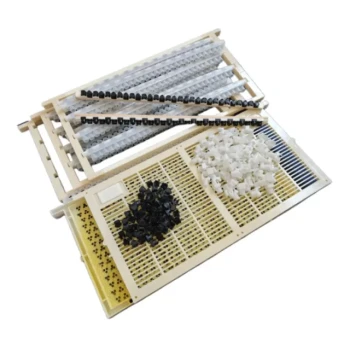
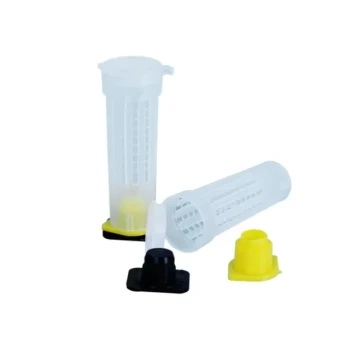
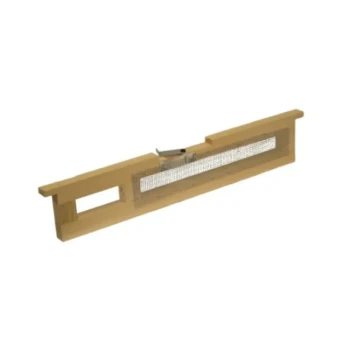
Grafting is the specialized manual technique of transferring a very young honey bee larva from a horizontal worker cell into a vertically oriented queen cup. By relocating the larva, you effectively alter its biological destiny, redirecting it from becoming a sterile worker to becoming a reproductive queen.
The success of grafting relies on a simple biological trigger: the vertical orientation of the cell cup. This positioning forces nurse bees to feed the larva an exclusive diet of royal jelly, which induces the epigenetic changes required for queen development.
The Biological Mechanism
Utilizing Vertical Orientation
In a natural hive, worker bees are raised in horizontal cells, while queens are raised in vertical cells.
By manually placing a larva into a vertically oriented cup, you simulate natural queen cells. This visual and physical cue signals the nurse bees to prioritize this larva.
The Role of Royal Jelly
Once the nurse bees accept the vertical cup, they flood it with royal jelly.
This super-nutritious diet is the key driver of caste differentiation. It triggers gene expression changes that develop reproductive organs and larger body size, traits absent in worker bees.
The Operational Procedure
Selecting the Candidate
You must identify and select extremely young larvae, ideally one-day-old or freshly hatched.
Larvae older than this have already begun the transition into worker bees. Grafting them too late results in "intercaste" queens with poor reproductive potential.
The Precision Transfer
Using a specialized grafting tool or needle, you gently scoop the larva out of the donor comb.
Great care must be taken to slide the tool under the larva to lift it along with a small amount of its original royal jelly.
Placement and Orientation
The larva is deposited into the artificial queen cup.
Crucially, you must not flip the larva over. It must remain in the same orientation it held in the worker cell; flipping it can cause the larva to drown in its own respiratory fluids.
Incubation and Development
Once grafted, the cups are placed into a "cell starter" or queenless hive where nurse bees draw out and cap the cells.
They are subsequently moved to a strong hive to maintain the critical warmth needed for metamorphosis. The total time from egg to hatched queen is approximately 16 days.
Understanding the Trade-offs
High Skill Requirement
Grafting is not a passive method; it requires excellent eyesight, steady hands, and significant practice.
A lack of dexterity can lead to low acceptance rates, wasting time and resources.
fragility of the Larva
The skin of a one-day-old larva is incredibly delicate.
Even invisible physical damage caused by the grafting needle can kill the larva or result in a queen of low biological quality.
Time Sensitivity
You are working against a strict biological clock.
If the larvae dry out during the transfer, or if you select larvae that are even slightly too old, the resulting queens will be inferior.
Making the Right Choice for Your Goal
To successfully rear queens using this method, align your approach with your specific objectives:
- If your primary focus is High Acceptance Rates: Ensure your grafting tool is non-invasive and prioritize speed to prevent larvae from dehydrating.
- If your primary focus is Queen Quality: Be ruthless in selecting only the youngest, smallest larvae to ensure they receive the maximum duration of royal jelly feeding.
Grafting allows you to take control of your apiary's genetics, but it demands a commitment to precision and a respect for the fragility of the developing bee.
Summary Table:
| Stage | Key Action | Target Larva Age | Critical Success Factor |
|---|---|---|---|
| Selection | Identify donor larvae | < 24 hours old | Choosing the smallest, freshly hatched larvae |
| Transfer | Lift with grafting tool | 1-day-old | Maintaining larval orientation (do not flip) |
| Placement | Insert into vertical cup | N/A | Simulating natural queen cell orientation |
| Incubation | Move to cell starter | Days 1-5 | Constant supply of nurse bees and royal jelly |
| Capping | Move to finisher hive | Days 5-16 | Maintaining precise temperature and humidity |
Scale Your Queen Rearing Operation with HONESTBEE
To achieve professional-grade results in queen rearing, you need more than just technique—you need precision-engineered equipment. HONESTBEE supports commercial apiaries and distributors with a comprehensive wholesale range of beekeeping tools, from high-accuracy grafting needles to advanced hive-making and honey-filling machinery.
Whether you are looking to enhance your apiary's genetics or stock your distribution business with premium industry consumables and cultural merchandise, we provide the hardware and expertise you need to succeed.
Ready to elevate your production? Contact us today to explore our wholesale catalog!
Related Products
- Stainless Steel Beekeeping Queen Grafting Tool for Honey Bee Rearing
- Plastic Beekeeping Honey Bee Larvae Grafting Tools for Queen Rearing and Chinese Grafting
- Plastic Chinese Queen Grafting Tool for Bee Queen Rearing
- Stainless Steel Queen Grafting Tool for Beekeeping and Bee Queen Grafting
- Black 2 Pack Beekeeper Queen Grafting Tool for Bee Queen Larva Transferring Needle
People Also Ask
- Why is it necessary for migratory beekeeping enterprises to utilize professional queen bee rearing tools? Boost Resilience
- What is the step-by-step process for using a queen grafting tool? Master Larva Transfer for Better Queen Rearing
- What is the primary function of a queen grafting tool? Master Precise Larval Transfer for High Queen Acceptance
- What specialized tools and frame configurations are needed for larval grafting during queen rearing, and how are queen cells properly spaced? Master the essentials for efficient queen production
- What are the benefits of using a queen grafting tool for queen rearing? Master Precision for Superior Bee Genetics