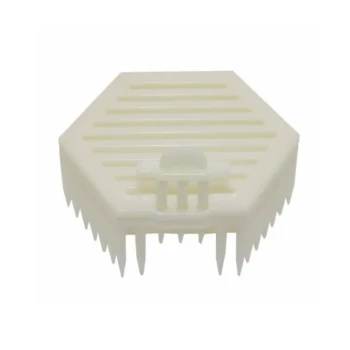
The half-ball netted cage serves as a mandatory safety barrier during queen introduction. Its primary function is to physically isolate the new queen from worker bees while allowing her pheromones to permeate the colony. This device prevents immediate rejection and aggressive attacks, ensuring the queen survives the critical initial period of establishing a new honeybee nucleus.
Introduction is the most dangerous moment for a new queen bee. The half-ball netted cage mitigates this risk by enforcing a safe, temporary "handshake" period where the colony acclimates to the new queen's scent without the ability to physically harm her.
The Mechanics of Safe Introduction
Preventing Aggressive "Balling"
When a new queen is introduced, worker bees often view her as a foreign intruder. Their natural defense is to surround and attack her in a tight cluster, a behavior known as "balling." The rigid structure of the half-ball cage acts as an impenetrable shield, making this physical aggression impossible while the queen remains inside.
Facilitating Pheromone Integration
Success depends on the colony recognizing the queen's unique scent signature. The netted design of the cage is crucial because it allows for free airflow. This facilitates the gradual release of queen pheromones throughout the hive, allowing the workers to "smell" and accept her authority before they can "touch" and reject her.
Operational Context
Stabilizing Honeybee Nuclei
The primary reference highlights this tool's importance specifically during the establishment of honeybee nuclei. A nucleus (or "nuc") is a small, developing colony that is often unstable. Using this cage ensures that the investment in a new queen is not lost during the volatile setup phase of these new units.
Promoting Rapid Acclimation
The cage is not a permanent home; it is a transition tool. By keeping the queen effectively "in" the hive but "out" of danger, it speeds up the timeline for acceptance. It allows the colony to settle and adapt to the new hierarchy faster than if the queen were introduced without protection.
Understanding the Trade-offs
Temporary Isolation vs. Long-Term Housing
It is critical to remember this is a temporary isolation device. Unlike larger mailing cages that might be used for transport, the half-ball cage is typically fixed onto the comb for a short duration. Leaving a queen confined for too long can hinder her egg-laying potential and the colony's growth.
The Requirement of Manual Intervention
Because the device is a physical barrier without an automated release mechanism (like the candy plugs found in some shipping cages), it generally requires the beekeeper to manage the timing of the release carefully. Misjudging this timing—releasing her before the pheromones have fully integrated—can still result in rejection.
Making the Right Choice for Your Goal
To determine if the half-ball netted cage is the right tool for your current operation, consider your specific objectives:
- If your primary focus is Colony Establishment: Prioritize this cage when setting up new nuclei to guarantee the new queen survives the initial chaos of colony formation.
- If your primary focus is Risk Mitigation: Use this device when introducing high-value queens, as it offers a higher degree of physical protection against balling than direct release methods.
By controlling the physical interaction while enabling chemical communication, you turn a high-risk introduction into a manageable, systematic process.
Summary Table:
| Feature | Function & Benefit |
|---|---|
| Physical Shield | Prevents worker bees from "balling" and attacking the new queen. |
| Netted Design | Facilitates free airflow for gradual queen pheromone distribution. |
| Nuclei Stability | Ensures high survival rates when establishing new honeybee units. |
| Controlled Integration | Allows beekeepers to manage the transition from isolation to acceptance. |
Scale Your Apiary Operations with HONESTBEE
Are you a commercial apiary or a beekeeping equipment distributor looking for reliable tools to minimize queen loss? HONESTBEE provides a comprehensive wholesale portfolio designed for professional success. From specialized half-ball netted cages and protective hardware to high-efficiency honey-filling machines and hive-making equipment, we supply everything you need to manage colonies at scale.
Partner with us to access professional-grade consumables and honey-themed cultural merchandise that adds value to your brand. Contact HONESTBEE today to discuss our wholesale offerings and let us help you build a more productive and resilient beekeeping business.
References
- Mahrous Mahrous, R. Sanad. EFFECT OF SOME FOOD ADDITIVE FORMULATIONS ON THE PERFORMANCE OF HONEYBEE, Apis mellifera L. COLONIES. DOI: 10.21608/zjar.2020.94488
This article is also based on technical information from HonestBee Knowledge Base .
Related Products
People Also Ask
- What is the technical purpose of using an introduction cage? Ensure Safe Queen Bee Integration and Colony Acceptance
- How does the introduction cage method differ from standard cage insertion for queen bees? Best Acceptance Strategies
- What is the mechanism of action for using temporary queen bee cages? Master Successful Queen Introduction
- Why are specialized queen bee cages used for the banking of mated queen bees? Maximize Commercial Apiary Storage Efficiency
- What is the importance of specialized queen introduction cages and tools? Secure High-Value Genetics & Scalability.