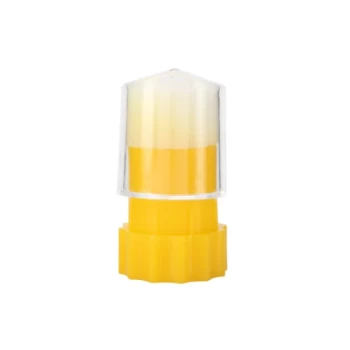
Queen marking tags and specialized pens serve as the primary mechanism for individual identification within a honey bee colony. By assigning a unique physical code to each newly emerged queen, breeders can link specific biological metrics to a single individual while drastically reducing the time required to locate her among thousands of workers.
The core value of marking tools lies in data integrity and management efficiency. In long-term breeding, a marked queen becomes a trackable data point, allowing for the correlation of birth weight, lifespan, and lineage with colony performance.
The Strategic Role of Identification
Enabling Precise Data Collection
In a breeding program, a queen is only as valuable as the data attached to her. Marking is the foundational step that allows breeders to record and track essential metrics. Without a unique identifier, it is impossible to accurately attribute data such as birth weight, insemination method, and the start date of egg-laying to a specific queen.
Streamlining Colony Management
Locating a single queen within a dense colony of thousands of worker bees is time-consuming and disruptive. Visual markers allow beekeepers to spot the queen quickly, minimizing the time the hive is open and reducing stress on the colony. This visual aid is also critical for safely transferring the queen and her resources between hives without accidental injury or loss.
Maintaining Pedigree Integrity
For breeding experiments that span several years, maintaining a reliable pedigree chain is non-negotiable. Numbered disks and color-coded paints provide a unique physical identification code. This ensures that technicians can connect a specific queen to her offspring and worker bees, validating the genetic lineage throughout performance testing.
Verifying Queen Continuity
A marked queen provides immediate confirmation of colony stability. If a beekeeper opens a hive and finds an unmarked queen, they instantly know that the original queen has been replaced (superseded) by the colony. This is a critical insight for breeders, as a replacement queen disrupts the genetic consistency of the experiment.
Operational Considerations and Risks
The Risk of Handling Injury
The process of marking requires physical manipulation of the queen, which introduces a risk of injury. While tools like "piston" devices and catch cages help immobilize the queen safely, direct handling requires significant skill. Excessive pressure or mishandling during the marking process can damage the queen's legs or wings, potentially affecting her acceptance by the colony or her longevity.
Durability and Recognition
While marking paints and tags are designed for durability, they are not always permanent. Paint can wear off, or tags can detach over time. Furthermore, if a marker is applied too heavily or incorrectly (e.g., inhibiting movement), the worker bees may perceive the queen as damaged or foreign and attempt to ball (kill) her.
Making the Right Choice for Your Goal
Whether you are managing a small apiary or running a large-scale genetic study, the marking strategy should align with your data needs.
- If your primary focus is genetic research: Use numbered disks to create a unique ID for every individual, ensuring you can track specific biological metrics like birth weight and total lifespan over years.
- If your primary focus is general colony management: Use standard color-coded paints to facilitate quick visual location and to easily verify that your original queen has not been superseded.
By treating the marking process as a critical data-entry step rather than a simple chore, you turn your apiary into a measurable, manageable system.
Summary Table:
| Feature | Marking Pens (Paint) | Numbered Disks (Tags) |
|---|---|---|
| Primary Use | Quick visual location and age tracking | Individual data tracking and pedigree research |
| Data Granularity | General (Year/Age) | Specific (Unique ID for each individual) |
| Ease of Use | Fast and simple application | Requires precision and adhesive |
| Identification | Color-coded (International standard) | Numerical/Alphanumeric coding |
| Best For | General colony management | Genetic research and commercial breeding |
Maximize Your Breeding Precision with HONESTBEE
At HONESTBEE, we understand that data integrity is the foundation of successful commercial beekeeping. We cater specifically to commercial apiaries and distributors, providing a comprehensive wholesale range of high-quality beekeeping tools and machinery. From specialized queen marking kits to advanced honey-filling machines and hive-making equipment, our portfolio ensures your operations are efficient and measurable.
Partner with us to access professional-grade consumables and specialized hardware designed to scale your business. Contact us today to explore our wholesale solutions and let HONESTBEE empower your apiary's growth.
References
- Daiana A. De Souza, Lionel Segui Gonçalves. Experimental evaluation of the reproductive quality of Africanized queen bees (Apis mellifera) on the basis of body weight at emergence. DOI: 10.4238/2013.november.7.13
This article is also based on technical information from HonestBee Knowledge Base .
Related Products
- Queen Bee Marking Pen POSCA Queen Marking Pens for Beekeeping Bee Markers
- Queen Bee Marking Pen UNI Medium Point for Queen and Bee Marking
- Plastic Long Marker Device for Catching and Marking Bees Queen Bee Marking Tube and Cage
- Queen Bee Marking Tube Cage Bottle Catcher Holder with Clear Plastic Plunger Marker
- One Hand Yellow Queen Marking Catcher Tube Cage Beekeeper Tool Accessory for Queen Bee
People Also Ask
- What role do specialized marking pens and color-coding systems play in honeybee tracking? Enhance Research Precision
- Why are specialized marking pens used for stingless bee queens? Essential Tools for Large-Scale Breeding Success
- How should a new paint pen be primed before marking a queen bee? Essential Tips for Safe & Clear Markings
- How should a queen bee marking pen tip be properly primed? Master the Art of Safe Queen Marking
- What specifications are required for a high-quality queen bee marking pen? Ensure Safety and Precision for Your Colony