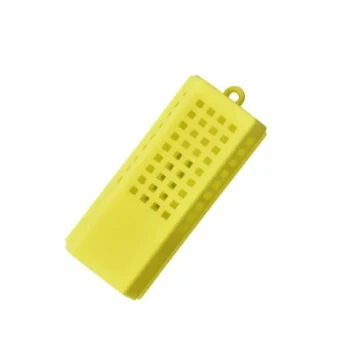
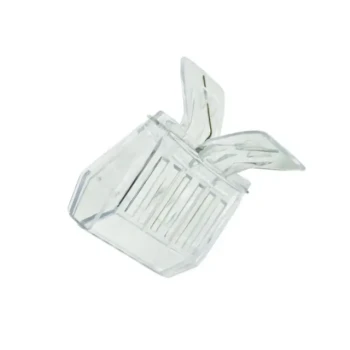
Artificial queen cups act as the primary, standardized vessels essential for initiating and scaling royal jelly production. Whether fashioned from wax or industrial plastic, these cups mimic the structural environment of a natural queen cell, housing transferred larvae and triggering worker bees to accept them and secrete royal jelly. Beyond their biological function, their uniform shape enables the mechanical or semi-mechanical harvesting required for commercial viability.
The core function of an artificial queen cup is to bridge the gap between biological instinct and industrial efficiency. By simulating a natural queen cell, it tricks the colony into mass-producing royal jelly, while its standardized form allows for hygienic, scalable harvesting.
The Biological Function: Triggering Production
Simulating the Natural Environment
The primary role of the cup is structural mimicry. It is designed to replicate the specific dimensions and geometry of a natural queen cell found in a beehive.
This simulation provides a familiar environment for the transferred larvae. It is the critical first step in convincing the colony that these larvae are destined to become queens.
Inducing Worker Acceptance
Once the larvae are grafted into these cups, the cups serve as a signal to the worker bees (specifically nurse bees).
Because the cup mimics a queen cell, it induces the nurse bees’ instinct to care for the occupant. This triggers them to secrete massive quantities of royal jelly to feed the larvae, filling the cup in the process.
The Industrial Function: Enabling Scale
Standardization for Efficiency
In a natural hive, honeycomb cells vary slightly; in commercial production, consistency is key. Artificial cups provide a standardized growth environment.
This uniformity allows beekeepers to manage thousands of larvae simultaneously. It transforms a biological variable into a predictable production metric.
Facilitating Mechanical Harvesting
The specific dimensions of artificial cups are engineered to interface with extraction equipment.
Because every cup is identical, producers can use mechanical or semi-mechanical systems to collect the jelly. This dramatically increases speed and yield compared to manual extraction from irregular natural cells.
Hygiene and Contamination Control
Modern production often utilizes food-grade plastic or acrylic cups.
Unlike natural wax which can be difficult to sterilize, these materials ensure the royal jelly remains uncontaminated. They also facilitate easier cleaning of the larvae and residue after the jelly is harvested.
Understanding the Trade-offs
Material Selection: Wax vs. Plastic
While plastic offers durability and hygiene, wax cups are sometimes used to maximize initial acceptance.
Bees may initially be more receptive to wax because it is a natural material they produce themselves. However, wax is less durable, harder to standardize for machines, and more difficult to reuse hygienically than plastic.
The Risk of Rejection
Even with high-quality cups, the simulation is not perfect.
If the cup's material or scent is "off," or if the dimensions are incorrect, worker bees will clean out or destroy the larvae. The cup must be precisely manufactured to ensure the colony invests its resources in filling it with jelly rather than rejecting the graft.
Making the Right Choice for Your Goal
To optimize your royal jelly production, consider which factor is your immediate priority:
- If your primary focus is maximum hygiene and efficiency: Prioritize food-grade plastic or acrylic cups, as they allow for easy cleaning, reuse, and integration with mechanical harvesting tools.
- If your primary focus is maximizing initial larval acceptance: Consider wax cups or coating plastic cups in a thin layer of wax, as the natural scent can improve the rate at which nurse bees accept the grafted larvae.
Success in royal jelly production relies on using the cup not just as a container, but as a biological trigger that harmonizes insect instinct with mechanical precision.
Summary Table:
| Feature | Wax Queen Cups | Plastic/Acrylic Queen Cups |
|---|---|---|
| Acceptance Rate | High (Natural scent/texture) | Moderate (May require wax coating) |
| Durability | Low (Single-use/Fragile) | High (Reusable/Robust) |
| Standardization | Variable | Precise (Ideal for machinery) |
| Hygiene | Difficult to sterilize | Easy to clean/Food-grade |
| Best Use Case | Small-scale or high-acceptance focus | Large-scale commercial production |
Maximize Your Royal Jelly Output with HONESTBEE
At HONESTBEE, we understand that commercial success in royal jelly production depends on the perfect balance of biological acceptance and industrial precision. As a premier partner for commercial apiaries and distributors, we provide a comprehensive wholesale range of high-performance beekeeping tools and machinery.
Whether you need precision-engineered food-grade queen cups, automated honey-filling machines, or specialized hive-making equipment, our portfolio is designed to scale your operations efficiently. From essential consumables to advanced hardware, let us help you enhance your yield and product quality.
Contact our experts today to discuss your wholesale needs
References
- O. Mishchenko, K. Afara. CПОСОБИ ФОРМУВАННЯ СІМЕЙ-ВИХОВАТЕЛЬОК У ТЕХНОЛОГІЇ ВИРОБНИЦТВА БДЖОЛИНОГО МАТОЧНОГО МОЛОЧКА. DOI: 10.46913/beekeepingjournal.2022.10.04
This article is also based on technical information from HonestBee Knowledge Base .
Related Products
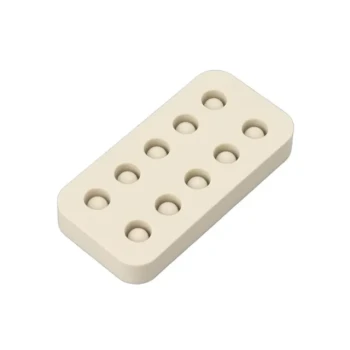
- 10-Cell Silicone Beeswax Bee Queen Cups Forming Mold
- JZBZ Type Wide Base Plastic Queen Cell Cups for Base Mounting and Queen Rearing
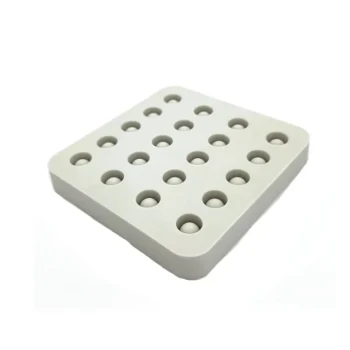
- High-Efficiency 20-Cell Silicone Mold for Beeswax Bee Queen Cup Production
- Clear Black Plain Polystyrene Queen Bee Grafting Cell Cups No Lug for Bee Queen Cup
- Brown Nicot Queen Cell Cups for Breeding Queen Bees Beekeeping
People Also Ask
- How do beeswax queen cell cups function? Optimize Queen Rearing with Biological Mimicry
- What is the biological function of beeswax queen cell cups? Boost Acceptance in Artificial Queen Rearing
- What role do specialized queen rearing tools play in developing mite-resistant honeybee stock? Master Genetic Selection
- What materials are used to make artificial queen cell cups for grafting? Beeswax vs. Plastic Guide
- What roles do specialized queen cell cups play in royal jelly production? Optimize Your Hive's Secretion and Yield