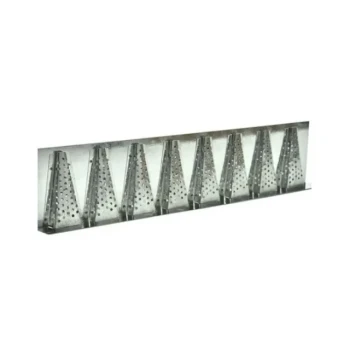
Anti-robbing hive structures are essential experimental controls designed to physically block the horizontal transmission of Varroa destructor mites between honey bee colonies. By narrowing entrances or creating isolated zones, researchers prevent stronger colonies from invading and stealing honey from weaker, infested colonies. This physical restriction eliminates a major variable, ensuring that any increase in mite populations can be attributed to internal factors or specific experimental conditions rather than opportunistic re-infestation.
By suppressing robbing behavior, these structures allow researchers to distinguish between natural mite population growth and external influxes, ensuring data validity regarding transmission dynamics.
Blocking the Transmission Vector
The Mechanics of Robbing
"Robbing" occurs when bees from a strong colony invade a weaker colony to steal resources. This interaction is a primary vector for horizontal transmission of parasites.
During these raids, bees from the healthy colony physically contact the infested environment. They unwittingly transport mites back to their own hive, spreading the infestation.
Cutting the Path
Anti-robbing structures, such as narrowed entrances, physically restrict access to the hive.
By making it difficult for intruders to enter, these structures effectively cut off the contact path between colonies. This ensures that mites are not introduced into new colonies through aggressive foraging interactions.
Isolating Variables for Data Integrity
Distinguishing Influx from Reproduction
In a research setting, it is critical to know why a mite population is growing.
Without anti-robbing controls, a sudden spike in mite numbers could be ambiguous. Researchers would not know if the mites reproduced naturally or arrived via a robbing event.
Validating Behavioral Studies
Many experiments aim to study specific biological impacts, such as how swarming behavior affects mite dynamics.
If robbing is allowed to occur, it muddies the data. Suppressing robbing guarantees that the results accurately reflect the specific impact of swarming, rather than random inter-colony theft.
The Role of Standardized Hardware
Integration with Langstroth Hives
While anti-robbing structures control bee behavior, the Langstroth hive provides the standardized infrastructure for measurement.
These hives allow for the integration of specialized equipment, such as removable sticky bottom boards and protective mesh.
Non-Invasive Data Collection
The design of the Langstroth hive complements anti-robbing measures by allowing researchers to count fallen mites without opening the hive.
This capability is essential for evaluating miticidal treatments or population counts without disturbing the colony's normal activities, which could otherwise introduce stress as another uncontrolled variable.
Designing a Controlled Experiment
To ensure your research on Varroa transmission is valid, you must match your hive structure to your specific experimental goals.
- If your primary focus is measuring natural mite reproduction: You must use anti-robbing entrances to ensure that population increases are not caused by external mites hitchhiking on robbing bees.
- If your primary focus is studying the impact of swarming: You need to isolate the colonies physically to confirm that any mite transfer is strictly a result of the swarm, not resource theft.
Successful Varroa research relies on physically segregating the variables of migration and reproduction.
Summary Table:
| Feature | Purpose in Varroa Research | Experimental Impact |
|---|---|---|
| Narrowed Entrances | Prevents inter-colony robbing | Eliminates external mite influxes |
| Physical Isolation | Blocks horizontal transmission | Ensures population growth is internal |
| Langstroth Compatibility | Standardizes measurement environment | Enables non-invasive data collection |
| Mesh/Sticky Boards | Facilitates accurate mite counts | Validates efficacy of miticidal treatments |
Elevate Your Apiary Operations with HONESTBEE
At HONESTBEE, we understand that precision is the backbone of successful beekeeping, whether you are conducting scientific research or managing a commercial enterprise. We specialize in catering to commercial apiaries and global distributors by providing a comprehensive wholesale range of professional-grade beekeeping tools, machinery, and essential consumables.
From standardized Langstroth hive components and specialized hive-making machinery to advanced honey-filling solutions, our portfolio is designed to enhance your efficiency and scale your business. Partner with us to access high-quality equipment that meets the rigorous demands of the modern industry.
Ready to upgrade your equipment or stock your distribution line?
Contact HONESTBEE today to discuss your wholesale needs
References
- Ingemar Fries, Peter Rosenkranz. Swarming in honey bees (<i>Apis mellifera</i>) and <i>Varroa destructor</i> population development in Sweden. DOI: 10.1051/apido:2003032
This article is also based on technical information from HonestBee Knowledge Base .
Related Products
- 8-Cone Galvanized Steel Bee Robber Guard
- Professional Reversible Beehive Hive Entrance
- Metal Hive Feet Bee Hive Stand for Ant Protection
People Also Ask
- What protective functions do beehive entrance guards provide? Defend Your Hive Against Wasps and Moths
- What is the primary function of protective guards at hive entrances? Block Rodents & Boost Winter Survival Rates
- How do conical metal guards or rubber inner tubes function as pest control tools? Stop Ants with Mechanical Barriers
- What is the function of Hive Entrance Guards? Master Bee Colony Defense Against Small Hive Beetles
- How can hardware mesh be applied to a beehive entrance for winter protection? Secure Your Colony Against Pests