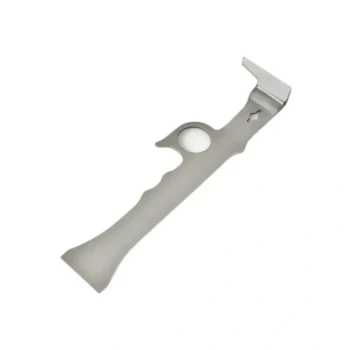
The Swiss grafting tool is the primary instrument used to ensure the physical integrity of honeybee larvae during their transfer from the hive to the laboratory. It is a high-precision micro-tool featuring a thin, flexible tip designed specifically to lift 24-hour-old larvae without damaging their incredibly delicate epidermis. This capability makes it the essential first step in successful in vitro rearing and quantitative pathogen inoculation experiments.
The tool’s significance lies in its ability to decouple physical handling trauma from experimental results; it ensures that observed larval mortality or physiological changes are caused by the intended variables—such as pathogen infection—rather than accidental injury during transfer.
The Mechanics of Precision Transfer
Protecting the Delicate Epidermis
The primary challenge in handling honeybee larvae is their fragility. The larvae possess a soft, easily ruptured epidermis.
The Swiss grafting tool addresses this with a specialized flexible tip. This allows researchers to scoop the larva without puncturing or crushing its outer layer.
Handling Micro-Sized Subjects
Researchers typically work with larvae that are only 24 hours old. At this stage, the organisms are microscopic and difficult to manipulate with standard laboratory forceps.
The Swiss grafting tool functions as a high-precision micro-tool, bridging the gap between the macroscopic hand movements of the researcher and the microscopic needs of the larva.
Preserving the Nutrient Droplet
Beyond the larva itself, the transfer environment matters. The design of the grafting tool allows for the transfer of the larva along with a small droplet of its original feed or royal jelly.
Keeping this nutrient solution intact at the base of the larva is vital. It ensures the larva maintains immediate feeding activity and prevents desiccation upon arriving in the culture plate.
Ensuring Experimental Integrity
Enabling Quantitative Pathogen Inoculation
In infection experiments, the goal is to measure how specific pathogens affect the bee. If a larva is physically damaged during collection, it may die from the wound rather than the pathogen.
By virtually eliminating mechanical damage, the Swiss grafting tool isolates the variable. It provides confidence that subsequent mortality data reflects the virulence of the pathogen, not the clumsiness of the transfer.
Facilitating In Vitro Rearing
Successful artificial rearing requires a seamless transition from the honeycomb to the petri dish. The tool ensures the larvae are physically stable when placed into artificial cups or culture plates.
This stability is a prerequisite for the larvae to develop normally into the queen stage or other desired phenotypes.
Understanding the Trade-offs
The Requirement for Sterility
While the tool is mechanically precise, it introduces a vector for contamination. Because honeybee larvae are highly susceptible to bacteria and fungi, the Swiss grafting tool must be rigorously sterilized.
Failure to sterilize the tool between uses can inadvertently inoculate larvae with environmental microbes, ruining the "quantitative pathogen inoculation" intended by the study.
The Skill Factor
The tool is not automated; it relies on the steady hand of the researcher. Even with a flexible tip, improper angle or excessive speed can still cause mechanical damage or roll the larva, separating it from its food source.
Making the Right Choice for Your Experiment
To maximize the reliability of your data, consider your primary experimental goals when utilizing this tool:
- If your primary focus is Pathogen Study: Prioritize the preservation of the epidermis to ensure that all mortality is statistically attributable to the infectious agent.
- If your primary focus is Larval Rearing/yield: Focus on transferring the nutrient droplet along with the larva to prevent starvation and ensure immediate acceptance of the artificial diet.
Mastering the use of the Swiss grafting tool is not just about moving a subject; it is about preserving the biological baseline of your experiment.
Summary Table:
| Feature | Significance in Experiments | Benefit to Researcher |
|---|---|---|
| Flexible Micro-Tip | Prevents rupture of the delicate epidermis | Minimizes mechanical trauma/accidental mortality |
| Precision Scooping | Handles 24-hour-old larvae accurately | Enables manipulation of microscopic subjects |
| Nutrient Preservation | Transfers larva with its original royal jelly | Prevents desiccation and ensures immediate feeding |
| Variable Isolation | Decouples handling injury from experimental data | Confirms results are due to pathogens, not injury |
| Sterilizable Design | Reduces vector-borne contamination | Maintains strict laboratory hygiene standards |
Elevate Your Beekeeping Productivity with HONESTBEE
At HONESTBEE, we understand that precision is the backbone of successful beekeeping operations—from the laboratory to the commercial apiary. As a premier provider for commercial apiaries and global distributors, we offer a comprehensive wholesale portfolio designed to enhance every stage of your business.
How HONESTBEE adds value to your operation:
- Precision Tools: High-quality grafting tools and laboratory-grade equipment for successful queen rearing.
- Advanced Machinery: Specialized hive-making and honey-filling machines to scale your production efficiency.
- Full-Spectrum Supply: From essential industry consumables to unique honey-themed cultural merchandise.
Ready to scale your operation with professional-grade beekeeping solutions? Contact us today to discuss your wholesale needs and discover the HONESTBEE advantage.
References
- Svjetlana Vojvodic, Jacobus J. Boomsma. Genetic Variation in Virulence among Chalkbrood Strains Infecting Honeybees. DOI: 10.1371/journal.pone.0025035
This article is also based on technical information from HonestBee Knowledge Base .
Related Products
- Stainless Steel Queen Grafting Tool for Beekeeping and Bee Queen Grafting
- Stainless Steel Beekeeping Queen Grafting Tool for Honey Bee Rearing
- Plastic Chinese Queen Grafting Tool for Bee Queen Rearing
- Retractable Chinese Queen Rearing Grafting Tools Equipment
- Double Head Beekeeping Grafting Tools for Beekeepers
People Also Ask
- What is grafting in queen rearing? Take Control of Your Apiary's Genetics
- What are the steps involved in using a queen grafting tool? A Guide to Successful Queen Rearing
- What are the benefits of using a queen grafting tool for queen rearing? Master Precision for Superior Bee Genetics
- What is the step-by-step process for using a queen grafting tool? Master Larva Transfer for Better Queen Rearing
- What is the primary function of a queen grafting tool? Master Precise Larval Transfer for High Queen Acceptance