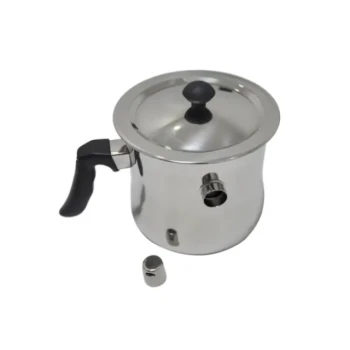
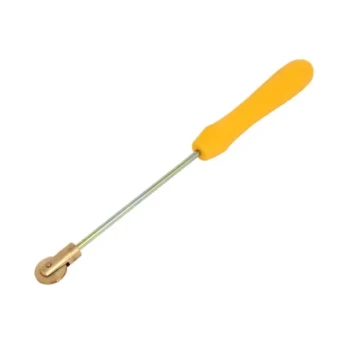
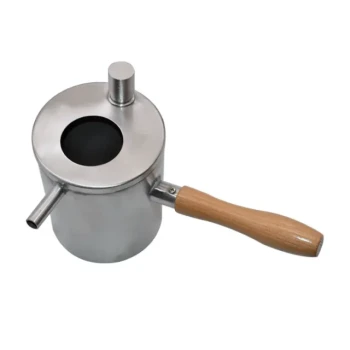
Achieving professional-grade beeswax foundation production requires a precise thermal and mechanical protocol. Heating beeswax to 85°C ensures complete liquefaction and reduced viscosity, while mechanical stirring facilitates a molecular-level uniform distribution of additives. This specific combination guarantees that every foundation sheet maintains a consistent concentration of active agents and a stable physical structure.
This technical process is designed to transform solid raw beeswax into a homogenized liquid medium, allowing for the precise integration of additives while preventing thermal degradation. For distributors and resellers, understanding this process is vital for verifying the structural integrity and quality of the foundation sheets they supply to the market.
Achieving Optimal Viscosity and Liquefaction
The Role of the 85°C Temperature Threshold
At 85°C, solid beeswax transitions fully into a low-viscosity liquid state. This temperature is high enough to ensure complete liquefaction without reaching the levels where the wax might suffer from oxidative damage or thermal degradation.
Impact on Material Flow and Processing
Reducing the viscosity is essential for the subsequent molding and shaping phases. A thinner liquid wax flows more efficiently through high-precision foundation machinery, ensuring a uniform physical structure across the entire production run.
Ensuring Homogeneous Distribution through Stirring
Molecular-Level Dispersion of Additives
Mechanical stirring during the liquid phase allows added components, such as pesticide powders or stabilizing oils, to achieve molecular-level uniform distribution. This prevents the settling of particles and ensures that the chemical composition is identical in every square inch of the wax matrix.
Consistency in Commercial Foundation Sheets
For B2B resellers, product consistency is the primary metric of quality. Proper stirring ensures that each molded sheet provides a consistent concentration of active agents, which is critical for both experimental applications and commercial hive health.
Understanding the Trade-offs and Risks
The Danger of Thermal Degradation
Exceeding the 85-90°C range can lead to the thermal breakdown of the beeswax’s natural esters. This results in a brittle foundation sheet that lacks the necessary barrier performance and may be rejected by the bees.
Insufficient Stirring and "Hot Spots"
Without continuous mechanical agitation, additives can clump or migrate, creating "hot spots" of high concentration. This not only compromises the structural integrity of the protective film but can also lead to inconsistent results for the end-user in the field.
Strategic Insights for High-Volume Sourcing
Identifying Professional Grade Manufacturing
Distributors should prioritize suppliers who utilize high-precision heating and stirring equipment. Professional-grade machinery ensures that the thermal window is strictly maintained, preserving the wax's natural properties while ensuring chemical homogeneity.
How to Apply This to Your Inventory Strategy
- If your primary focus is Quality Assurance: Verify that your manufacturer uses continuous agitation and precise temperature controls to prevent brittle or inconsistent foundation sheets.
- If your primary focus is Supply Chain Reliability: Source from partners with a full-spectrum product portfolio who demonstrate deep professional expertise in the molecular stabilization of wax foundations.
- If your primary focus is Rapid Market Response: Partner with wholesalers who utilize automated foundation machines, as these systems provide the fastest delivery times while maintaining the technical standards of 85°C processing.
Mastering these technical nuances ensures you deliver a superior product that supports hive productivity and builds long-term client trust.
Summary Table:
| Process Component | Technical Objective | Benefit for B2B Resellers |
|---|---|---|
| Heating to 85°C | Achieves full liquefaction and optimal low viscosity. | Ensures smooth flow through machinery for uniform sheets. |
| Mechanical Stirring | Facilitates molecular-level distribution of additives. | Guarantees consistent quality and chemical stability. |
| Precision Control | Prevents thermal degradation and ester breakdown. | Results in durable, non-brittle foundations that bees accept. |
| Homogenization | Prevents settling of particles and "hot spots." | High product consistency across large-volume orders. |
Partner with HONESTBEE for Professional-Grade Beekeeping Solutions
Elevate your inventory with HONESTBEE, your premier one-stop sourcing partner for commercial apiaries and B2B distributors. We provide a full-spectrum product portfolio—from high-precision foundation-making and honey-filling machines to essential industry consumables and cultural merchandise.
Why choose HONESTBEE?
- Deep Industry Expertise: We understand the technical nuances of wax processing to ensure superior product integrity.
- Rapid Fulfillment: Ultra-fast delivery and efficient order processing to keep your supply chain moving.
- B2B Advantage: Dedicated support for wholesalers, including OEM/ODM capabilities and competitive profit margins.
Ready to scale your business with reliable, high-performance equipment? Contact us today to request a quote!
References
- Christina Kast, Verena Kilchenmann. Toxicity of Coumaphos Residues in Beeswax Foundation to the Honey Bee Brood. DOI: 10.1002/etc.5645
This article is also based on technical information from HonestBee Knowledge Base .
Related Products
- Beeswax Machine Press Embosser Wax Foundation Mold Printer Bee Hive Equipment Making Sheet
- Fully Automatic Beeswax Embossing Machine Foundation Mill
- Electric Flatting and Embossing Machine with Tray for Beekeeping
- Manual Beeswax Comb Foundation Machine Wax Foundation Mill Embossing Machine
- Electric Beeswax Foundation Machine With Operating Tray and Wax Foundation Roller
People Also Ask
- What equipment is needed to make beeswax foundation? A Guide to DIY Wax Sheet Production
- What miscellaneous equipment is needed for making foundation? A Guide to the Essential Tools
- What miscellaneous equipment is useful when making beeswax foundation? Essential Support Tools for Beekeepers
- What specific equipment is required for making beeswax foundation? Essential Tools for High-Quality Production
- What is the recommended temperature for melting beeswax to make foundation sheets? Master the 70°C-80°C Ideal Range