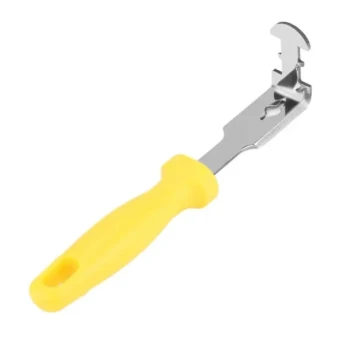
The technical rationale centers on biomimicry: specifically, aligning the collector's geometry with the natural movement patterns of Western honeybees (Apis mellifera L.). Designing holes parallel to the hive frames eliminates physical friction against the colony's daily activity cycles. This orientation allows bees to seal gaps instinctively, preventing the stress behaviors often triggered by incompatible designs.
By orienting collector holes parallel to the frames, you align mechanical design with biological instinct; this reduces stress on the colony and significantly increases the efficiency of propolis deposition.
The Biology of Hive Architecture
Respecting Natural Movement
Honeybees do not move randomly; they follow established activity cycles and traffic lanes between frames.
When collector holes are parallel to these frames, the device becomes an extension of the hive's natural architecture.
This allows bees to navigate the collector without disrupting their standard workflow.
Reducing Instinctual Stress
Designs that ignore natural directionality can be viewed by the colony as an obstacle rather than a space to be managed.
Incompatible hole directions trigger stress-induced behaviors as the bees struggle to adapt their work patterns.
Minimizing this stress is critical for maintaining a calm, productive colony focused on resource collection.
Mechanics of Propolis Deposition
Facilitating the Sealing Instinct
The primary function of a propolis collector is to trigger the bees' instinct to seal gaps in their enclosure.
When holes run parallel to the frames, they present a familiar geometry that is easier for the bees to address.
This ease of access encourages rapid initiation of the sealing process.
Boosting Collection Efficiency
Efficiency in the hive is defined by energy expenditure versus output.
By removing the friction of awkward geometry, bees can deposit propolis with less physical effort.
This streamlined process directly results in a higher yield per collection cycle.
Common Pitfalls to Avoid
The Cost of Misalignment
It is a mistake to assume that hole orientation is purely an aesthetic choice.
Ignoring the parallel requirement disrupts the bees' natural instincts, leading to slower sealing rates.
Consequently, "incorrect" orientations often result in significantly lower production yields.
Species Specificity
The rationale described here is specifically calibrated for Western honeybees (Apis mellifera L.).
Applying this specific geometric logic to other bee species with different nesting behaviors may not yield the same results.
How to Apply This to Your Project
When selecting or designing propolis collection hardware, prioritize the geometric relationship between the collector and the frames.
- If your primary focus is maximizing yield: Ensure the collector holes are strictly parallel to the frames to accelerate the deposition process.
- If your primary focus is colony health: Avoid complex or perpendicular patterns that contradict natural movement and increase biological stress.
Ultimately, successful equipment design must subordinate itself to the biological instincts of the hive.
Summary Table:
| Feature | Parallel Orientation (Optimal) | Perpendicular/Random Orientation |
|---|---|---|
| Bee Movement | Smooth, follows natural traffic lanes | Obstructed, creates physical friction |
| Stress Level | Low; mimics natural hive architecture | High; perceived as an obstacle |
| Sealing Speed | Rapid initiation of sealing instinct | Slower, hesitant deposition |
| Yield Potential | High; streamlined energy expenditure | Low; inefficient collection cycles |
| Target Species | Optimized for Apis mellifera L. | Incompatible with Western honeybee logic |
Maximize Your Apiary’s Propolis Yield with HONESTBEE
At HONESTBEE, we specialize in engineering equipment that respects the biological instincts of your colony. Whether you are a commercial apiary looking to scale production or a distributor seeking high-quality wholesale supplies, we provide the specialized hardware you need.
Our extensive portfolio includes:
- Precision-Engineered Beekeeping Tools: Designed to align with honeybee movement patterns.
- Advanced Machinery: From hive-making to professional honey-filling solutions.
- Industrial Consumables: A complete range of high-performance supplies for large-scale operations.
Ready to enhance your efficiency with equipment that works with nature? Contact our expert team today to discuss how our wholesale solutions can support your business growth.
References
- Budiaman Budiaman, Arief Rahman. UJI EFEKTIVITAS EMPAT VARIASI PROPOLIS TRAP TERHADAP PRODUKSI PROPOLIS LEBAH MADU Apis mellifera L.. DOI: 10.24259/perennial.v2i2.154
This article is also based on technical information from HonestBee Knowledge Base .
Related Products
- 8 Frame and 10 Frame Propolis Trap Collector Screen for Propolis Collection
- Heavy Duty Stainless Steel Frame Cleaner with Plastic Handle
- 30 cm Plastic Entrance Hole Bee Pollen Trap and Collector
- Plastic Bee Pollen Trap Strips Comb Catcher Collector
- Heavy-Duty Ergonomic Grip Galvanized Pollen Shovel
People Also Ask
- Why is a specific wooden frame required when installing a propolis screen? Optimize Your Propolis Harvest Efficiency
- What are the advantages of using propolis collector screens? Elevate Your Harvest to Pharmaceutical Purity
- How do propolis collection screens work? Discover material specs for commercial harvesting equipment
- How does the mesh size of a propolis collection screen influence the efficiency of propolis harvesting? Optimize Yields!
- How do commercial-grade plastic screens compare to custom fine-mesh screens? Maximize Your Propolis Yield & ROI