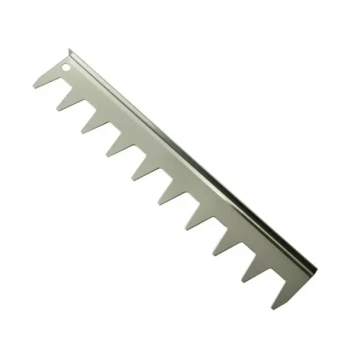
The technical significance of using standardized 9-frame brood boxes lies in the isolation of variables. By mandating a uniform hardware configuration, researchers create an identical physical baseline for every colony in an apiary. This ensures that the living space, resource availability, and structural environment are constants rather than variables, allowing for accurate comparative analysis of biological data.
Standardized hardware is the control mechanism of field research. It guarantees that observed differences in colony productivity or health are the result of specific experimental factors—such as Queen genetics—rather than inconsistencies in hive volume or nest layout.
The Role of Uniformity in Data Integrity
Consistent Nest Configuration
Standardization extends beyond the external dimensions of the box to the internal arrangement of the hive.
By using a fixed 9-frame setup, researchers ensure every colony starts with an identical distribution of honey, pollen, and empty combs. This prevents resource disparity from influencing the colony's early development or survival rates.
Equalizing Living Space
The volume of the hive directly impacts colony behavior, swarm impulse, and thermoregulation.
Providing a uniform living space ensures that no single colony possesses a spatial advantage or disadvantage. Every biological subject operates within the exact same physical constraints.
Eliminating Confounding Variables
Removing Structural Bias
In scientific experiments, "noise" created by inconsistent equipment can obscure true data signals.
Using hardware with consistent specifications eliminates hive structure as a variable. Researchers can be confident that a colony's underperformance is not caused by a drafty box, irregular frame spacing, or differing insulation properties associated with mixed equipment.
Isolating the Target Variable
The primary goal of an experimental apiary is often to evaluate specific biological or environmental factors.
When the hardware is controlled, metrics regarding productivity and health can be attributed solely to the Queen bee breed or specific environmental conditions. This isolation is critical for breeding programs and ecological studies.
Understanding the Constraints
The Maintenance of Standardization
While standardization provides a perfect baseline, it requires rigorous active management.
Researchers cannot simply set up the boxes and leave; they must constantly monitor the hives to ensure that the ratio of resources (honey/pollen) and empty combs remains consistent across all units as the season progresses.
Limitations on Colony Variance
Forcing all colonies into a 9-frame configuration creates equality, but it may constrain exceptionally vigorous colonies.
If a colony naturally outgrows the standardized space faster than others, the hardware itself becomes a limiting factor. Researchers must account for this when analyzing productivity ceilings.
Making the Right Choice for Your Research
To derive valid conclusions from your apiary, you must align your hardware choices with your specific experimental goals.
- If your primary focus is Queen Breeding: Use standardized boxes to ensure that differences in brood pattern and honey production are strictly due to genetics, not available space.
- If your primary focus is Environmental Impact: Maintain identical nest configurations so that external stressors affect all colonies in a mechanically similar way.
Precision in your hardware yields precision in your data.
Summary Table:
| Feature | Technical Significance | Research Benefit |
|---|---|---|
| Uniform Living Space | Equalizes hive volume and thermoregulation | Removes spatial advantage as a variable |
| Consistent Internal Layout | Identical distribution of honey, pollen, and comb | Prevents resource disparity from skewing data |
| Structural Control | Eliminates irregular frame spacing or insulation | Attributes colony health solely to experimental factors |
| Variable Isolation | Baselines hardware as a constant | Enables accurate comparative analysis of Queen genetics |
Elevate Your Apiary Research with HONESTBEE Precision
At HONESTBEE, we understand that scientific integrity starts with superior hardware. As a premier provider for commercial apiaries and global distributors, we supply high-quality, standardized beekeeping tools and machinery designed to meet the rigorous demands of experimental research.
Whether you are scaling a breeding program or managing a commercial honey operation, our comprehensive wholesale portfolio includes:
- Precision Hardware: Hive-making and honey-filling machines for consistent infrastructure.
- Essential Equipment: Full spectrum of beekeeping tools and specialized consumables.
- Commercial Support: Tailored solutions for large-scale operations and distribution networks.
Ensure your data is driven by genetics, not equipment flaws. Contact us today to discuss your wholesale equipment needs and experience the value of HONESTBEE engineering.
References
- Leslie A. Holmes, S. E. Hoover. Queen quality, performance, and winter survival of imported and domestic honey bee queen stocks. DOI: 10.1038/s41598-023-44298-x
This article is also based on technical information from HonestBee Knowledge Base .
Related Products
- Stainless Steel 9 Frame Hive Spacer Durable Precise for Commercial Beekeeping
- Langstroth Honey Bee Box Hive Boxes for Different Depths
- Australian Langstroth Beehive Boxes for Beekeeping Wholesales
- Portable Bee Mating Hive Boxes Mini Mating Nucs 8 Frames for Queen Rearing
- Assembled Wooden Bee Frames with Plastic Foundation for Durability and Convenience by HONESTBEE
People Also Ask
- What is the function of Langstroth frames in comb foundation construction? Optimize Your Apiary's Structural Integrity
- What are the specific dimensions for the wooden parts of Langstroth beehive frames? Precision Guide for All Sizes
- How are Langstroth beehive frames assembled? A Step-by-Step Guide for a Durable Hive
- What is the purpose of Langstroth beehive frames in beekeeping? Key to Professional Hive Management & Scaling
- What is the purpose of Langstroth beehive frames? Unlock the Key to Modern Beekeeping