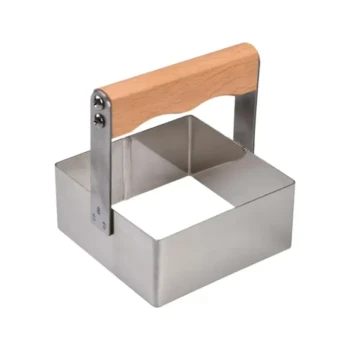
Standardized measurement grids function as essential calibration tools that convert the biological irregularity of a hive into quantifiable data. By overlaying frames with precise geometric units (often 5 cm x 5 cm), these grids eliminate the subjective errors inherent in visual estimation, providing an exact metric for brood distribution and honey storage.
The transition from visual estimation to grid-based measurement fundamentally shifts apiary management from an art to a data-driven science. It provides the objective baseline required to accurately assess queen performance, track colony health trends, and time interventions like splitting or feeding with precision.
The Shift from Estimation to Precision
Eliminating Subjective Error
Relying on manual visual estimation leads to inconsistent data. Different observers—or even the same observer on different days—may judge the density of a frame differently.
Standardized grids enforce objectivity. They demand that specific areas be counted rather than guessed, ensuring that the data collected is scientifically valid and reproducible.
Quantifying Biological Complexity
Honeycomb structures and brood patterns are naturally irregular. A measurement grid superimposes a structured framework over this chaos.
This process converts organic shapes into countable geometric units. This transformation allows biological performance (like egg-laying) to be recorded as numerical data suitable for statistical analysis.
Strategic Applications for Colony Management
Accurately Assessing Queen Capacity
The primary indicator of a colony's potential is the queen's egg-laying capability.
By measuring the exact surface area of the brood, you obtain a direct reflection of the queen’s reproductive status. This is far more reliable than estimating "frame coverage," as it accounts for the density of the pattern.
Optimizing Resource Management
Grid data informs critical management decisions regarding resources.
By quantifying honey storage area versus brood area, you can mathematically determine the colony's developmental status. This provides clear triggers for when to implement supplemental feeding or when the colony is strong enough for splitting.
Establishing Disease Control Benchmarks
There is a direct correlation between brood volume and parasite reproduction, specifically Varroa mites.
Precise measurement of larvae and pupae distribution allows you to predict mite reproduction rates. This data is critical for establishing consistent benchmarks for treatment efficacy and overall colony health monitoring.
Understanding the Trade-offs
Time Investment vs. Data Quality
The primary trade-off of using measurement grids is the time required per inspection.
Overlaying grids and counting units is significantly slower than a quick visual check. While this method offers superior accuracy for research, breeding programs, or critical seasonal assessments, it may be impractical for rapid, routine commercial inspections where speed is the priority.
The Learning Curve of Methodologies
Different methodologies, such as the PUCHTA method (which uses long and short axis dimensions), require specific formulas.
To gain value from these tools, the user must understand not just how to count, but how to input these dimensions into the correct formulas to calculate proliferation potential. Data without proper analysis remains just numbers.
Making the Right Choice for Your Goal
To maximize the value of standardized grids, align their use with your specific objectives:
- If your primary focus is Breeding and Genetics: Use grids to strictly quantify the queen's egg-laying capacity, allowing for objective comparison of productivity between different genetic lines.
- If your primary focus is Disease Management: Use the brood area data to model Varroa mite reproduction rates, ensuring your treatment schedules match the biological reality of the colony.
- If your primary focus is Colony Expansion: Use the ratio of brood to food stores to mathematically determine the exact moment for colony splitting, preventing swarming while ensuring survival.
By replacing guesswork with geometry, you gain the control necessary to manage colonies not just by feel, but by fact.
Summary Table:
| Metric | Visual Estimation | Standardized Grid Measurement |
|---|---|---|
| Accuracy | Subjective & Variable | Objective & Reproducible |
| Data Format | Qualitative (High/Low) | Quantitative (Numerical Units) |
| Best Use Case | Rapid Routine Checks | Breeding, Research & Scaling |
| Queen Assessment | Estimated Frame Coverage | Exact Egg-Laying Capacity |
| Decision Making | Intuition-Based | Data-Driven (Math Triggers) |
Precision Tools for Professional Apiaries
Maximize your colony's productivity by transitioning from guesswork to geometry. At HONESTBEE, we specialize in empowering commercial apiaries and distributors with the high-precision equipment necessary for data-driven beekeeping.
From specialized hive-making and honey-filling machinery to a full spectrum of wholesale beekeeping tools and essential consumables, we provide the hardware and support you need to scale your operations efficiently. Whether you are refining your breeding program or optimizing honey production, our portfolio is designed to deliver measurable results.
Ready to elevate your apiary management? Contact our expert team today to discover how HONESTBEE’s comprehensive wholesale solutions can streamline your business and boost your yield.
References
- Cameron G. Lait, Cristina M. Machial. Treatment With Synthetic Brood Pheromone (SuperBoost) Enhances Honey Production and Improves Overwintering Survival of Package Honey Bee (Hymenoptera: Apidae) Colonies. DOI: 10.1603/ec11285
This article is also based on technical information from HonestBee Knowledge Base .
Related Products
- Professional 500g Sectional Comb Honey Frame System for Beekeeping
- Professional Sectional Comb Honey Frame with 250g Cassette System for Beekeeping
- Heart-Shaped Comb Honey Frame and Honeycomb Cassette
- Heavy Duty Castellated Iron Frame Spacer for Honey Supers
- Plastic Honey Comb Frames Cassette Box for Honey
People Also Ask
- How are honeybee combs utilized for non-destructive colony monitoring? Master Population Density Tracking
- What frame to use for honeycomb? Choose the Right System for Pure, Edible Comb
- What is a honeycomb frame? The Key to Modern, Sustainable Beekeeping
- What is the technical purpose of exchanging honeycomb frames? Master Apiary Equalization for Growth
- What is the significance of sampling honeycomb frames and hive bottoms? A Guide to Scientific Sanitation Monitoring