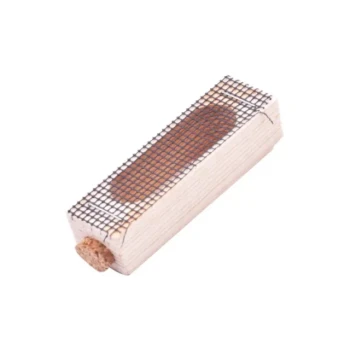
Wooden wire mesh boxes create a controlled yet permeable environment designed to mimic natural resting conditions for honeybees. By utilizing wire mesh sides, these enclosures ensure adequate airflow permeates the bee cluster, while simultaneously providing a rigid structure to secure queen cages and support the natural clustering behavior of worker bees.
The core function of this environment is to balance ventilation with structural stability. It successfully simulates a natural bivouac to maintain swarm health and cohesion, which is essential for the accurate, real-time sampling of queen volatiles.
Replicating Natural Conditions
The primary goal of the wooden wire mesh box is not merely containment, but the simulation of a natural habitat.
Optimizing Airflow
The device utilizes wire mesh sides rather than solid walls.
This design choice ensures that adequate airflow reaches the center of the bee cluster. Proper ventilation is critical to prevent overheating and maintain the respiratory health of the swarm during the bivouac phase.
Encouraging Natural Clustering
The box is engineered to allow worker bees to form a cluster naturally.
By providing a physical environment that mimics a natural resting state, the bees remain cohesive. This prevents the stress or disorganization often associated with artificial containment.
Structural Support and Sampling
Beyond mimicking nature, the box serves a functional role in research and observation.
Anchoring the Queen
The wooden structure provides the necessary physical support to fix queen cages in place.
Securing the queen is the central mechanic for establishing the bivouac. It creates a focal point around which the workers can gather, ensuring the swarm remains unified.
Facilitating Volatile Sampling
The setup is specifically designed to enable real-time sampling of queen volatiles.
Because the environment maintains the swarm's health and cohesion, the chemical signals (volatiles) released by the queen represent a more accurate, stress-free biological state.
Understanding the Trade-offs
While effective, this system relies on specific physical constraints to function.
Artificial Constraints for Stability
The environment is a simulation, not a perfect replica of the wild.
The system requires the artificial fixing of the queen cage to dictate the location of the cluster. While the worker behavior remains natural, the location of the bivouac is enforced by the hardware to facilitate human observation and sampling.
Making the Right Choice for Your Goal
When utilizing wooden wire mesh boxes for honeybee research, consider your specific objectives:
- If your primary focus is biological sampling: Rely on the wire mesh design to allow for the non-intrusive collection of volatiles without disrupting the air composition.
- If your primary focus is swarm maintenance: Use the fixed queen cage feature to ensure the colony remains cohesive and healthy during the observation period.
This device effectively bridges the gap between artificial containment and natural behavior, providing a stable platform for high-fidelity data collection.
Summary Table:
| Feature | Physical Environment Benefit | Functional Application |
|---|---|---|
| Wire Mesh Sides | Maximizes airflow and prevents overheating | Real-time volatile sampling & cluster health |
| Wooden Frame | Provides rigid structural stability | Securely anchors queen cages for hive cohesion |
| Enclosed Space | Mimics natural resting/bivouac conditions | Reduces stress and encourages natural clustering |
| Modular Design | Facilitates non-intrusive observation | High-fidelity biological data collection |
Elevate Your Beekeeping Operations with HONESTBEE
At HONESTBEE, we specialize in empowering commercial apiaries and distributors with the highest-grade equipment in the industry. Whether you are conducting advanced research requiring precise bee environments or scaling your production with automated hive-making and honey-filling machinery, our comprehensive wholesale catalog has you covered.
From essential consumables to specialized beekeeping tools and unique honey-themed cultural merchandise, we provide the full spectrum of hardware needed to succeed in the modern market. Let us help you optimize your swarm management and operational efficiency.
Ready to upgrade your apiary? Contact us today to discuss our wholesale solutions and how we can support your business growth!
References
- Jessica Richards, Heather R. Mattila. Queen-produced volatiles change dynamically during reproductive swarming and are associated with changes in honey bee (Apis mellifera) worker behavior. DOI: 10.1007/s13592-015-0358-x
This article is also based on technical information from HonestBee Knowledge Base .
Related Products
- HONESTBEE Wired and Assembled Wooden Bee Frames Foundation for a Thriving Hive
- Wood and Mesh Push-In Queen Cage
- Classic Wooden and Mesh California Queen Cage
- HONESTBEE Wooden Bee Escape Board with Triangle Mesh Design for Beekeeping
- HONESTBEE Wooden Bar Copper Prong Wire Embedder for Battery Operation
People Also Ask
- What role does replacing foundation and frames play in controlling American Foulbrood (AFB)? A Key to Hive Sanitation
- What is the role of frames and foundation in a bee hive? Build a Stable and Productive Apiary with Modern Design
- What is the difference between frames and foundation in a bee hive? A Guide to Hive Structure and Comb Building
- What is the purpose of frames and foundations in a beehive? Achieve a Healthy, Manageable Hive
- How do wooden and plastic hive frames compare in terms of durability? Wood vs. Plastic Longevity & Repairability