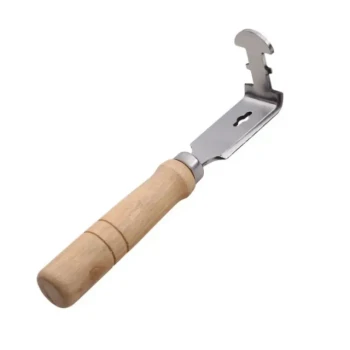
Professional hive inspection tools serve as the critical interface for transforming visual observations into quantitative data regarding a queen's performance. They enable beekeepers to systematically track the distribution of brood circles, verify the concentric patterns of egg-laying, and evaluate the developmental consistency of offspring to accurately determine the queen's movement and overall productivity.
The core value of these tools lies in their ability to turn operational convenience into evaluation efficiency. They convert abstract biological behaviors—specifically egg-laying continuity and honeycomb space utilization—into measurable productivity indicators that determine the viability of the colony.
Quantifying Biological Patterns
Systematizing Brood Observation
The primary role of inspection tools is to facilitate the orderly examination of honeycomb frames.
Without a systematic approach, assessing the queen's performance is subjective and prone to error. These tools allow for a structured review of how brood circles are distributed across the frame.
Measuring Concentric Distribution
A key indicator of a healthy, productive queen is the geometry of her egg-laying.
Professional tools assist in visualizing and verifying concentric distribution patterns. This geometric consistency is a direct reflection of the queen's methodical movement and her ability to maximize the available space on the comb.
Evaluating Developmental Consistency
Beyond just the placement of eggs, these tools help the beekeeper analyze the offspring's age.
By observing the consistency of developmental stages among the brood, a beekeeper can infer the queen's laying speed and rhythm. Gaps in development often signal interruptions in the queen's movement patterns or fertility issues.
Enhancing Precision Through Magnification
Overcoming Human Visual Limits
Honeybee larvae and eggs are incredibly small, typically measuring only 2 to 3 millimeters.
Attempting to identify these with the naked eye frequently results in visual misjudgment. High-precision magnification tools are essential for accurate identification, ensuring that the evaluation of the queen's activity is based on fact rather than estimation.
Mitigating Operator Fatigue
Field inspections often take place in bright outdoor environments, which can lead to rapid eye fatigue.
Prolonged observation under these conditions poses a risk of vision damage. Professional optical tools mitigate this risk, allowing for faster, more accurate assessments of colony health without physical strain on the beekeeper.
Advanced Environmental Control
Isulating Variables in the Lab
For high-level professional evaluation, laboratory-controlled monitoring systems take inspection beyond simple observation.
These systems allow for the precise regulation of temperature, humidity, and nutritional intake. This isolation of variables is necessary for determining how specific factors, such as pollen nutrition, directly impact the queen's physiology.
Tracking Real-Time Metrics
Advanced monitoring equipment provides data that field tools cannot, such as real-time tracking of egg-laying frequency.
This level of detail provides a scientific basis for management decisions. It allows commercial apiaries to develop precise supplementary feeding plans based on the quantified success rates of the queen.
Understanding the Trade-offs
Field Utility vs. Laboratory Precision
It is critical to distinguish between field inspection tools and laboratory monitoring systems.
Field tools excel at operational convenience and assessing the colony in its natural state, but they cannot control environmental variables. Conversely, laboratory systems offer perfect control over temperature and diet but remove the colony from real-world foraging conditions.
The Risk of Interpretation Errors
While tools provide magnification and structure, they do not replace biological knowledge.
A tool may highlight a gap in the brood pattern, but it cannot diagnose the cause on its own. The beekeeper must still interpret whether the "measurable indicator" suggests a failing queen or an external factor like a pollen shortage.
Making the Right Choice for Your Goal
To select the correct class of tools for your evaluation needs, consider your operational context:
- If your primary focus is commercial apiary management: Prioritize field inspection tools that streamline the observation of brood circle distribution and space utilization to ensure hive productivity.
- If your primary focus is breeding or nutritional research: Implement laboratory-controlled monitoring systems to quantify how specific variables like temperature and diet affect egg-laying frequency.
Success depends on using these tools not just to see the hive, but to measure its potential.
Summary Table:
| Tool Category | Key Function | Primary Metric | Best Use Case |
|---|---|---|---|
| Field Inspection Tools | Structural frame review | Brood circle distribution & space utilization | Commercial apiary management |
| Magnification Tools | Precise identification | Egg/larvae detection & worker health | Mitigating operator eye fatigue |
| Lab Monitoring Systems | Environmental control | Real-time egg-laying frequency | Breeding & nutritional research |
| Feeding Systems | Nutritional isolation | Impact of pollen on queen physiology | Specialized supplement testing |
Maximize Your Colony Productivity with HONESTBEE
Precise queen evaluation is the cornerstone of a successful commercial apiary. At HONESTBEE, we empower commercial beekeepers and distributors by providing the professional-grade tools and machinery needed to turn field observations into measurable growth.
Our comprehensive wholesale portfolio includes:
- Advanced Hive-Making & Honey-Filling Machinery to scale your operations.
- High-Precision Inspection Tools for accurate brood evaluation.
- Full Spectrum Consumables to maintain colony health and nutrition.
Whether you are managing thousands of hives or supplying the industry, our expertise ensures you have the hardware and support to succeed. Contact us today to explore our wholesale solutions and see how HONESTBEE can optimize your beekeeping business.
References
- Methods of Zootechnical Evaluation of the Queens. DOI: 10.31038/ijvb.2023713
This article is also based on technical information from HonestBee Knowledge Base .
Related Products
- Professional Multi-Function Stainless Steel Hive Tool
- Professional Stainless Steel Pry-Bar Hive Tool
- HONESTBEE Professional Long Handled Hive Tool with Precision Cutting Blade
- HONESTBEE Professional Multi-Functional Hive Tool with Ergonomic Wood Handle
- Professional Dual-End Stainless Steel Hive Tool for Beekeeping
People Also Ask
- Why are professional hive tools considered indispensable? Master Beekeeping Maintenance with Precision Leverage
- What is the role of professional hive tools in routine apiary maintenance? Expert Tips for Hive Health and Longevity
- What are the benefits of a multi-functional hive tool? Streamline Your Apiary Workflow with One Tool
- What advantages do multi-functional hive tools offer? Maximize Your Apiary Efficiency and Workflow
- What are the common construction features of hive tools? Key Insights for Superior Beekeeping Efficiency