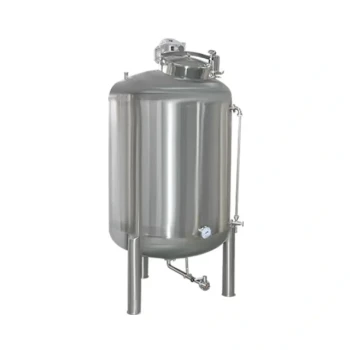
Settling tanks serve as the critical passive clarification stage in honey processing, bridging the gap between raw extraction and final bottling.
These vessels facilitate static sedimentation, a process where honey is allowed to rest undisturbed for approximately two weeks. During this period, the natural physical properties of the honey allow fine impurities, air bubbles, and residual wax to separate based on density, resulting in a high-purity product without the need for aggressive mechanical intervention.
Core Takeaway: Settling tanks utilize the principles of gravity and time to naturally stratify honey, removing organic debris and micro-bubbles to ensure the final product meets rigorous hygiene, clarity, and commercial standards.
The Mechanics of Static Sedimentation
Utilizing Density Differences
The fundamental mechanism of a settling tank is specific gravity. Because honey is denser than most of the impurities contained within it, separation occurs naturally over time.
Upward and Downward Separation
Lighter elements, such as air bubbles, fine wax particles, and pollen, rise to the surface to form a "scum" or foam that can be skimmed off. Conversely, heavier debris settles at the bottom of the tank, leaving the middle layer of honey clear and pure.
The Role of Time
According to standard protocols, this is not a rapid process; it requires approximately two weeks of resting time. This duration is essential to allow even microscopic suspended particles and micro-bubbles enough time to travel through the viscous liquid to their respective separation zones.
Enhancing Product Quality and Marketability
Achieving Visual Clarity
Post-extraction honey is often cloudy due to thousands of micro-bubbles and suspended solids. Settling tanks remove these elements, ensuring the final liquid is transparent and visually appealing, which is a primary sensory requirement for the retail market.
Removing Organic Contaminants
Beyond aesthetics, these tanks play a vital role in food hygiene. They effectively isolate organic impurities introduced during centrifugation, such as larval remains and bee debris, which is critical for extending shelf life and meeting food safety standards.
Ensuring Data Accuracy
Using settling tanks helps strictly define what is "honey" and what is waste. By removing non-honey substances prior to the final weigh-in, producers ensure that their yield data constitutes high-purity liquid product, allowing for rigorous production analysis.
Understanding the Trade-offs
Production Bottlenecks
The primary trade-off of using settling tanks is velocity. Because the process requires roughly two weeks of static standing time, it introduces a significant pause in the production line that must be accounted for in logistical planning.
Space Requirements
To maintain continuous production while batches settle for two weeks, a facility requires significant floor space to house multiple tanks. This can be a limiting factor for operations with restricted square footage.
Passive vs. Active Filtration
While settling is excellent for preserving the raw qualities of honey, it is a passive process. It is most effective when used in conjunction with—or immediately following—mechanical filtration to catch larger debris before the fine clarification begins.
Making the Right Choice for Your Goal
To maximize the effectiveness of your post-processing phase, align your use of settling tanks with your specific production targets:
- If your primary focus is Visual Quality: Prioritize the full two-week settling period to ensure all micro-bubbles rise to the surface, guaranteeing a crystal-clear presentation for glass jars.
- If your primary focus is Operational Efficiency: Use settling tanks as a secondary step after multi-stage filtration to reduce the sediment load and slightly shorten the required standing time.
- If your primary focus is Market Competitiveness: Market your use of stainless steel settling tanks to highlight the purity and hygiene standards of your process, appealing to safety-conscious distributors.
Ultimately, the settling tank is the guardian of quality, transforming raw, aerated extraction output into the polished, shelf-stable product consumers demand.
Summary Table:
| Feature | Description | Key Benefit |
|---|---|---|
| Mechanism | Static Sedimentation (Specific Gravity) | Naturally separates wax, bubbles, and debris |
| Process Time | Approximately 14 days (2 weeks) | Ensures removal of even microscopic impurities |
| Hygiene | Organic Contaminant Isolation | Meets food safety standards and extends shelf life |
| Visual Impact | Micro-bubble elimination | Produces crystal-clear, market-ready honey |
| Yield Accuracy | Pre-bottling purification | Provides precise data on high-purity liquid honey |
Elevate Your Honey Quality with HONESTBEE Professional Solutions
At HONESTBEE, we understand that purity is the hallmark of premium honey. We provide commercial apiaries and distributors with high-grade stainless steel settling tanks, honey-filling machines, and advanced processing equipment designed to maximize your yield and market appeal. From specialized hive-making machinery to essential consumables, our comprehensive wholesale offering is tailored to help you scale your operations efficiently.
Ready to optimize your honey production line? Contact us today to discover how our professional beekeeping tools and hardware can drive your business success.
References
- Juan Lerdón, Eduardo Macario Moctezuma Navarro. Análisis económico de una unidad productiva de miel, localizada en el sector Antilhue. DOI: 10.4206/agrosur.2017.v45n2-01
This article is also based on technical information from HonestBee Knowledge Base .
Related Products
- Stainless Steel Honey Storage and Settling Tank with Double Strainer
- Stainless Steel Honey Storage Tank with Lid for Honey
- Heavy Duty Stainless Steel Honey Processing Machine Decrystallizing Tank
- Professional Honey Storage Tank with Agitation System
- Stainless Steel Heated Honey Tank Warming Heating Tank
People Also Ask
- What economic role do honey storage tanks play? Boost Your Revenue Through Strategic Inventory Management
- What roles do industrial honey storage tanks and filtration meshes play in processing? Ensure Purity & Consistency
- What is the purpose of a honey storage tank? Streamline Your Honey Processing for Quality & Efficiency
- Why are large settling tanks used in the honey clarification process? Achieve Natural Purity & Batch Consistency
- How do high-precision filtering equipment and honey settling tanks contribute to product quality? Enhance Honey Purity