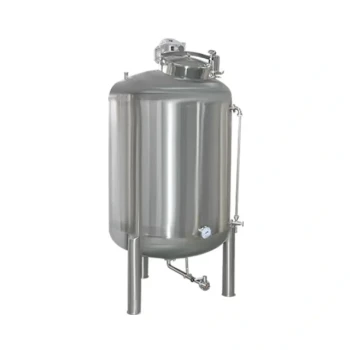
The primary purpose of a settling tank, or de-aerator, is to provide final clarification and homogenization of honey before bottling. By allowing the honey to remain undisturbed for a minimum of 48 hours, the tank leverages natural density differences to separate trapped air bubbles and microscopic impurities from the pure liquid. This passive process results in a product that is visually transparent, physically stable, and balanced with the ambient temperature.
The settling tank is not merely a storage vessel; it is a passive purification tool. It utilizes the principles of gravity and buoyancy to achieve commercial-grade clarity without the need for aggressive mechanical processing that could degrade the honey's quality.
The Mechanics of Natural Clarification
Utilizing Specific Gravity
The effectiveness of a settling tank relies on the difference in density between pure honey and the contaminants suspended within it.
Honey is a dense liquid, whereas air bubbles, beeswax fragments, and fine particles are generally lighter.
When left to stand, these lighter elements naturally buoyant upward, forming a "scum" layer on top that can be skimmed off, while heavier particles sink to the bottom.
The Critical Role of Time
Because honey is viscous, this separation process is slow and requires patience.
The primary reference dictates that honey must sit undisturbed for at least 48 hours.
This duration allows even the smallest micro-bubbles—which cause cloudiness—to travel to the surface, ensuring the final product is crystal clear.
Thermal Homogenization
Beyond cleaning the honey, the settling tank acts as a thermal buffer.
It allows the product to balance with the ambient temperature, ensuring the physical properties of the honey are stable before packaging.
This step prevents issues related to expansion or contraction after the honey has been sealed in jars.
Operational Conditions for Success
Controlled Temperature Environment
To function correctly, these tanks should ideally operate in a controlled environment between 25 and 30 degrees Celsius.
This temperature range is warm enough to slightly reduce viscosity, allowing bubbles to rise faster, but cool enough to prevent heat damage.
Passive Preservation
Unlike high-pressure filtration or excessive heating, settling tanks do not strip the honey of its character.
This method maintains the natural nutritional components and enzymes intact.
It allows producers to upgrade the commercial grade of the product while keeping it as close to its raw state as possible.
Understanding the Trade-offs
The Production Bottleneck
The most significant downside of using a settling tank is the impact on throughput.
Requiring a minimum 48-hour holding period creates a bottleneck that halts the bottling line.
Producers must account for this delay or invest in multiple tanks to maintain a continuous workflow.
Space and Volume Requirements
To rely on gravity rather than mechanical force, the volume of the tank matters.
Large tanks are required to process significant batches, demanding substantial floor space in the facility.
Furthermore, if the ambient temperature drops below the recommended 25°C, the settling time increases significantly, potentially disrupting schedules.
Making the Right Choice for Your Goal
While settling is a standard practice, how you implement it depends on your specific production targets.
- If your primary focus is Premium Quality: Prioritize the full 48+ hour settling period at 25-30°C to achieve maximum transparency and enzyme retention without fine filtration.
- If your primary focus is Commercial Volume: Use the settling tank primarily for homogenization and de-aeration, but rely on upstream mechanical filtration to remove physical debris faster.
By respecting the physics of density and time, the settling tank transforms raw, cloudy extraction into the clear, golden product consumers expect.
Summary Table:
| Feature | Function in Clarification |
|---|---|
| Passive Purification | Uses buoyancy to separate beeswax and air bubbles from dense honey. |
| Settling Time | Requires a minimum of 48 hours to ensure micro-bubbles reach the surface. |
| Thermal Buffering | Balances honey with ambient temperature (25-30°C) for physical stability. |
| Quality Retention | Preserves enzymes and nutrients by avoiding high-pressure filtration. |
| Visual Outcome | Transforms cloudy, extracted honey into a transparent, golden product. |
Scale Your Honey Production with HONESTBEE Precision Equipment
At HONESTBEE, we understand that commercial-grade clarity defines your brand's success. We provide professional-grade settling tanks, honey-filling machines, and high-capacity processing equipment specifically engineered for commercial apiaries and distributors. Whether you need to eliminate bottlenecks in your bottling line or source essential beekeeping tools and consumables, our team delivers the specialized hardware and wholesale expertise required to grow your business.
Ready to upgrade your facility? Contact our experts today to discuss how our honey processing solutions can enhance your product quality and operational efficiency.
References
- José Vivaldo Machado Fernandes Júnior, Napiê Galvê Araújo Silva. Cadeia Produtiva do Mel: um estudo no município de Pau dos Ferros/RN. DOI: 10.5902/2236117019781
This article is also based on technical information from HonestBee Knowledge Base .
Related Products
- Stainless Steel Honey Storage and Settling Tank with Double Strainer
- Heavy Duty Stainless Steel Honey Processing Machine Decrystallizing Tank
- Stainless Steel Honey Storage Tank with Lid for Honey
- Professional Honey Storage Tank with Agitation System
- Stainless Steel Uncapping Tank with Stand and Strainer
People Also Ask
- What economic role do honey storage tanks play? Boost Your Revenue Through Strategic Inventory Management
- What roles do industrial honey storage tanks and filtration meshes play in processing? Ensure Purity & Consistency
- What is the purpose of a honey storage tank? Streamline Your Honey Processing for Quality & Efficiency
- What role do settling tanks play in honey production? Achieve Pure, High-Clarity Honey Naturally
- Why are large settling tanks used in the honey clarification process? Achieve Natural Purity & Batch Consistency