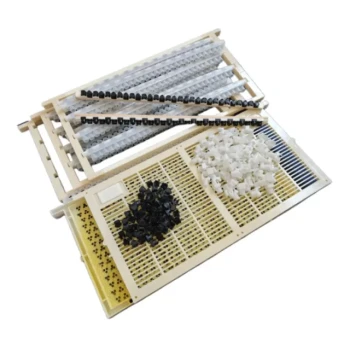
Specialized artificial queen cells serve as the fundamental catalyst for industrializing royal jelly production. By simulating the natural conditions required for queen rearing, these standardized containers induce worker bees to deposit surplus royal jelly, transforming a scarce biological secretion into a harvestable commodity suitable for large-scale extraction.
Natural hives produce royal jelly only in minute quantities for immediate larval nutrition. Artificial cells leverage this instinct, tricking the colony into over-producing the substance in standardized cups that make systematic, high-volume harvesting possible.
The Mechanics of Induced Secretion
Simulating the Natural Environment
The primary role of the artificial cell is biological mimicry.
Worker bees are instinctively driven to fill queen cells with royal jelly. By introducing artificial cells that replicate the shape and orientation of natural queen cups, beekeepers trigger this innate nursing behavior on a mass scale.
The Larval Trigger
The process relies on the precise transfer of 1-2 day old larvae into these artificial cells.
The presence of the larvae confirms to the worker bees that a "queen" is being reared. This prompts them to secrete and deposit high-purity royal jelly to feed the developing organism.
Accumulation Over Consumption
Unlike natural worker cells, artificial queen cells are designed to hold an excess of nutrients.
The goal is to induce the bees to deposit more jelly than the larva can consume. This results in a pool of residual royal jelly that can be harvested after a set period, typically 48 to 72 hours.
Enabling Industrial Efficiency
Standardization for Harvest
Without artificial cells, royal jelly is a substance that is exceptionally difficult to collect.
The artificial cell acts as a standardized vessel. This uniformity allows for the use of specialized manual tools or mechanical suction devices to extract the jelly quickly and cleanly.
Predictable Yield Cycles
The use of these cells transforms beekeeping into a structured production line.
Because the cells allow for the systematic introduction of larvae, producers can establish a rigorous schedule. This ensures a consistent, bulk harvest of high-purity jelly every few days, rather than relying on the hive's unpredictable natural swarming cycles.
Understanding the Constraints
The Precision Requirement
Not any container will work; the dimensions must be exact to ensure the colony accepts the artificial cell.
Tools such as standardized molds (often 9mm in diameter) are used to create cells with high precision. This accuracy is critical; correct dimensions can boost the larval acceptance rate to over 95 percent, directly impacting total yield.
Volume and Physical Space
The artificial cell must provide sufficient physical volume.
If the cell is too narrow, it creates cramped conditions that can cause physical distortion or nutritional deficiency in the larva. Wide artificial cells are necessary to accommodate the massive accumulation of "larval food" (royal jelly) required for a successful harvest.
Making the Right Choice for Your Operation
To maximize the efficacy of artificial queen cells in your harvesting process, consider the following strategic priorities:
- If your primary focus is maximizing volume: Prioritize high-precision molds with standardized dimensions (e.g., 9mm) to ensure acceptance rates exceed 95%.
- If your primary focus is workflow efficiency: Implement a strict 48-72 hour harvest cycle to balance maximum jelly accumulation with efficient larvae turnover.
- If your primary focus is potency retention: Ensure the standardized design of your cells is compatible with rapid-transfer suction tools to move the product immediately into cold storage.
Success in royal jelly harvesting relies on using artificial cells not just as containers, but as precise biological triggers that align hive instincts with production goals.
Summary Table:
| Feature | Role in Harvesting Process | Impact on Production |
|---|---|---|
| Biological Mimicry | Triggers worker bees' nursing instinct | Induces mass secretion of royal jelly |
| Standardization | Provides uniform vessels for larvae | Enables rapid extraction via mechanical tools |
| 9mm Dimensions | Ensures high larval acceptance rates | Increases success rate to over 95% |
| Volume Capacity | Allows for nutrient accumulation | Provides surplus jelly beyond larval consumption |
| Cycle Timing | Supports 48-72 hour harvest schedules | Ensures predictable and consistent bulk yields |
Scale Your Apiary Production with HONESTBEE
At HONESTBEE, we specialize in empowering commercial apiaries and distributors with the precision tools required for high-volume royal jelly production. Whether you need high-precision artificial queen cells, hive-making machinery, or honey-filling equipment, our comprehensive wholesale portfolio is designed to optimize your workflow.
From industrial-grade beekeeping hardware to essential consumables and honey-themed cultural merchandise, we provide the full spectrum of solutions to grow your business. Contact us today to discover how our specialized equipment can enhance your yield and efficiency.
References
- Olimpia Popescu, Daniel Severus Dezmirean. A STUDY ABOUT COMPOSITION AND QUALITY CONTROL. DOI: 10.15835/buasvmcn-asb:64:1-2:2237
This article is also based on technical information from HonestBee Knowledge Base .
Related Products
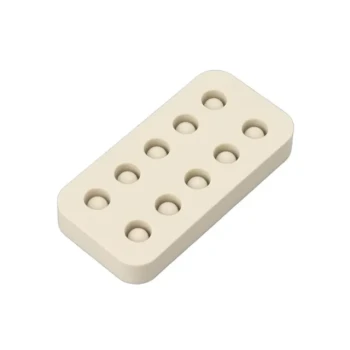
- 10-Cell Silicone Beeswax Bee Queen Cups Forming Mold
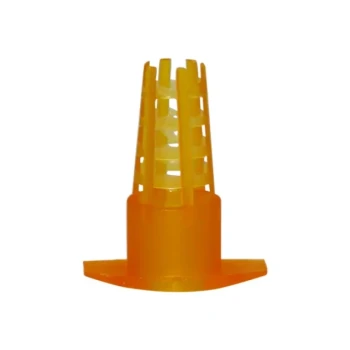
- JZBZ Type Wide Base Plastic Queen Cell Cups for Base Mounting and Queen Rearing
- Clear Black Plain Polystyrene Queen Bee Grafting Cell Cups No Lug for Bee Queen Cup
- Premium Nicot Style Cell Bar Holder and Queen Cell Cup Holder System
- Brown Nicot Queen Cell Cups for Breeding Queen Bees Beekeeping
People Also Ask
- How do beeswax queen cell cups function? Optimize Queen Rearing with Biological Mimicry
- What is the biological function of beeswax queen cell cups? Boost Acceptance in Artificial Queen Rearing
- What role do specialized queen rearing tools play in developing mite-resistant honeybee stock? Master Genetic Selection
- What materials are used to make artificial queen cell cups for grafting? Beeswax vs. Plastic Guide
- What roles do specialized queen cell cups play in royal jelly production? Optimize Your Hive's Secretion and Yield