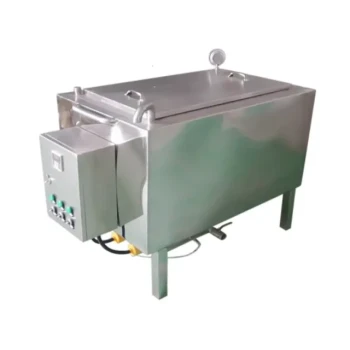
An industrial electromagnetic or electric mixer serves as the fundamental standardization tool for pollen analysis. It applies consistent mechanical shear force through constant rotation speeds to disperse pollen grains into a solvent, creating a perfectly uniform suspension known as a homogenate.
Core Takeaway: By neutralizing the physical differences between pollen grains, the mixer prevents sedimentation and density-driven separation. This ensures that any sample drawn for analysis is statistically identical to the bulk mixture, guaranteeing data accuracy.
The Mechanics of Homogenization
Applying Consistent Shear Force
To analyze pollen accurately, the sample must be physically manipulated into a state of uniformity. An industrial mixer provides mechanical shear force that manual agitation cannot replicate.
This force breaks down clusters of pollen grains. It ensures that individual grains are separated and suspended freely within the liquid solvent.
Maintaining Constant Rotation
The effectiveness of the mixer relies on its ability to maintain constant rotation speeds.
Fluctuations in speed can allow gravity to take over, causing the suspension to destabilize. The industrial nature of the equipment guarantees the sustained energy input required to keep the mixture stable over time.
Solving the Density Problem
Counteracting Sedimentation Rates
One of the greatest threats to analytical accuracy is gravity. Without constant, vigorous mixing, pollen grains will settle to the bottom of the container.
The mixer keeps the fluid in motion, preventing sedimentation. This ensures that the concentration of pollen at the top of the container is exactly the same as at the bottom.
Equalizing Botanical Variation
Pollen samples are rarely uniform; they contain grains from various botanical sources with different physical properties.
Some grains are denser or heavier than others. The mixer’s role is to neutralize these density differences, ensuring that heavy grains do not separate from lighter ones, which would otherwise skew the microscopic count.
Understanding the Trade-offs
Equipment Dependency vs. Accuracy
While manual mixing is inexpensive and requires no power, it introduces significant sampling error.
The trade-off for utilizing an industrial mixer is the requirement for a power source and equipment maintenance. However, this investment is necessary to eliminate the human variable and the inconsistency inherent in non-mechanical methods.
The Risk of Stratification
If the mixer is stopped or fails to maintain adequate speed before sampling is complete, the homogenate will stratify immediately.
Reliance on this method requires strict adherence to protocol. Sampling must occur during or immediately after the mixing process to capture the sample representativeness the machine provides.
Making the Right Choice for Your Goal
To ensure your pollen analysis yields valid scientific data, apply the mixer’s capabilities to your specific objectives:
- If your primary focus is Statistical Accuracy: Maintain constant rotation throughout the entire sampling process to prevent sedimentation from altering the count.
- If your primary focus is Sample Representativeness: Utilize sufficient shear force to fully disperse grains of varying densities, ensuring the aliquot reflects the true botanical diversity of the source.
The industrial mixer is not just a blending tool; it is the gatekeeper of statistical validity in pollen microscopy.
Summary Table:
| Feature | Role in Homogenization | Analytical Benefit |
|---|---|---|
| Consistent Shear Force | Breaks down pollen clusters and disperses grains | Ensures individual grain separation |
| Constant Rotation | Maintains energy input and prevents fluid stagnation | Eliminates sedimentation and stratification |
| Density Neutralization | Equalizes grains from various botanical sources | Prevents skewing of microscopic counts |
| Mechanical Standardization | Replaces inconsistent manual agitation | Removes human error and sampling bias |
Scale Your Apiary Operations with HONESTBEE
Are you looking to enhance the precision of your pollen analysis or scale your honey production? HONESTBEE is the trusted partner for commercial apiaries and distributors worldwide.
We provide a comprehensive wholesale catalog including:
- Advanced Machinery: From industrial mixers and hive-making machines to high-speed honey-filling lines.
- Beekeeping Equipment: A full spectrum of professional-grade tools and hardware.
- Industry Consumables: Essential supplies and honey-themed cultural merchandise.
Our equipment is designed to ensure the statistical validity of your data and the efficiency of your workflow. Contact us today to discover how our tailored wholesale solutions can grow your business!
References
- Alicia Basilio. Pollen gathering by Apis mellifera (Hymenoptera) in the lower Delta of the Paraná River: bee behavior and pollen diversity. DOI: 10.22179/revmacn.2.115
This article is also based on technical information from HonestBee Knowledge Base .
Related Products
- Electric Commercial Beeswax Melter for Factory Use
- Double Wall Honey Heating Stirring Homogenizer Mixing Machine with Various Capacity
- Economy Honey Homogenizer Mixer and Melting Machine for Beekeeping
People Also Ask
- Why might a commercial beekeeper prefer an electric beeswax melter? Maximize Profit with Speed & Scale
- What safety precautions should be taken when melting beeswax? A Guide to Flammable Wax Handling
- What types of beeswax melters are available for different scales of beekeeping? Solar vs. Electric Melters Compared
- What are the three popular methods for melting beeswax? Safely Process Your Wax with Ease
- How do you melt beeswax without making a mess? Master Safe & Clean Techniques