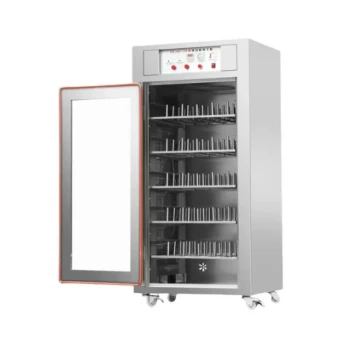
Industrial vacuum freeze-drying acts as the definitive stabilization method for preserving the pharmacological integrity of royal jelly and propolis. By utilizing low-temperature sublimation to remove moisture under extremely low pressure, this technology prevents the denaturation of bioactive proteins, converting perishable raw bee products into potent, stable powders suitable for high-grade pharmaceutical applications.
Core Takeaway The primary function of this equipment is to decouple the drying process from heat, which is traditionally the enemy of biological potency. This ensures that the final pharmaceutical ingredients retain the exact bioactive profile required for medical efficacy, from respiratory treatments to tissue repair.
The Mechanism of Preservation
Sublimation Over Evaporation
The central value of industrial vacuum freeze-drying is its ability to remove moisture through sublimation.
Instead of heating the material to evaporate water (which destroys sensitive compounds), the equipment lowers the pressure and temperature.
This causes the frozen water content in the royal jelly and propolis to transition directly from a solid state to a gas, bypassing the liquid phase entirely.
Protecting Bioactive Proteins
Royal jelly and propolis are rich in bioactive proteins that are highly susceptible to thermal degradation.
Standard drying methods introduce heat that unravels these protein structures, rendering them pharmacologically inert.
Freeze-drying maintains a cold environment throughout the dehydration process, ensuring these vital proteins remain intact and biologically active.
Enabling Pharmaceutical Formulation
Achieving Long-Term Stability
Raw bee products are naturally perishable and unstable in their native state.
Freeze-drying converts these volatile raw materials into stable dry powders.
This transformation arrests biological activity that leads to spoilage, allowing the ingredients to be stored for extended periods without losing potency.
Precision in Medical Dosages
Pharmaceutical and cosmetic applications require exact measurements, which is difficult with viscous or sticky raw materials.
The resulting dry powder allows for precise weighing and formulation.
This consistency is critical for creating standardized medical preparations, such as respiratory aids or skin repair creams, where dosage accuracy directly impacts patient outcomes.
The Critical Role of Pre-Processing (The Cold Chain)
Importance of Pre-Drying Temperature Control
While freeze-drying is the final stabilization step, the quality of the output depends on the "cold chain" maintained before drying.
Supplementary data indicates that raw propolis must be stored at -10°C immediately after collection.
This prevents the escape of volatile components and slows chemical changes that could alter the material's metallic element distribution before it ever reaches the freeze-dryer.
Physical Transformation for Extraction
Before drying, propolis specifically requires exposure to temperatures around -20°C.
At room temperature, propolis is viscoelastic and sticky, making it impossible to process efficiently.
Deep freezing renders the resin brittle, allowing it to be crushed into a fine powder. This maximizes the surface area for solvent extraction and ensures the material does not adhere to machinery.
Understanding the Trade-offs
The Necessity of Strict Temperature Control
The primary trade-off in using this technology is the operational complexity of the temperature requirements.
Effective preservation is not just about the freeze-drying machine; it requires a continuous, unbroken chain of temperature control from collection to processing.
If the raw material is not kept at -10°C during storage or -20°C during crushing, the material may chemically degrade or physically foul the equipment before freeze-drying can even occur.
Equipment Material Standards
High-purity pharmaceutical applications demand more than just temperature control.
The equipment must be manufactured from non-reactive materials to prevent cross-contamination.
Using inferior equipment risks the migration of metal ions into the propolis resin, which would compromise the purity and safety of the final medical product.
Making the Right Choice for Your Goal
When selecting equipment or designing a process for bee products, align your choice with your specific pharmaceutical objective:
- If your primary focus is Pharmacological Efficacy: Prioritize vacuum freeze-drying capabilities that guarantee low-temperature sublimation to protect heat-sensitive proteins.
- If your primary focus is Manufacturing Efficiency: Ensure your upstream equipment can achieve -20°C to induce brittleness in propolis, preventing machinery fouling and ensuring consistent crushing.
- If your primary focus is Purity and Safety: Verify that all processing surfaces are non-reactive to prevent metal ion migration and cross-contamination of flavor or odor profiles.
Ultimately, industrial freeze-drying is not just a drying method; it is a bio-preservation strategy that bridges the gap between raw nature and clinical precision.
Summary Table:
| Feature | Vacuum Freeze-Drying Impact | Pharmaceutical Benefit |
|---|---|---|
| Drying Mechanism | Low-temp sublimation (Solid to Gas) | Prevents thermal denaturation of proteins |
| Physical State | Converts viscous material to stable powder | Enables precise dosage and standardized formulation |
| Biological Activity | Arrests spoilage-related biological activity | Ensures long-term stability and extended shelf-life |
| Material Handling | Temperature-controlled brittle state | Improves extraction efficiency and prevents fouling |
| Purity Control | Non-reactive processing surfaces | Prevents metal ion migration and contamination |
Elevate Your Bee Product Processing with HONESTBEE
To bridge the gap between raw nature and clinical precision, you need equipment that guarantees biological integrity. HONESTBEE specializes in supporting commercial apiaries and distributors with high-performance beekeeping machinery and pharmaceutical-grade tools.
From specialized honey-filling and hive-making machines to advanced processing equipment, we provide the comprehensive wholesale solutions required to maintain the strict cold chains and non-reactive environments your products demand. Whether you are scaling a medical-grade production line or expanding a distribution portfolio, our expertise ensures your royal jelly and propolis meet the highest industry standards.
Ready to optimize your production and ensure medical efficacy?
Contact HONESTBEE Today for Expert Solutions
References
- Juozas Labokas, Gintarė Kleibaitė. Knowledge and Use of Bee Products in Lithuania. DOI: 10.3390/nu17243927
This article is also based on technical information from HonestBee Knowledge Base .
Related Products
- 0.5T Capacity Honey Dehumidifier Dryer with Vacuum Heating and Thickening Filtering Machine
- HONESTBEE Professional Cabinet Bottle Dryer
- Electric Commercial Beeswax Melter for Factory Use
- Economy Small Scale Honey Dryer Dehumidifier Thickening Machine
- High Quality Honey Dehumidifier Dryer Thickening Machine for Beekeeping
People Also Ask
- What is the primary function of professional dehumidification equipment in honey processing? Stability & Quality
- How to dry up honey? The Safe Guide to Stabilizing Honey and Preventing Fermentation
- What is the process for using a dehumidifier to lower honey's moisture content? Expert Drying Techniques
- How to decrease moisture in honey? Prevent Fermentation and Ensure Long-Term Quality
- How to remove humidity from honey? Protect Your Harvest from Fermentation