For high-volume royal jelly production, the key equipment is an integrated mechanization line—not a single machine. Commercial apiaries can replace labor-intensive manual grafting with bionic non-grafting larval depositor systems, then increase cell capacity with double-frame queen cup assemblies. For harvesting, automated larval withdrawal machines, vacuum extraction systems, mechanical royal jelly collectors, filtration equipment, and immediate cold-storage units support faster, cleaner, and more consistent production.
High-volume production depends on synchronizing three stages: larval placement, cell handling, and rapid extraction. The strongest commercial setup combines non-grafting deposition technology with high-density queen cup frames and mechanized collection.
The Equipment Required for Commercial-Scale Production
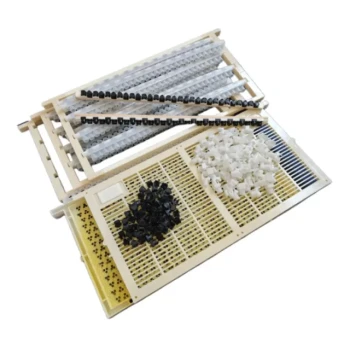
Bionic non-grafting larval depositor systems
These systems are designed to eliminate the manual transfer of thousands of one-day-old larvae into queen cups. Instead of relying on operators to graft each larva individually with a needle, the equipment automates or streamlines larval deposition.
This is often the most important mechanization upgrade because manual grafting can become the primary labor bottleneck in large apiaries.
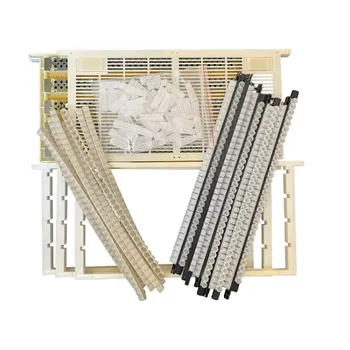
Double-frame queen cup assemblies
Double-frame queen cup assemblies increase the number of artificial queen cells that can be managed within the hive or production workflow. They are suitable for operations seeking higher production density without expanding labor proportionally.
These assemblies typically work with plastic queen cups or other artificial cell components mounted on frame bars.
Plastic queen cups and artificial queen cells
Pre-molded plastic queen cups provide standardized cell dimensions and faster preparation than traditional wax cups. They can be mounted on wooden bars or specialized queen-rearing frames for repeatable production.
For distributors and commercial buyers, these consumables are essential recurring products because mechanized equipment still depends on a reliable supply of compatible cups, bars, and replacement components.
Queen-rearing frames and cell-bar systems
Dedicated queen-rearing frames organize the cups and allow operators to move groups of cells efficiently between preparation, hive placement, withdrawal, and harvesting stages.
A well-designed frame system also improves process consistency by keeping cell spacing, orientation, and handling uniform across production batches.
Grafting needles, forceps, and precision tools
Even operations using mechanized deposition systems may require manual tools for small batches, maintenance, quality checks, or exceptional larvae. Essential tools include:
- High-precision grafting needles
- Fine forceps
- Dissecting needles
- Plastic spatulas
- Specialized royal jelly spoons
A royal jelly spoon may feature a narrow, slightly curved tip for removing jelly from individual cups with minimal residue.
Mechanizing Larval Handling and Harvesting
Automated larval withdrawal machines
After nurse bees have fed the larvae, the larvae must be removed before they consume the royal jelly or the cells are capped. Automated larval withdrawal machines accelerate this step and reduce repetitive manual handling.
This equipment is particularly valuable when a facility processes large numbers of queen cups on a strict timetable.
Vacuum suction extraction systems
A vacuum suction system can remove royal jelly directly from the queen cups. A typical arrangement includes an aspirator or collection tube connected to a vacuum pump.
Compared with manual scooping, vacuum extraction can improve throughput and reduce the time that the product remains exposed to air and potential contamination.
Mechanical royal jelly collectors
Mechanical collectors are designed to gather royal jelly from multiple cells more efficiently than individual hand tools. They may be integrated with suction, cup-handling, or collection assemblies depending on the production line.
For high-volume operations, the priority is not simply extraction speed. The collection system should also minimize product loss, air exposure, and contact with non-sterile surfaces.
Strainers and fine filtration equipment
After extraction, royal jelly may contain traces of wax, larval skins, or other cell material. Fine straining or filtration equipment removes these residues before storage or packaging.
Filtration should be designed to protect the product from unnecessary heat, prolonged exposure, or excessive handling.
Hive-Side Equipment That Supports Mechanization
Queen excluders and queenless rearing sections
A queen excluder can help isolate the queen-rearing area and maintain the conditions required for nurse bees to feed the larvae. In standard operations, grafted or deposited larvae are placed in artificial queen cups within a managed rearing section.
This equipment is not a harvesting machine, but it is important for maintaining a repeatable production cycle.
Managed nurse-bee colonies
Royal jelly production depends on strong colonies with sufficient nurse bees. Mechanized equipment cannot compensate for inadequate colony strength, poor timing, or unsuitable rearing conditions.
Commercial buyers should therefore evaluate equipment as part of a complete production system rather than as an independent factory solution.
Cell bars and cup mounting systems
Reusable or replaceable cell bars keep artificial cups organized and make it easier to transfer groups of cells through the production process. Compatible mounting systems also reduce setup time and simplify cleaning or replacement.
Standardized cup-and-bar formats are especially useful for wholesalers supplying multiple apiaries with common consumables.
Cold-Chain and Quality-Preservation Equipment
Refrigerated storage
Royal jelly is a sensitive bioactive product, so it should be refrigerated immediately after collection. Refrigerated holding units are necessary for short-term storage, batch consolidation, and preparation for packaging.
The cold-storage area should be positioned close to the extraction point to reduce the time between collection and cooling.
Freezing equipment
For longer storage, freezing equipment is commonly used to help preserve biological activity and quality. This is important when production volumes exceed immediate packaging or order-fulfillment capacity.
Distributors and B2B buyers should confirm that cold-storage capacity matches expected production volumes rather than treating refrigeration as an afterthought.
Hygienic collection and handling components
Pumps, tubes, collection containers, filters, and transfer tools should be selected for hygienic handling and easy cleaning. The goal is to reduce contact between the raw product, air, operators, and potentially contaminated surfaces.
A complete supplier package may therefore include both major machinery and the smaller components required to keep the line operational.
How the Production Workflow Fits Together
1. Prepare the queen cups and frames
Plastic queen cups or artificial cells are mounted onto compatible bars or double-frame assemblies. The equipment should allow fast loading, consistent spacing, and easy transfer.
2. Deposit or graft one-day-old larvae
The larvae are placed into the cups using either a bionic non-grafting depositor system or precision manual grafting tools. For large production volumes, non-grafting deposition reduces the main labor constraint.
3. Place the frames in managed colonies
The prepared frames are placed in an appropriate nurse-bee or queenless rearing section. The colony provides royal jelly to the developing larvae during the scheduled production period.
4. Withdraw the larvae on schedule
Automated withdrawal equipment or manual forceps remove the larvae before they consume the accumulated jelly or the cells are capped. Timing is critical because delays can significantly reduce recoverable yield.
5. Extract and filter the royal jelly
Mechanical collectors, vacuum systems, or manual spoons remove the jelly from the cups. The product is then fine-strained to remove wax and larval residues.
6. Cool the product immediately
The collected royal jelly should move directly into refrigeration or freezing. Rapid cooling helps preserve its sensitive proteins and other bioactive components.
Understanding the Trade-offs
Automation reduces labor but increases system complexity
Non-grafting depositors, larval withdrawal machines, and mechanical collectors can significantly improve throughput. However, they require investment, operator training, compatible consumables, cleaning procedures, and maintenance support.
The best solution is not always the most automated one. A semi-automated line may be more practical for a medium-sized apiary that needs flexibility across different production batches.
Higher capacity requires stronger process control
Double-frame assemblies and high-density cup systems can increase output, but they also increase the consequences of poor timing or weak colony management. More cells do not automatically produce more saleable royal jelly if nurse-bee capacity and harvesting schedules are inadequate.
Vacuum extraction improves speed but requires hygienic design
Vacuum systems can harvest jelly quickly and reduce manual contact. Poorly designed tubing, collection vessels, or cleaning procedures can introduce contamination or cause product loss.
Buyers should assess the complete fluid path, not just the pump specification.
Cold storage is a production requirement, not an optional accessory
A fast extraction system is of limited value if the product remains at room temperature while operators finish a large batch. Refrigeration or freezing capacity must be sized alongside harvesting equipment.
Choosing a Supply Package for Different Operations
A reliable commercial sourcing package should cover more than the headline machine. It may include deposition equipment, queen cups, frames, cell bars, larval withdrawal systems, vacuum collectors, filters, cleaning accessories, and cold-storage equipment.
For distributors and wholesalers, a full-spectrum product portfolio creates practical value because customers can source compatible equipment and consumables through one channel. Rapid response, technical product matching, spare parts availability, and efficient fulfillment are especially important when production schedules depend on narrow harvesting windows.
Making the Right Choice for Your Goal
Select equipment according to production volume, labor availability, colony capacity, and required product quality.
- If your primary focus is reducing manual labor: Prioritize a bionic non-grafting larval depositor and automated larval withdrawal machine.
- If your primary focus is increasing cell capacity: Choose double-frame queen cup assemblies, standardized plastic cups, and compatible queen-rearing frames.
- If your primary focus is faster harvesting: Invest in a vacuum suction system or mechanical royal jelly collector with hygienic collection components.
- If your primary focus is preserving product quality: Pair rapid extraction with fine filtration and immediate refrigeration or freezing.
- If your primary focus is reliable commercial sourcing: Work with a supplier that can provide the complete equipment-and-consumables package, technical support, and fast order fulfillment.
With the right combination of automation, hive-side equipment, hygienic collection, and cold-chain control, royal jelly production can be transformed from a labor-heavy apiary task into a repeatable high-volume operation.
Summary Table:
| Equipment Category | Key Equipment | Function | Benefits |
|---|---|---|---|
| Larval Deposition | Bionic non-grafting larval depositor systems | Automates transfer of larvae into queen cups | Eliminates manual grafting bottleneck |
| Cell Capacity | Double-frame queen cup assemblies | Increases number of queen cells per frame | Higher output per hive |
| Consumables | Plastic queen cups, artificial cells, cell bars | Standardized reusable components | Consistency and ease of use |
| Harvesting | Automated larval withdrawal machines | Removes larvae before capping | Saves time, reduces labor |
| Extraction | Vacuum suction systems, mechanical collectors | Rapidly extract royal jelly from cups | Increases throughput, reduces exposure |
| Filtration | Strainers, fine filtration | Removes impurities | Ensures product purity |
| Cold Chain | Refrigerated storage, freezing units | Immediate cooling after harvest | Preserves bioactive properties |
Ready to upgrade your royal jelly production? HONESTBEE offers complete mechanization lines, from non-grafting depositors to cold-chain solutions, tailored for commercial apiaries and distributors. We provide OEM/ODM support, fast delivery, and reliable supply. Contact us today to optimize your operation and increase profitability — Get a Free Quote!
Related Products
- No Grafting Queen Rearing Kit: System for Royal Jelly Production and Queen Rearing
- HONESTBEE Improved No Grafting Queen Rearing Kit For Queen Rearing and Royal Jelly Production
- Plastic Chinese Queen Grafting Tool for Bee Queen Rearing
- Double Nozzle Small Honey Filling Machine Honey Sachet Packing Packaging Equipment
- Manual Honey Filling Machine Bottling Machine for Honey
People Also Ask
- What is the primary function of a queen rearing kit? Eliminate Manual Grafting for Superior Bee Breeding
- How do specialized queen rearing kits and queen management tools improve the success rate of bee colony expansion?
- What are some alternative methods to grafting for queen cell production? Discover Graft-Free Queen Rearing Systems
- Are queen rearing systems generally suitable for all honeybee species? Master Efficient Breeding Methods
- Are queen rearing systems suitable for all beekeepers? Modern Tools for Every Experience Level