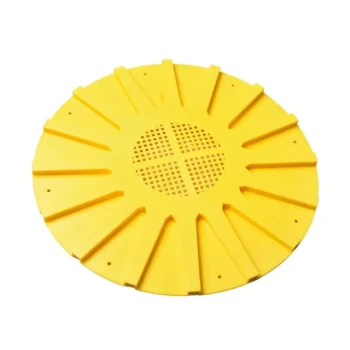
Beehive landing boards serve as a critical external staging ground for active colony ventilation. During periods of high heat—specifically when ambient temperatures exceed 24°C—these boards provide the necessary physical surface area for worker bees to align outside the hive entrance and mechanically drive airflow.
Core Insight: The landing board is not merely a doorway; it is an active cooling component. It allows the colony to externalize the labor of temperature regulation, enabling massed bees to exhaust hot air and draw in cool air without overcrowding the hive interior.
The Mechanics of Heat Exchange
Creating a Ventilation Station
When internal temperatures rise, the landing board acts as a physical foundation for a large number of worker bees.
Rather than crowding the internal entrance, ventilating bees move onto this external platform.
This expansion of space allows a significant portion of the workforce to dedicate themselves to cooling duties without obstructing traffic flow.
Generating Directional Airflow
The primary function of bees on the landing board is to facilitate active air circulation.
Bees align themselves on the board and fan their wings at high frequencies.
This coordinated movement creates a pressure differential that efficiently exhausts hot, stale air from the hive while drawing in cooler, fresh air from the outside environment.
Efficiency at Critical Temperatures
This mechanism becomes vital once the temperature surpasses the 24°C threshold.
The structural design of the board directly influences exchange efficiency.
A larger or better-designed surface area allows more bees to participate in the fanning process, increasing the volume of air turned over per minute.
Impact on Colony Health
Preventing Structural Failure
Effective ventilation supported by the landing board protects the hive's physical integrity.
By regulating the internal temperature, the colony prevents the softening or melting of beeswax structures.
This ensures that combs remain rigid enough to support the weight of stored honey and developing brood.
Reducing Biological Stress
The airflow generated on the landing board assists in evaporative cooling.
This reduces the overall workload for bees inside the hive, freeing them for foraging and other tasks.
Crucially, this temperature control prevents larval death due to overheating, ensuring the colony maintains normal growth rates during heat waves.
Understanding the Trade-offs
Design Limitations
The mere presence of a landing board does not guarantee optimal ventilation.
Surface area matters. If the board is too small or poorly designed, it bottlenecks the number of bees that can fan simultaneously, capping the cooling efficiency regardless of the colony's size.
Balancing Ventilation with Defense
In multi-family systems, landing boards serve a dual purpose: ventilation and territorial guidance.
While large boards help with cooling, in high-density apiaries (like two-block hives), the board must also clearly define the entrance to prevent drifting and fighting.
An overly broad board without clear demarcation can lead to resource wars between colonies, negating the benefits of improved ventilation.
Making the Right Choice for Your Goal
To select or design the right landing board for your apiary, consider your primary environmental constraints:
- If your primary focus is Extreme Heat Management: Prioritize large, wide landing boards that maximize surface area, allowing the highest number of bees to align for fanning.
- If your primary focus is Multi-Family Organization: Ensure the landing boards are distinct and separate for each section to minimize drifting while still providing adequate space for airflow.
Ultimately, the landing board is an essential infrastructure investment that buffers your colony against climate stress and ensures survival during peak summer temperatures.
Summary Table:
| Ventilation Function | Description & Impact |
|---|---|
| Staging Ground | Provides external surface area for worker bees to fan without blocking the hive entrance. |
| Airflow Generation | Facilitates a pressure differential to exhaust hot air and intake cool air when >24°C. |
| Structural Safety | Prevents beeswax from melting and combs from collapsing due to internal heat. |
| Biological Health | Reduces larval mortality and biological stress by maintaining optimal brood temperatures. |
| Space Efficiency | Allows for massed cooling labor while keeping internal traffic flow clear. |
Boost Your Apiary Efficiency with HONESTBEE Professional Equipment
Protect your colonies from extreme heat with high-performance beehive components. HONESTBEE specializes in supporting commercial apiaries and distributors with a complete range of wholesale beekeeping solutions. From precision-engineered hive-making and honey-filling machines to durable hardware and essential consumables, we provide everything needed to scale your operations.
Partner with HONESTBEE to access:
- Comprehensive Wholesale Supplies: Tools, machinery, and equipment for any scale.
- Industry Expertise: Hardware designed for maximum colony ventilation and health.
- Complete Portfolio: Everything from specialized machinery to honey-themed cultural merchandise.
Ready to upgrade your equipment? Contact us today to discuss your wholesale needs!
References
- Валерій Дмитрович Броварський, О.С. Величко. Високi температури навколишнього середовища i етологiя бджiл. DOI: 10.18372/2306-6407.1.16145
This article is also based on technical information from HonestBee Knowledge Base .
Related Products
- Langstroth Solid Bottom Board for Beekeeping
- Solid Bottom Board Australian Pine Wood Langstroth Bottom Board for Wholesale
- HONESTBEE Wooden Bee Escape Board with Triangle Mesh Design for Beekeeping
- Efficient Hive Clearing: HONESTBEE 8-Way Plastic Bee Escape
- Wooden Bee Hive Frames for Beekeeping and Wholesale
People Also Ask
- What are the functions of solid bottom boards for a beehive? Essential Thermal Protection and Winter Survival Tips
- What is the purpose of a solid bottom board for bee hives? Enhance Hive Health and Winter Survival
- How does climate influence the choice between a solid and screened bottom board? Optimize Your Hive for Local Weather
- What is the primary function of a bottom board in a modern modified beehive system? Essential Foundation Guide
- What are the characteristics of a solid bottom board for a beehive? Boost Colony Health and Thermal Insulation