Prioritize ventilation, secure containment, standardized dimensions, and load-bearing construction when selecting swarm-collecting boxes and hive transport equipment. Swarm boxes should keep bees cool and calm while accommodating the full cluster, while transport equipment must safely support the substantial weight of occupied hives. Designs that also match standard hive dimensions or support multiple uses can simplify field operations, inventory management, and downstream hive installation.
The best equipment combines continuous airflow, reliable closure, appropriate internal volume, standardized compatibility, and robust structural support. Ventilation protects the colony from heat buildup; secure, compatible construction makes collection, transport, and transfer more efficient.
Structural Priorities for Swarm-Collecting Boxes
Integrated ventilation is essential
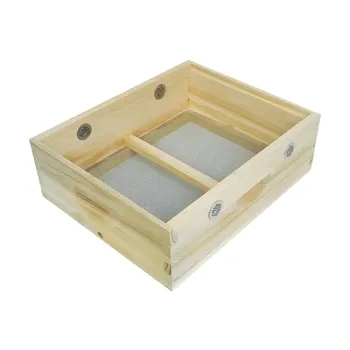
A swarm box should include integrated wire mesh, gauze windows, or ventilation ports. These features allow continuous airflow and reduce the risk of lethal heat buildup when a clustered swarm is sealed during transport.
Mesh should be securely attached rather than loosely fitted. Metal-reinforced flanges or protective frames help prevent damage during repeated handling and maintain ventilation performance over the product’s service life.
The box must accommodate the entire swarm
The container should be sized to house the full bee cluster, including any attached branch material that cannot be removed immediately. An undersized box can compress the cluster, restrict airflow, and make secure closure more difficult.
For field collection, adequate internal clearance is more important than minimizing the box’s external dimensions. The design should allow operators to place the swarm inside without excessive shaking or disturbance.
Secure closure prevents escapes
A swarm box needs a reliable sealing system that remains closed during lifting, vehicle movement, and temporary storage. The closure should work together with the ventilation system so that sealing the box does not eliminate airflow.
Smooth edges and secure fittings also reduce the risk of crushing bees during closure. This is particularly important when the box is being handled quickly in field conditions.
Standardized dimensions improve transfer
Versatile swarm boxes that accommodate standard hive dimensions can make it easier to transfer a captured colony into a permanent brood chamber. Compatibility reduces the need for improvised adapters, repacking, or prolonged colony disturbance.
Some designs can also serve as queen-rearing equipment or temporary nuc hardware. For distributors and resellers, this multifunctionality can make one product relevant to more customer applications.
Structural Priorities for Hive Transport Equipment
Load-bearing construction comes first
Occupied hives are heavy, so transport equipment must be designed around the total loaded weight, not the empty hive body alone. Frames, brood, honey, equipment, and the colony all contribute to the handling load.
Prioritize rigid construction, stable support surfaces, and hardware that can tolerate repeated loading and unloading. A lightweight design is useful only if it remains structurally secure under real operating conditions.
The hive must remain stable during movement
Transport equipment should hold hive components securely and limit unwanted shifting. Movement can disturb the colony, damage hive parts, or compromise ventilation and closures.
Look for a design that supports the hive evenly and allows operators to secure the load without obstructing necessary airflow. Stability is especially important during rapid handling and vehicle transport.
Compatibility should be built into the design
Transport equipment should match the standard dimensions of the hive systems used by the intended market. Broad compatibility improves purchasing flexibility for beekeepers and allows distributors to serve more customers with fewer product variations.
Where equipment is used with standard frames and hive bodies, maintaining the correct bee space—approximately 1 centimeter between parallel comb faces—is essential. This prevents burr comb and blocked frame gaps that can complicate inspections, frame removal, and mechanical honey extraction.
Consider hive climate management
Transport hardware should not unintentionally block the hive’s ventilation paths or interfere with compatible inner covers. Inner covers commonly use ventilation openings to regulate airflow and moisture inside the hive.
A practical transport system therefore needs to preserve the hive’s climate-management features while keeping the colony contained. Avoid designs that force operators to remove or modify standard components unnecessarily.
Designing for Field Collection and Transfer
Support gentle handling
Swarm equipment should allow the operator to collect and transfer bees with minimal disturbance. When a swarm is attached to a branch, heavy-duty pruning shears can help remove the supporting branch cleanly before placing the cluster into the capture box.
The box itself should provide enough opening area and access for a controlled transfer. Structural convenience matters because difficult access encourages rough handling and increases the chance of losing bees.
Support eventual hive installation
A swarm box is more valuable when its form factor supports a straightforward move into a permanent hive. Standardized dimensions, compatible frames, and secure but accessible closures reduce the time between capture and final placement.
For commercial buyers, this makes the product easier to position as part of a broader capture-to-hive equipment solution, rather than as a single-purpose container.
Match volume to the intended use
Hive bodies used for commercial beekeeping commonly fall within an approximate 30–40 liter range, providing usable space for brood rearing and honey storage while remaining manageable for temperature regulation and colony defense. This range should be treated as a reference for compatible hive systems, not as a universal requirement for every swarm container.
The correct size depends on whether the box is intended for short-term capture, temporary nuc use, queen rearing, or direct transfer into a standard hive.
Understanding the Trade-offs
More ventilation can reduce protection
Large mesh panels improve airflow but may reduce protection from weather, impact, and unwanted openings. The strongest designs balance open ventilation with guarded, reinforced mesh construction.
Ventilation should be evaluated as part of the complete enclosure, not as a feature added without regard to durability or security.
Larger boxes improve capacity but reduce mobility
A larger container can accommodate a substantial cluster and attached branches, but it may become harder to lift, carry, and secure. Excess internal space can also complicate handling if the colony is not stabilized appropriately.
Choose the smallest practical volume that safely accommodates the intended swarm and collection method.
Multifunctionality may increase complexity
A box that serves as a swarm container, nuc, and queen-rearing unit can reduce equipment duplication. However, additional functions may introduce removable parts, nonstandard fittings, or compromises in ease of use.
For high-volume distribution, prioritize multifunctionality only when the additional features remain intuitive, durable, and compatible with common hive hardware.
Weight reduction must not weaken transport safety
Lightweight transport equipment can reduce labor and shipping costs, but insufficient rigidity creates a greater operational risk. Structural performance should take priority over minimal empty weight when moving occupied hives.
Ask suppliers for clear specifications on load capacity, dimensions, materials, and closure or securing methods before making a bulk purchase.
Evaluating Suppliers and Product Portfolios
Check the complete equipment ecosystem
Distributors and wholesalers should assess whether a supplier can provide compatible swarm boxes, hive bodies, inner covers, transport hardware, and supporting tools. A one-stop product portfolio reduces sourcing complexity and helps customers build complete operating systems.
Compatibility across the portfolio is often more valuable than isolated low pricing on one component.
Verify practical specifications
Before ordering, confirm:
- Ventilation construction: Mesh type, port placement, reinforcement, and airflow access.
- Internal capacity: Suitability for the intended swarm, cluster, or hive configuration.
- Hive compatibility: Standard dimensions, frame spacing, and inner-cover fit.
- Load performance: Rated capacity and stability for occupied hives.
- Closure security: Resistance to accidental opening during handling and transport.
- Material durability: Resistance to outdoor moisture, impact, and repeated use.
- Order fulfillment: Availability, response time, delivery speed, and after-sales support.
These checks help distinguish equipment that merely appears suitable from equipment that can perform reliably in commercial conditions.
Making the Right Choice for Your Goal
Use the following priorities to match structural features to the intended application:
- If your primary focus is safe swarm capture: Choose a box with reinforced integrated ventilation, sufficient room for the entire cluster and attached branches, and a secure, bee-safe closure.
- If your primary focus is fast transfer into permanent hives: Prioritize standard hive dimensions, compatible frame arrangements, and a design that can also function as temporary nuc or queen-rearing equipment.
- If your primary focus is hive transportation: Select rigid, load-bearing equipment that stabilizes occupied hives without blocking ventilation or interfering with standard inner covers.
- If your primary focus is wholesale or distribution efficiency: Source a compatible product range from suppliers offering dependable specifications, rapid response, efficient fulfillment, and reliable after-sales service.
The right structural design protects the colony, simplifies handling, and gives distributors and beekeepers a dependable equipment platform from capture through transport and final hive installation.
Summary Table:
| Equipment Type | Key Structural Features | Why It Matters |
|---|---|---|
| Swarm-Collecting Boxes | Integrated ventilation (mesh, gauze, ports) | Prevents heat buildup and keeps bees calm |
| Adequate internal volume | Accommodates full cluster and attached branches | |
| Secure closure with bee-safe edges | Prevents escapes and bee damage | |
| Standardized dimensions compatible with hives | Simplifies transfer and multifunctional use | |
| Hive Transport Equipment | Load-bearing construction rated for occupied hives | Ensures safety and durability |
| Stable support to prevent shifting | Minimizes colony disturbance and damage | |
| Compatibility with standard hive dimensions and bee space | Maintains proper hive function | |
| Preservation of ventilation and climate management | Supports colony health during transport |
Enhance Your Beekeeping Operations with HONESTBEE
At HONESTBEE, we provide a comprehensive wholesale portfolio of beekeeping tools, machinery, and equipment, including high-quality swarm-collecting boxes and hive transport solutions. Our products are designed with the structural priorities that matter, ensuring safety, efficiency, and reliability.
Why choose HONESTBEE?
- One-stop sourcing: Full spectrum of products, from hive-making machines to honey-themed merchandise.
- Premium trading services: Rapid response, dedicated customer service, and deep professional expertise.
- Ultra-fast delivery: Efficient order fulfillment to keep your operations running smoothly.
- B2B support: OEM/ODM customization, certifications, and supply reliability for distributors and resellers.
Ready to upgrade your equipment? Contact us today for tailored solutions that boost your productivity and profitability!
Related Products
- Plastic Transporting Bee Packages and Nuc Boxes for Beekeeping
- Durable Plastic Interlocking Hive Connector for Beekeeping
- Langstroth Honey Bee Box Hive Boxes for Different Depths
- Metal Bee Hive Stand Bee Box Stand for Beekeeping
- Automatic High-Speed Bee Hive Box Stapling Machine
People Also Ask
- What role do bee package boxes play in the commercial transport and expansion of honeybee colonies? - Logistic Essentials
- What are beekeeping boxes called? A Guide to Hive Bodies and Box Types
- How do standardized bee packages serve as a recovery mechanism for commercial beekeeping? Ensure Business Continuity
- What is the commercial value of using standardized bee packages? Drive Scalability in Large-Scale Apiaries
- Why is the timely introduction of high-quality bee packages critical? Save Your Apiary from Asian Hornet Invasions