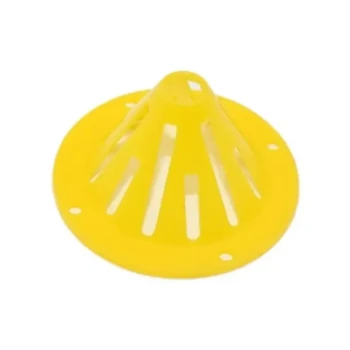
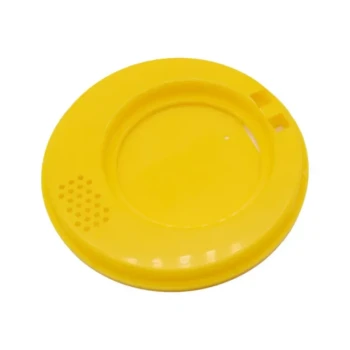
The primary technical challenge addressed is the lack of a standardized, secure interface for attaching external accessories to the hive entrance. By implementing a low-relief halo structure, the design provides a dedicated connection point for installing predator guards or attaching flight tubing for remote access.
The low-relief halo structure transforms the hive entrance from a simple opening into a modular interface. It solves two critical issues: securing the colony against small predators and enabling flexible placement of the hive indoors by connecting it to the outside via tubing.
Enhancing Hive Security and Connectivity
The halo structure is not merely aesthetic; it is a functional adapter that resolves specific environmental and biological threats.
Mitigating Predator Threats
The entrance of a stingless bee hive is often a point of vulnerability. The low-relief halo facilitates the installation of protective devices.
This specific design allows beekeepers to attach guards that prevent the intrusion of common predators. As noted in the reference, this is particularly effective against threats such as ants and lizards.
Enabling Indoor Application
Perhaps the most significant technical problem solved is the limitation of hive placement. The halo structure supports the connection of plastic tube flight tunnels.
This creates a bridge between the hive and the external environment. Consequently, the hive can be housed safely indoors while the bees maintain access to the outdoors to forage.
Expanding Use Cases
By solving the connectivity issue, the structure opens new possibilities for deployment.
It significantly expands the application of these hives in controlled settings. This includes laboratory environments for research and environmental education exhibitions where live observation is required without exposing the colony to the elements directly.
Operational Considerations
While the low-relief halo solves connectivity issues, it introduces specific operational requirements that must be managed.
Reliance on Connection Integrity
The effectiveness of the system is entirely dependent on the quality of the attachment at the halo.
If using the structure for flight tunnels, the connection must be secure to prevent bees from escaping into the indoor environment. Similarly, a loose connection to a predator guard renders the protection useless.
Optimizing Hive Configuration
The low-relief halo provides versatility, but how you utilize it depends on your specific objectives.
- If your primary focus is colony survival: Prioritize using the halo to mount protective barriers that specifically target local pests like ants and lizards.
- If your primary focus is education or research: Utilize the halo's tubing connection capabilities to install the hive indoors, allowing for safe, close-up human observation while maintaining a natural foraging cycle.
The low-relief halo structure effectively bridges the gap between the natural needs of the bee colony and the practical requirements of human management and observation.
Summary Table:
| Feature | Technical Problem Addressed | Practical Benefit |
|---|---|---|
| Standardized Interface | Lack of secure attachment points | Easy installation of modular accessories |
| Predator Guard Support | Vulnerability to ants and lizards | Enhanced colony survival and defense |
| Tubing Compatibility | Limited hive placement options | Enables indoor research and educational displays |
| Modular Design | Inflexible hive entry points | Versatile deployment in various environments |
Partner with HONESTBEE for Professional Beekeeping Solutions
Are you looking to scale your apiary operations or expand your distribution network? HONESTBEE provides commercial apiaries and distributors with premium beekeeping tools, specialized hive-making machinery, and essential consumables designed for modern efficiency.
Our comprehensive wholesale portfolio includes everything from protective hive structures to advanced honey-filling equipment and honey-themed cultural merchandise. Let us help you optimize your colony management and increase your market value.
Contact HONESTBEE Today to Discuss Your Wholesale Needs
References
- Celso Barbiéri, Tiago Maurício Francoy. A Scientific Note on a Stingless Bee Hive Model for Ecological and Behavioral Studies and for Environmental Education. DOI: 10.13102/sociobiology.v66i1.3401
This article is also based on technical information from HonestBee Knowledge Base .
Related Products
- HONESTBEE Entrance Bee Feeder Efficient Hive Front Liquid Feeding Solution for Beekeeping
- HONESTBEE Entrance Bee Feeder Professional Hive Nutrition Solution for Beekeeping
- Beehive Entrance Discs Plastic Bee Entrance Disc for Bee Hives
- Professional Reversible Beehive Hive Entrance
- Multi-Functional Sliding Hive Entrance for Beekeeping
People Also Ask
- What types of bee feeders are available for beginners? Start with the Simple Entrance Feeder
- What are the advantages and disadvantages of using an entrance feeder for bees? Balance Convenience and Hive Security.
- What is a bee entrance feeder and what are its drawbacks? Essential Guide to Hive Security and Feeding Efficiency
- How does a bee entrance feeder work? A Simple Guide to Convenient Hive Feeding
- How to make an entrance feeder for bees? A DIY Guide for Safe & Effective Feeding