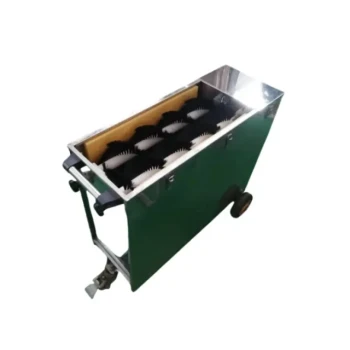
The fundamental difference lies in hive architecture. Traditional centrifuges are designed for the flat, uniform honeycomb frames of Apis mellifera (European honeybees), which do not exist in stingless bee colonies. Because stingless bees store honey in irregular clusters of specialized cerumen pots, flexible tube suction is the only method that allows for extraction without physically destroying the hive's delicate internal structure.
Core Insight: The preference for suction over centrifugation is not merely about efficiency, but physical possibility and biological preservation. Suction devices allow for the non-destructive harvesting of individual pots, ensuring high honey purity while drastically reducing the stress and repair workload placed on the colony.
The Architecture Problem: Pots vs. Combs
The Incompatibility of Centrifuges
Centrifugal extractors rely on spinning removable frames to force honey out of open cells. Stingless bees, however, build distinct, enclosed vessels known as cerumen pots made of propolis and wax. These pots are often fused together in complex, irregular clusters that cannot be placed into a standard centrifuge.
Precision Access via Flexible Tubes
Flexible tube suction devices are designed to navigate the unique geometry of a stingless bee nest. Operators can maneuver the tube to access individual pots, piercing the seal to extract honey via negative pressure. This method accommodates the natural, non-uniform layout of the hive without requiring the removal or destruction of the storage structures.
Ensuring Purity and Quality
Preventing Cross-Contamination
Traditional alternatives to centrifugation for stingless bees involve crushing or pressing the hive material, which is disastrous for quality. Pressing often mixes the honey with royal jelly, larval fluids, bee bread, and propolis. Suction extraction isolates the honey, significantly reducing the introduction of these mechanical impurities.
Superior Clarity
By using a vacuum principle to draw liquid directly from the pot into a collection vessel, the final product retains high clarity. This "non-contact" harvesting method bypasses the need for heavy filtration to remove debris that would otherwise cloud the honey during a crushing process.
Colony Health and Sustainability
Non-Destructive Harvesting
The primary biological advantage of suction is that it preserves the structural integrity of the cerumen pots. The pots remain largely intact after draining, meaning the structural framework of the hive is not compromised during the harvest.
Reduced Energy Expenditure
When pots are destroyed (as they would be in pressing) or removed, bees must expend significant energy and resources to rebuild them from scratch. With suction harvesting, the bees only need to repair the small puncture or reseal the pot. This shortens the colony's recovery time and allows them to resume continuous production more quickly.
Understanding the Trade-offs
Operational Speed
While suction preserves quality, it is inherently more labor-intensive than centrifugal extraction. Each honey pot must be targeted individually, making the process slower than spinning multiple frames simultaneously.
Equipment Maintenance
Suction devices involve hoses, pumps, and collection bottles that require rigorous cleaning to maintain hygiene. The sticky nature of honey combined with the narrow diameter of flexible tubes can lead to clogging if not managed correctly during the extraction process.
Making the Right Choice for Your Goal
To maximize the success of your harvesting operation, align your method with your specific priorities:
- If your primary focus is honey purity: Use electric vacuum suction to prevent the contamination of honey with pollen, larval fluids, or propolis.
- If your primary focus is colony longevity: Prioritize suction devices with adjustable pressure to minimize stress on the bees and preserve the cerumen pots for rapid re-use.
By aligning the harvesting mechanism with the natural architecture of the bee's nest, you ensure a sustainable cycle of production that benefits both the harvester and the hive.
Summary Table:
| Feature | Flexible Tube Suction | Traditional Centrifuge |
|---|---|---|
| Hive Compatibility | Ideal for irregular cerumen pots | Designed for flat honeycombs only |
| Structural Impact | Non-destructive; pots remain intact | Requires frame removal/destruction |
| Honey Purity | High; isolates honey from brood/pollen | High risk of cross-contamination |
| Colony Recovery | Fast; minimal repair needed | Slow; requires major rebuilding |
| Process Type | Precision vacuum extraction | Centrifugal force spinning |
Elevate Your Beekeeping Operation with HONESTBEE
At HONESTBEE, we understand that the delicate nature of stingless bee colonies requires specialized solutions. As a leading provider for commercial apiaries and distributors, we offer a comprehensive wholesale range of professional beekeeping tools and machinery designed for precision and sustainability.
Whether you need advanced honey-filling machines for your processing line or durable hardware to support large-scale hive management, our portfolio delivers the quality your business demands. Partner with us to access high-performance equipment that maximizes your honey purity and protects your colony health.
Ready to scale your production? Contact us today to explore our wholesale offerings and discover how HONESTBEE can streamline your harvesting workflow.
References
- Larry Yah-Rosales, Sergio A. Baz-Rodríguez. Physicochemical, Rheological, and Thermal Properties of Pot-Honey from the Stingless Bee Melipona beecheii. DOI: 10.15446/ing.investig.103232
This article is also based on technical information from HonestBee Knowledge Base .
Related Products
- Adjustable Stainless Steel Honey Uncapping Fork with Plastic Handle for Beekeeping
- Plastic Handle Single Row Artificial Fiber Bee Brush
- All-Stainless Steel Pivoting Honey Uncapping Fork for Beekeeping
- Double Sided Adjustable Honey Uncapping Fork with Plastic Handle
- Stainless Steel Pivoting Honey Uncapping Fork with Plastic Handle
People Also Ask
- What is the design purpose of honey uncapping forks and honey uncapping tanks? Maximize Your Harvest Efficiency
- How does a honey uncapping fork supplement the use of an uncapping knife? Boost Your Honey Yield and Extraction Efficiency
- What are the essential tools for uncapping honey frames? Choose the Right Tool for Your Apiary
- What other tools are available for honey uncapping besides knives? Find the Right Tool for Your Apiary's Scale
- What tools are used for honey uncapping? Choose the Right Knife for Your Harvest