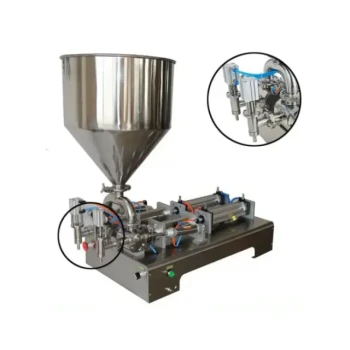
Industrial-grade automatic filling machines are the critical link between raw agricultural production and a viable commercial product. These systems utilize precise quantitative filling and sealing technologies to ensure hygienic safety, preventing the honey from contacting air or moisture. This process effectively halts fermentation and spoilage, delivering the standardized packaging necessary for entry into high-end retail markets and international export trade.
While manual packing may suffice for direct farm-gate sales, it cannot achieve the preservation standards required for broad commercial distribution. Industrial automation transforms honey from a perishable bulk commodity into a shelf-stable brand by scientifically controlling hygiene and exposure.
Ensuring Hygienic Integrity and Preservation
Preventing Environmental Contamination
Honey is naturally hygroscopic, meaning it absorbs moisture from the air. If moisture levels rise, yeast can activate, leading to fermentation.
Industrial filling machines create a controlled environment that minimizes honey's contact with air and humidity. By hermetically sealing the product immediately after filling, these machines prevent the absorption of moisture that causes spoilage.
Eliminating Secondary Contamination
Manual handling is the leading cause of "secondary contamination," where bacteria or foreign particles are introduced during packaging.
Automated systems operate as closed loops, removing the human variable from direct contact with the product. This sterility is essential for extending shelf life and ensuring the honey remains safe for consumption over long periods.
Meeting Global Retail Standards
Precision in Quantitative Filling
Commercial retailers, from supermarkets to export partners, demand strict adherence to labeled weights and volumes.
Automatic machines utilize precise metering controls to ensure every unit contains exactly the specified amount of honey. This consistency is virtually impossible to achieve with manual pouring but is a legal and technical requirement for formal retail channels.
Accessing High-End and Export Markets
To enter the international trade market or high-end domestic retail, a product must meet rigorous technical specifications regarding packaging integrity.
Retailers require standardized, professional packaging that guarantees the product will not leak or degrade during transport. Industrial-grade machinery provides the mechanical reliability and sealing strength that manual operations cannot replicate, acting as a prerequisite for market expansion.
Transitioning from Commodity to Brand
Establishing Product Uniformity
A commercial brand relies on the consumer's trust that the product will be the same every time they buy it.
Automation ensures that different batches of honey maintain consistent purity, volume, and visual presentation. This uniformity transforms honey from a variable agricultural product into a recognizable, trusted commercial commodity.
Enhancing Sensory Quality
Speed and precision in filling help preserve the honey's unique physical properties.
By reducing the time honey is exposed to processing environments, automated equipment helps retain original aromas, flavors, and color. It ensures that the sensory quality produced at the apiary is the same quality experienced by the consumer.
Understanding the Trade-offs
Capital Investment vs. Volume
Industrial-grade machinery represents a significant upfront capital expense compared to manual labor.
For very small operations with low output, the Return on Investment (ROI) may be slow. These machines are designed for scale; they become cost-effective only when production volumes are high enough to justify the initial expenditure.
Maintenance and Technical Requirements
Automation introduces complexity to the production line.
These machines require regular, specialized maintenance and calibration to maintain their precision. Operators must be trained not just in honey processing, but in the operation and sanitation of complex mechanical systems.
Making the Right Choice for Your Goal
To determine if industrial automation is the right step for your operation, consider your specific market targets:
- If your primary focus is International Export: You must prioritize automation to ensure the hermetic sealing required to prevent fermentation during long-haul shipping.
- If your primary focus is High-End Retail: You need industrial filling to achieve the precise volumetric consistency and standardized appearance required by supermarket stocking agreements.
- If your primary focus is Brand Longevity: You should invest in automation to eliminate secondary contamination, ensuring your product remains safe and shelf-stable for months or years.
True commercial viability begins when you can guarantee purity and consistency at scale.
Summary Table:
| Feature | Manual Filling | Industrial Automatic Filling |
|---|---|---|
| Hygienic Control | High risk of secondary contamination | Closed-loop sterile environment |
| Volume Precision | High variance; prone to wastage | Exact quantitative metering |
| Shelf Stability | Limited; prone to fermentation | Maximum; hermetic sealing prevents moisture |
| Market Access | Local/Farm-gate only | High-end retail & international export |
| Primary Goal | Low-cost, small-scale production | Brand uniformity and scalability |
Elevate Your Apiary Operation with HONESTBEE
Transitioning from raw production to a global honey brand requires more than just quality honey—it requires professional industrial equipment. HONESTBEE specializes in empowering commercial apiaries and distributors with the technical tools needed to dominate the market.
From high-precision honey-filling machines and automated hive-making hardware to a full spectrum of beekeeping consumables and honey-themed cultural merchandise, we provide the end-to-end infrastructure your business needs. Partner with us to guarantee product purity, achieve consistent branding, and meet the rigorous standards of international trade.
Ready to scale your production and secure your spot in high-end retail?
Contact our wholesale experts today to find the perfect machinery for your operation.
References
- ASSESSMENT OF GENDER ROLES AND INFORMATION NEEDS OF BEEKEEPING IN KANO STATE, NIGERIA. DOI: 10.56160/jaeess/2025/11/i1/003
This article is also based on technical information from HonestBee Knowledge Base .
Related Products
- Precision Durable Efficient HONESTBEE Rotary Honey Filling Machine
- Semi Automatic Small Honey Bottle Filling Machine Honey Filler
- Economy Small Honey Filling Machine Honey Bottle Filler Packaging Machine
- Fully Automatic Honey Filling Packaging Machine for Processing Line
- Commercial Rotary Honey Filling Machine for Production
People Also Ask
- What is a key feature of the new generation of the honey filling machine? The Advanced Electronic Control Unit
- What quality control role does professional honey filling equipment perform? Ensure Consistency and Product Stability
- How do high-precision honey filling machines ensure quality? Optimize Your Commercial Production with HONESTBEE
- How do honey filling and processing machines aid native bee product conservation? Boost Value with HONESTBEE Technology
- What are the common types of bottling machines used for honey? Choosing the Right Solution for Your Apiary