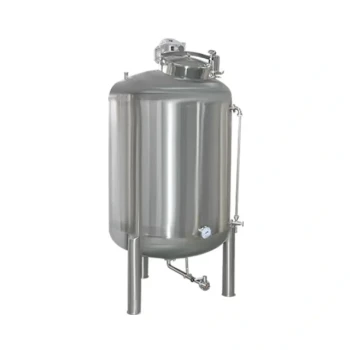
Large-scale industrial containers ranging from 50 to 300 liters are the standard for international honey trade because they provide the robust protection required for long-haul logistics. These units are specifically engineered to consolidate bulk resources while offering high-performance sealing that shields sensitive products from environmental degradation during transit.
Core Takeaway: These standardized containers are not merely storage vessels; they are critical preservation systems designed to resist corrosion, temperature fluctuations, and moisture absorption, ensuring honey retains its chemical stability and commercial value across global supply chains.
Engineering for Preservation and Quality
Combating Moisture and Spoilage
Honey is hygroscopic, meaning it naturally absorbs water from the air. If moisture levels rise, the product can ferment and spoil.
Industrial containers utilize high sealing performance to create an impermeable barrier against ambient humidity. This prevents moisture ingress effectively, maintaining the honey's quality during weeks of maritime or land transport.
Resistance to Temperature and Corrosion
International shipping exposes cargo to extreme thermal cycles and physical stress. The materials used in these 50L-300L containers are chosen for their corrosion resistance and structural integrity.
This durability prevents chemical reactions between the container and the honey. It also isolates the product from physical impacts, ensuring the shipment arrives intact without leaks or contamination.
Logistics and Supply Chain Efficiency
Consolidating Resources for Bulk Trade
Global value chains operate on high-volume requirements. These large-format containers serve as the primary logistics units for producers to consolidate smaller batches into trade-ready quantities.
By standardizing volume, producers can accelerate the turnover rate of large-scale trade. This allows raw honey to enter high-value trade channels efficiently, satisfying the bulk demands of international markets.
Enhancing Standardization and Compliance
While the container provides the shell, the system relies on integration with industrial filling equipment. This machinery uses vacuum sealing technology to ensure every container meets strict volume accuracy.
This standardization is critical for meeting international regulations, such as European Union hygiene standards. It ensures that the export units maintain trade credibility by guaranteeing sealing integrity and safety.
Understanding the Trade-offs
Equipment Dependencies
Handling containers of this size (weighing roughly 70kg to over 400kg when full) is impossible by hand. Adopting this standard requires investment in specialized mechanical handling equipment, such as forklifts and drum handlers.
Repackaging Requirements
These units are strictly for B2B (business-to-business) distribution. They necessitate a downstream facility capable of "breaking bulk"—transforming the large industrial volume into retail-ready packaging. This adds a processing step before the product can reach the end consumer.
Optimizing Your Logistics Strategy
- If your primary focus is maximizing export efficiency: Prioritize the larger capacity units (approx. 300 liters) to consolidate resources and maximize the density of product loaded into shipping containers.
- If your primary focus is market compliance: Ensure your containers are compatible with automated vacuum-sealing equipment to guarantee the moisture control and hygiene certification required by strict markets like the EU.
By standardizing protection and volume, these industrial containers transform raw agricultural output into a stable, high-value commodity ready for the global market.
Summary Table:
| Feature | 50L - 300L Industrial Containers | Benefit for Honey Trade |
|---|---|---|
| Sealing Performance | High-performance vacuum sealing | Prevents fermentation by blocking moisture ingress |
| Material Durability | Corrosion-resistant & structurally robust | Protects honey from chemical reactions and leaks |
| Logistics Volume | Standardized bulk capacity | Optimizes shipping density and speeds up trade turnover |
| Compliance | Meets EU and international hygiene standards | Ensures trade credibility and regulatory approval |
| Handling | Compatible with automated machinery | Reduces labor costs through mechanized filling and transport |
Scaling Your Honey Export Business with HONESTBEE
Transitioning to international bulk trade requires more than just honey; it requires a robust logistics infrastructure. HONESTBEE specializes in empowering commercial apiaries and global distributors with the professional-grade tools needed to succeed.
From high-capacity industrial containers that preserve honey quality during long-haul transit to advanced honey-filling and vacuum-sealing machines, we provide the full spectrum of equipment necessary to meet rigorous international standards. Whether you are expanding your wholesale operations or looking to streamline your bulk distribution, our team delivers the hardware and consumables tailored to your scale.
Ready to optimize your supply chain? Contact us today to discover how HONESTBEE can enhance your production efficiency and global market reach.
References
- Luciana Marques Vieira, Tatiana Maia. The governance of fair trade system: evidence from small honey producers in Rio Grande do Sul. DOI: 10.1590/s1807-76922009000400007
This article is also based on technical information from HonestBee Knowledge Base .
Related Products
- Stainless Steel Honey Storage Tank with Lid for Honey
- Premium Stainless Steel Honey Tank Bucket Pail with Reinforced Handle and Polished Finish
- Professional Honey Storage Tank with Agitation System
- Stainless Steel Honey Storage and Settling Tank with Double Strainer
- Food Grade Plastic Honey Bucket Pail for Beekeeping
People Also Ask
- What economic role do honey storage tanks play? Boost Your Revenue Through Strategic Inventory Management
- What roles do industrial honey storage tanks and filtration meshes play in processing? Ensure Purity & Consistency
- What is the purpose of a honey storage tank? Streamline Your Honey Processing for Quality & Efficiency
- What are honey storage tanks used for? Essential Features for Quality Preservation and Profit
- How do large honey storage tanks and gravity fall filling systems improve honey packaging efficiency and safety?